The AI AP Lang essay grader for every rubric point
Score rhetorical analysis, argument, and synthesis essays against the current College Board AP Lang rubric. Thesis, evidence and commentary, and the sophistication point — each explained with line citations from the student's own essay.
Free plan · 6-point College Board rubric · All three AP Lang essay types
Trusted by 10,000+ teachers for AP Lang
The AP Lang grading problem
Three AP Lang FRQs, one rubric, and a sophistication point that nobody agrees on.
AP Lang teachers grade all three AP Lang FRQs — rhetorical analysis, argument, and synthesis — against the same 6-point AP Lang rubric (thesis / evidence and commentary / sophistication). The three essay types look different but share the rubric, which makes consistency hard. The sophistication point in particular is the hardest to train on and the hardest to calibrate across teachers. Students cannot improve on sophistication unless feedback names which rhetorical move they attempted and whether it landed.
- Sophistication is a moving target
- Between teachers, between essays, sometimes between drafts. Students can't aim at it unless feedback is specific.
- Evidence and commentary interlock
- The rubric scores evidence and commentary together. A student can have strong evidence and shallow commentary and still miss the whole 4-point band.
- Synthesis is its own genre
- Synthesis essays require source integration and attribution that doesn't map to argument or rhetorical analysis. Students need format-specific feedback.
6-point AP Lang rubric
Scored the way AP readers score — with the sophistication point named
The AI grades against the current AP Lang rubric: 1 point for thesis, 4 points for evidence and commentary, 1 point for sophistication. For each point the feedback names the specific rubric language and cites the passage in the student's essay that earned (or missed) the decision. The sophistication point gets special treatment — the AI names which sophisticated move the student attempted (nuance, broader context, alternative interpretation, precise language) and whether it landed.
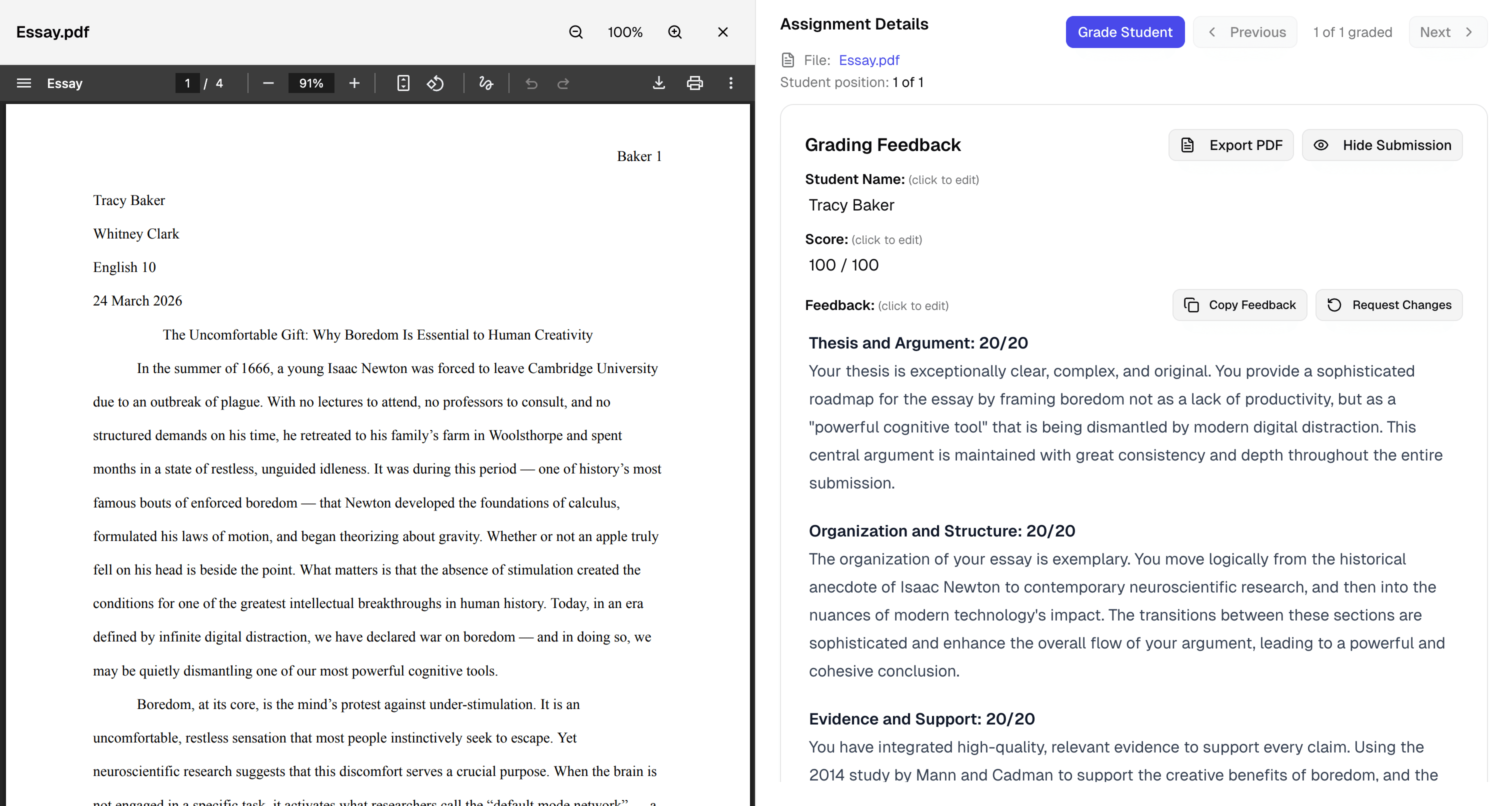
- Sophistication-point coaching
- The AI identifies the rhetorical move — qualification, nuance, broader implications, precise diction — and explains whether it sustained across the essay.
- Evidence + commentary together
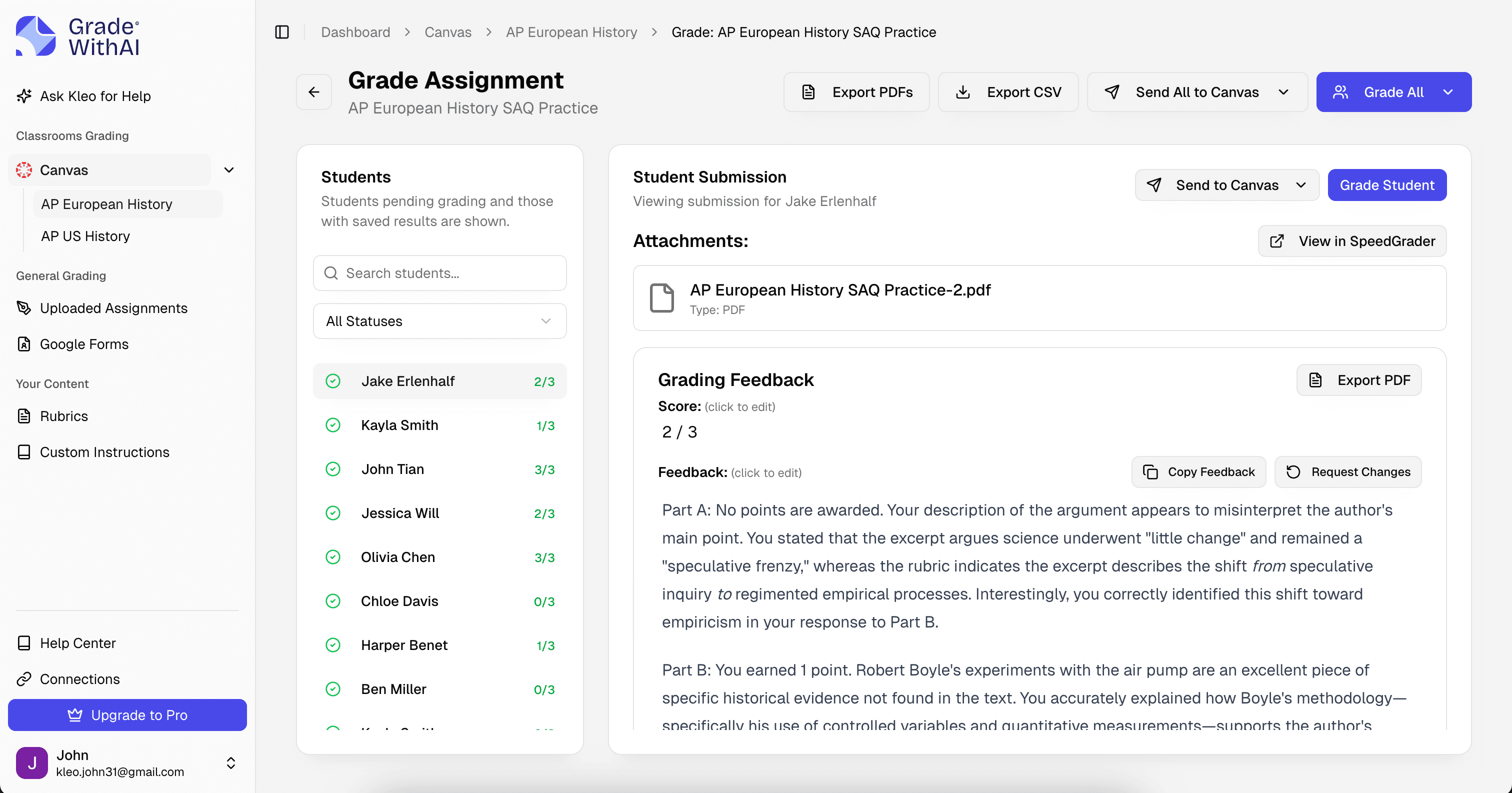
- The 4-point band is evaluated as a bundle. Strong evidence with thin commentary gets specific feedback on which commentary move would move the score up.
- Essay-type awareness
- Rhetorical analysis, argument, and synthesis essays each get genre-specific feedback on top of the shared rubric.
AP Lang rubric
The 6-point AP Lang rubric, applied essay by essay
Default matches the current College Board rubric. The rubric is identical across all three essay types, with genre-specific interpretation layered on top.
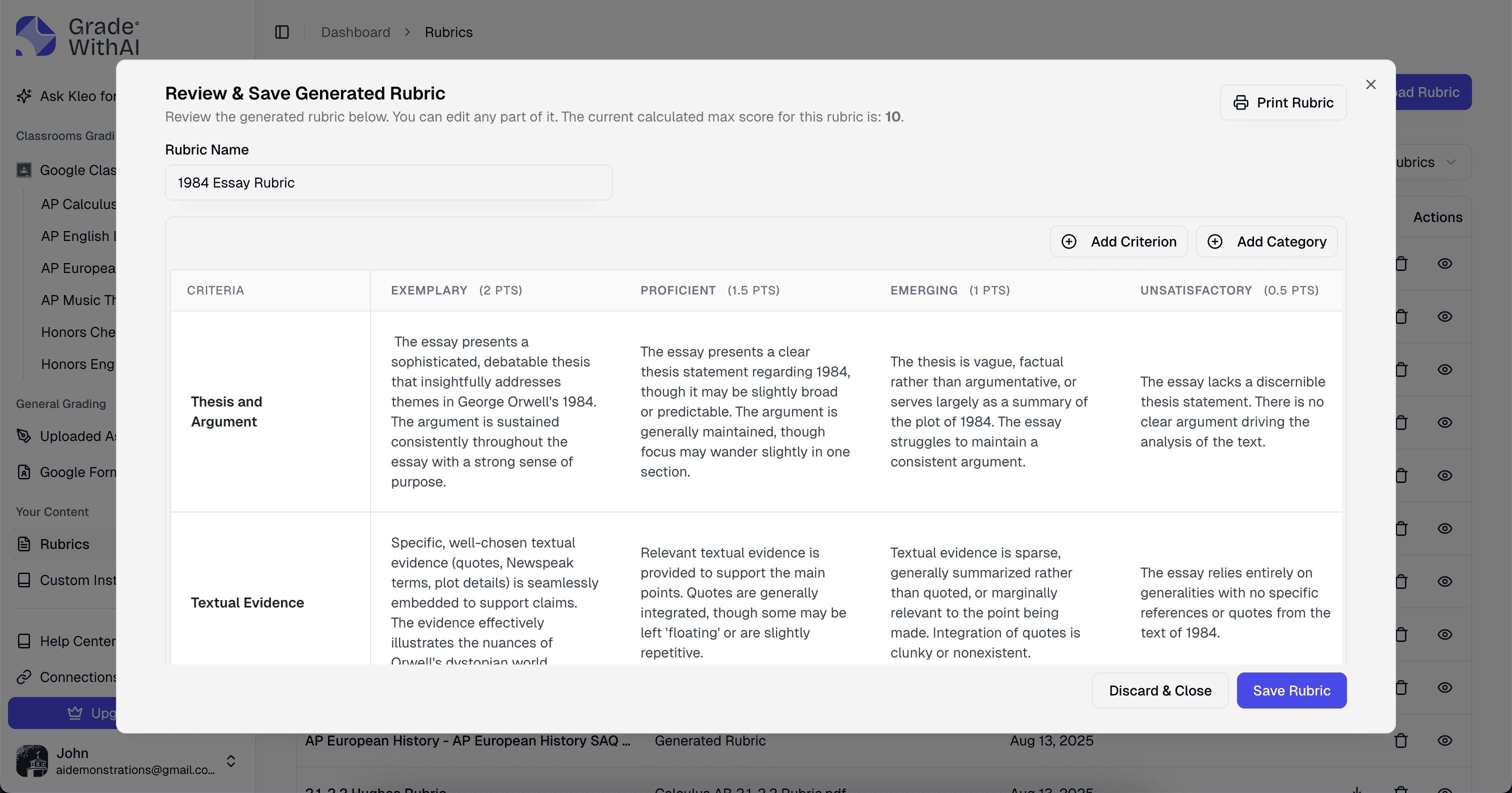
AP Lang rubric · AI-generated
Thesis / claim
1 ptDefensible thesis that responds to the prompt and (for rhetorical analysis) identifies the writer's rhetorical choices.
- Earned
- Defensible claim that establishes a line of reasoning. For RA: names the writer's rhetorical choices, not just the topic.
- Developing
- Thesis present but vague, too narrow, or — for RA — only identifies the topic, not rhetorical choices.
- Not yet
- No defensible claim or a restatement of the prompt.
Evidence & commentary
4 ptsSpecific, relevant evidence with commentary that explains how and why the evidence supports the argument.
- Full (4)
- Multiple specific pieces of evidence; commentary consistently explains how evidence supports a precise claim.
- Mid (2–3)
- Evidence present; commentary partly explains significance but may slip into summary or gap between claim and evidence.
- Low (0–1)
- Evidence thin or generic; commentary largely summary, with weak connection to any claim.
Sophistication
1 ptSophisticated thinking — nuance, complication, broader implications, or consistently vivid and precise writing.
- Earned
- Sustained sophistication move — nuanced qualification, broader context, alternative interpretation, or precise style — across the essay.
- Developing
- Sophistication attempted in one paragraph but not sustained, or relies on surface-level nuance without development.
- Not yet
- No sophistication move; writing stays at claim-evidence-commentary without nuance or broader implications.
Genre-aware feedback
Rhetorical analysis, argument, synthesis — each graded for what it is
The same rubric applies to all three, but the essays do fundamentally different things. Rhetorical analysis requires identifying rhetorical choices and explaining their effect. Argument requires building a defensible position with evidence. Synthesis requires integrating sources and attributing them correctly. The AI's feedback reflects which essay type you assigned.
- Rhetorical analysis
- Feedback names which rhetorical choices the student identified (diction, syntax, appeals, tone) and whether commentary explained their effect on the audience.
- Argument essay
- Feedback focuses on claim strength, evidence selection, counterargument handling, and the logic chain from claim to warrant.
- Synthesis essay
- Source integration, attribution, and the balance between student argument and source material. Flags over-reliance on one source.
Sample AI feedback
Sophistication feedback that names the move
Here's a closing paragraph from an AP Lang argument essay on the value of college. The student attempts nuance in the last two sentences. The AI evaluates whether that push earns the sophistication point.
Assignment prompt
Is college worth the cost? Write an essay that argues your position on the value of a four-year college education.
Student submission
College is expensive, and not everyone needs to go. Trade schools are often cheaper and lead to good jobs. But for students who want careers in medicine, law, or research, a four-year college is necessary. The answer is not the same for everyone, so each student should think carefully about their specific goals before committing to four years and tens of thousands of dollars.
AI feedback · Sophistication
1 / 1The sophistication point is earned here. The student sustains a nuance move — acknowledging that the answer varies by student goals — across the last two sentences, and it's not just a token concession. The “not the same for everyone” framing qualifies the broader position without abandoning it, and the closing line names the specific stakes (four years, tens of thousands of dollars). Strong final move. For a high-6, try weaving that qualification earlier rather than saving it for the conclusion.
Revision tip · To make the sophistication move land even stronger, try weaving nuance into earlier paragraphs as well — a single paragraph at the end is the minimum threshold. Earning it consistently is a high-6 mark.
- Quotes the student's actual work
- Feedback points to specific sentences and claims the student wrote, not vague impressions.
- Names the rubric language
- Comments reuse the criteria you set, so students learn what the rubric actually asks for.
- Suggests a concrete revision
- Every comment ends with a specific next step the student can take on the next draft.
Built for AP Lang
Every detail, handled
- All three AP Lang essays
- Rhetorical analysis, argument, and synthesis — same rubric, genre-specific interpretation per essay type.
- Rhetorical device identification
- For RA essays, the AI identifies which rhetorical choices (diction, syntax, appeals, tone, figurative language) the student analyzed and flags missed opportunities.
- Source attribution checks
- For synthesis essays, the AI verifies that sources are attributed correctly and balanced across the argument, flagging over-reliance on one document.
- Timed-exam mode
- Exam-simulation timing accounts for the 40-minute writing window. Feedback still references the full rubric but weights revision polish appropriately.
Why teachers switch
The AI AP Lang essay grader that moves the sophistication point
The difference between a 4 and a 6 on the AP Lang rubric often comes down to sophistication. Vague feedback (“try to be more sophisticated”) does not teach that move. As an AI AP Lang essay grader, GradeWithAI names the rhetorical choice, identifies whether the student landed it, and gives a concrete next step — across all three AP Lang FRQs.
6-point College Board rubric applied identically across the class
Sophistication-point coaching with specific named moves
Rhetorical analysis essays scored with rhetorical-device identification
Synthesis essays scored with source-balance and attribution checks
Line-level citations for every rubric-point decision
Timed-exam mode for in-class practice essays
“For Chadwick users, GradeWithAI has improved feedback efficiency and effectiveness, as it is grounded in existing platforms and is highly adaptable.”

Why it matters for AP Lang
The difference between a 4 and a 6 on the AP Lang rubric often comes down to sophistication. Vague feedback (“try to be more sophisticated”) does not teach that move. As an AI AP Lang essay grader, GradeWithAI names the rhetorical choice, identifies whether the student landed it, and gives a concrete next step — across all three AP Lang FRQs.
How AP Lang grading works
From essay submitted to feedback returned
Three-step flow, identical for rhetorical analysis, argument, and synthesis essays.
- 1
Pick the essay type
Select rhetorical analysis, argument, or synthesis — the AI applies the correct genre-specific feedback layer on top of the shared rubric.
- 2
Upload essays
Drop files or sync from Canvas / Google Classroom. Handwritten blue books are transcribed automatically.
- 3
Review & return
Each essay shows per-point feedback with line citations. Edit or approve, then sync grades back to your LMS.
Also covered
Every AP Lang FRQ and English-teacher workflow
The same 6-point AP Lang rubric with genre-aware feedback for each of the three AP Lang FRQs, plus English-department-wide workflows:
- Essay grader
- Argumentative, narrative, and analytical essays for English classes outside AP — same quoted-evidence feedback.
- Writing grader
- Any writing genre — narratives, reflections, journals, one-pagers — graded against your rubric.
- AP Seminar grader
- For AP Capstone teachers: IRR, IWA, and TMP scoring against the current College Board rubrics.
- APUSH grader
- For students who take AP Lang alongside APUSH — DBQ, LEQ, and SAQ scoring with HIPP sourcing checks.
Simple, transparent pricing
Start free and upgrade when you’re ready.
Free
Perfect for trying out AI grading.
- 25 AI requests/month
- Google Classroom integration
- Canvas integration
- Google Forms grading
- Handwritten assignment support
- AI rubric generation
- Unlimited Kleo AI assistant
Pro
Unlimited grading for dedicated educators.
- Unlimited AI requests
- Automated submissions grading
- AI detection on every submission
- Custom instructions
- Everything in Free
Schools & Districts
CustomEnterprise features for your entire school.
- Bulk user management
- Admin dashboard & analytics
- SSO / SAML authentication
- Dedicated onboarding & training
- Everything in Pro
Secure by design.
Built for K-12.
FERPA-aligned workflows, encryption everywhere, and no student data in model training. Ready for your district’s IT review from day one.
- FERPA-aligned
- SOC 2 practices
- AES-256 at rest
- TLS 1.2+ in transit
- Role-based access
- No AI training
- FERPA-aligned by default
- Role-based access and audit trails protect student submissions and grades.
- Never used for training
- Student work is processed for grading only — never used to train AI models.
- District-ready docs
- Security documentation and procurement support ready for your IT team.
Questions, answered
AP Lang FAQ
Answers to the questions we hear most from teachers using GradeWithAI for AP Lang. Start a free account and explore in minutes, or email john@gradewithai.com for a fast reply.
Yes. The default rubric is the current 6-point College Board AP Language and Composition rubric: 1 point for thesis, 4 points for evidence and commentary, 1 point for sophistication. You can modify point language for a practice rubric, but the default is what AP readers apply.
By assignment
More grading guides


Ready to try the AI AP Lang essay grader that coaches sophistication?
AP Lang students can only chase the sophistication point if they know what it looks like. See how named feedback moves the rubric.
Free plan available · No credit card required
Teachers using GradeWithAI report grading in a fraction of the time, with richer feedback for every student.