The AI DBQ grader for history teachers
Grade DBQs, LEQs, SAQs, and history essays against your rubric in minutes. Built for on-level, pre-AP, and state-assessment history classes, with sourcing, evidence, and historical-thinking skill checks on every response.
Free plan · Works with state and district rubrics · Pre-AP, on-level, and middle school
Trusted by 10,000+ teachers for history grading
History isn't just AP
Every AI DBQ grader covers APUSH. Yours should cover the other 90 students too.
Most AI DBQ grader and history grader tools focus on AP US and AP World. But the bulk of history teachers are grading on-level world history, US history, civics, and geography — where the rubric is simpler, the writing is shorter, and the volume is larger. You need a DBQ grader that scales to five sections without demanding AP-level preparation from eighth graders.
- Rubrics vary by state
- New York Regents, California HSS standards, Texas TEKS, NGSS-aligned social science — every state wants something slightly different. Generic rubrics don't cut it.
- Document analysis at every level
- DBQs aren't just for AP. Middle school and on-level classes use document sets too, scaled down. Feedback has to match the course rigor.
- Short answer volume
- History classes run on short-answer questions — exit tickets, quizzes, unit tests. Grading a stack of 150 short answers is where the weekend disappears.
AI DBQ grader for every level
An AI DBQ grader that scales from middle school to pre-AP
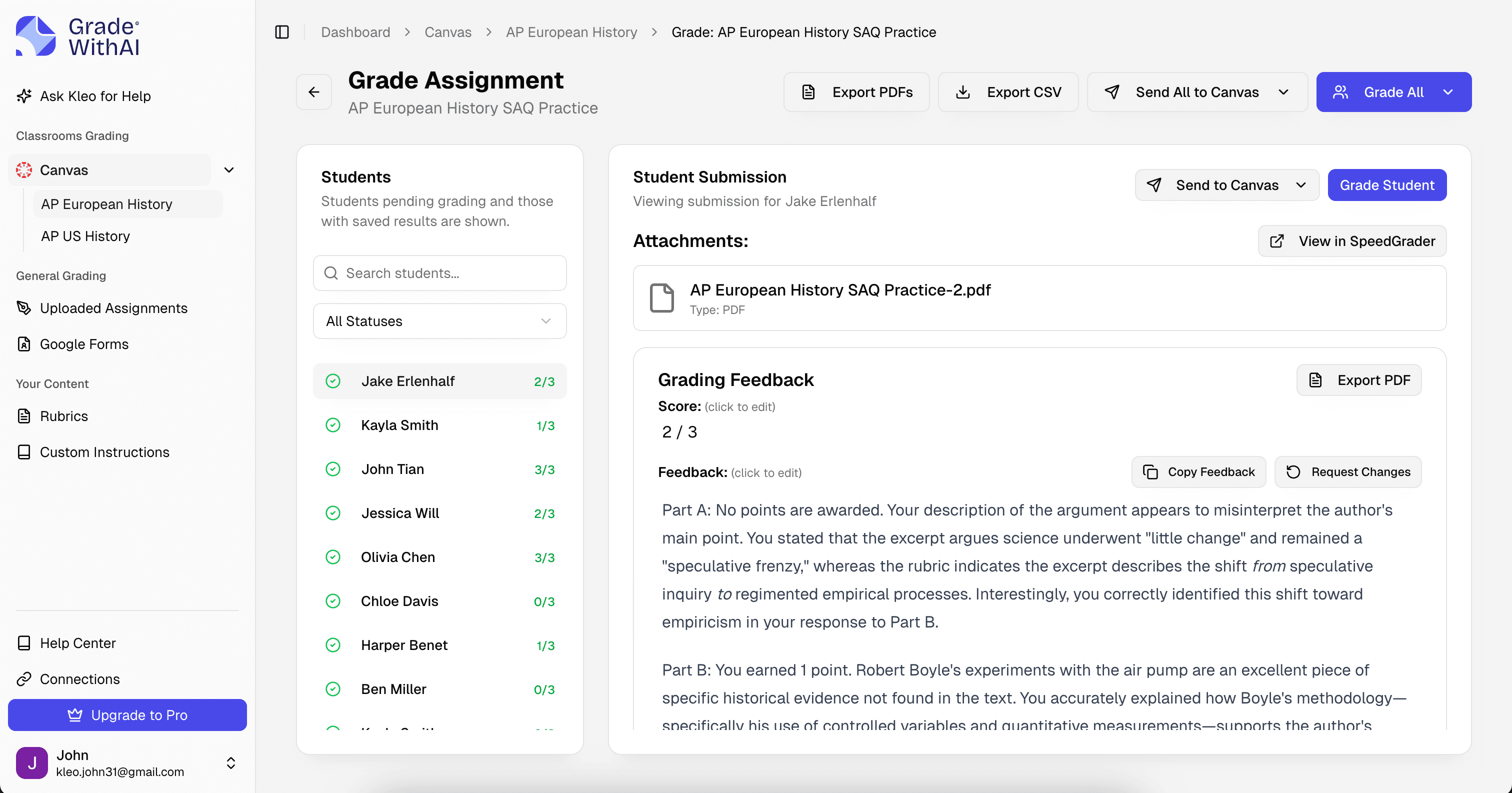
Every AI DBQ grader claims AP coverage — this one scales down. Grade DBQs at the course level you actually teach: on-level ninth graders get rubric weight on basic document use and evidence; pre-AP juniors get sourcing and complexity layered in. You set the level and the DBQ grader rubric adjusts. Feedback cites the specific document the student referenced and names which historical-thinking skill (sourcing, contextualization, corroboration) the student attempted.
- Document-use tracking
- Automatically counts documents referenced and evaluates whether each was described accurately versus misread or conflated.
- Historical-thinking skills
- Sourcing, contextualization, corroboration, and causation evaluated individually — not bundled into a single “analysis” grade.
- Scalable to course level
- Same grader, different expectations. A sixth-grade DBQ rubric looks different from an AP rubric, and the AI adjusts automatically.
Example rubric
A DBQ rubric that works for pre-AP and on-level classes
Simpler than AP, but built on the same historical thinking skills. You can swap in a state-specific rubric — New York Regents, Texas TEKS, or California HSS — without changing how the AI grades.
History grading rubric · AI-generated
Claim
3 ptsA clear, defensible position that responds to the prompt.
- Strong
- Specific, defensible claim that establishes a line of reasoning.
- Developing
- Claim is present but general, narrow, or partially off-prompt.
- Beginning
- No defensible claim, or a restatement of the prompt.
Evidence from documents
4 ptsUses specific documents to support the claim with accurate description.
- Strong
- Uses 4+ documents accurately, describing what each one shows and how it supports the claim.
- Developing
- Uses 2–3 documents with mostly accurate description; some evidence disconnected from the claim.
- Beginning
- Uses fewer than 2 documents, or describes them inaccurately.
Historical thinking
3 ptsSourcing, contextualization, or corroboration applied to at least one document.
- Strong
- Sources or contextualizes at least 2 documents with specific reasoning beyond the document itself.
- Developing
- Attempts sourcing or contextualization on 1 document, or does so superficially across several.
- Beginning
- No sourcing or contextualization beyond describing what the document says.
Organization & writing
2 ptsClear paragraphs, logical flow, and grammar that doesn't interfere with meaning.
- Strong
- Clear intro, body, and conclusion with topic sentences and smooth transitions.
- Developing
- Basic structure with uneven topic sentences or mechanical transitions.
- Beginning
- Structure is unclear; errors in grammar or organization distract from meaning.
Short-answer at scale
Grade 150 short answers faster than you drink a coffee
History classes run on short answers — “What caused the fall of Rome?”, “Name three consequences of the Columbian Exchange.” The AI grades constructed responses against a rubric that treats accuracy, specificity, and evidence use as separate criteria. You see which students missed content and which missed the task.
- Question 1
- 92%
- On track
- Question 2
- 78%
- On track
- Question 3
- 41%
- Reteach
- Question 4
- 85%
- On track
- Question 5
- 36%
- Reteach
- Question 6
- 69%
- Watch
Reteach focus · Questions 3 and 5 flagged for class-wide review tomorrow.
- Semantic matching
- A student who answers “the spread of disease” and one who says “epidemics decimated indigenous populations” both get credit when both are correct.
- Accuracy flags
- Historically inaccurate claims (wrong date, wrong dynasty, wrong continent) are flagged per question with the specific correction.
- Item-by-item analytics
- Class-wide performance per question so you can see which one to reteach tomorrow.
Sample AI feedback
Historical accuracy feedback that names the specific error
Here's a short-answer response on the Industrial Revolution. The student's core understanding is correct — but one factual slip changes the meaning of the answer.
Assignment prompt
Describe two ways the Industrial Revolution changed working conditions in 19th-century Britain. (4 pts)
Student submission
The Industrial Revolution changed working conditions in Britain. Factory workers had to work very long hours, sometimes 14–16 hours a day. Also, children as young as six were sent to work in coal mines, which started in the 1920s after the Factory Acts were passed.
AI feedback · Historical accuracy
3 / 4The first example (long working hours) is accurate and specific — full credit. The second example has the right idea (child labor in mines) but inverts the causality: the Factory Acts restricted child labor rather than starting it, and they were passed in the 1830s–1840s, not the 1920s. The error is meaningful because it misrepresents the historical relationship between legislation and labor practice. 3 of 4.
Revision tip · The Factory Acts of the 1830s–1840s restricted child labor — they did not start it. Child labor in mines predated the Acts by decades. Adjust the final clause to: “Child labor in mines predated the Factory Acts of the 1830s and 1840s, which gradually restricted it.”
- Quotes the student's actual work
- Feedback points to specific sentences and claims the student wrote, not vague impressions.
- Names the rubric language
- Comments reuse the criteria you set, so students learn what the rubric actually asks for.
- Suggests a concrete revision
- Every comment ends with a specific next step the student can take on the next draft.
Built for history grading
Every detail, handled
- C3 Framework alignment
- Map rubrics to the C3 Framework (dimensions 2–4: applying disciplinary tools, evaluating sources, communicating conclusions) for standards-aligned reporting.
- State-specific rubrics
- Import New York Regents, California HSS, Texas TEKS, or any state or district rubric. The AI grades against whatever rubric is active.
- Grade levels from middle school up
- Rubric complexity scales from sixth-grade document analysis to senior-year capstone essays automatically.
- Works with any period
- Ancient civilizations, medieval, early modern, modern, world, US, regional — the AI handles any historical period or region.
Why teachers switch
The AI DBQ grader that keeps feedback fast across five sections
History teachers often teach five sections. That's 150 students turning in DBQs, LEQs, SAQs, and essays every week. GradeWithAI works as your AI DBQ grader and SAQ grader in the same workflow, making that volume manageable without sacrificing the quality of feedback that actually moves student writing forward.
DBQs, essays, and short answers all graded in one workflow
Historical accuracy flagged per claim, not hidden in a rubric
Rubric scales from middle school through pre-AP
C3 Framework and state-standard alignment built in
Class-wide item analysis for every assignment
Document use and sourcing tracked automatically
“Students have also appreciated the consistency and immediacy of the feedback I can provide through GradeWithAI. This has enabled them to make necessary corrections and achieve their desired scores on any assignment.”

Why it matters for history grading
History teachers often teach five sections. That's 150 students turning in DBQs, LEQs, SAQs, and essays every week. GradeWithAI works as your AI DBQ grader and SAQ grader in the same workflow, making that volume manageable without sacrificing the quality of feedback that actually moves student writing forward.
How history grading works
From student work to graded feedback in minutes
Same three-step flow across DBQs, essays, and short answers.
- 1
Set your rubric
Default to a scalable DBQ rubric, use your state or district's rubric, or let AI generate one from the assignment.
- 2
Upload the work
Drag in files, scan paper responses, or sync from Canvas / Google Classroom. Mixed-format classes land in one queue.
- 3
Review & return
Each response comes with rubric-level feedback and line citations. Approve, edit, and sync grades to your gradebook.
Also covered
History grading across every course and task
Whether you teach sixth-grade civics, on-level US history, or pre-AP world history, the AI DBQ grader adapts — and links into dedicated workflows for related tasks:
- SAQ & short-answer grader
- Short-answer questions (AP SAQs, unit quizzes, exit tickets) graded at scale with semantic matching and accuracy flags.
- History essay grader
- Analytical and argumentative history essays graded with historical-thinking skill rubrics.
- APUSH grader
- Full APUSH-rubric grading for DBQs, LEQs, and SAQs with HIPP sourcing and complexity checks.
- AP World History grader
- AP World: Modern rubric grading across the 9 AP World units with period-specific evidence checks.
Simple, transparent pricing
Start free and upgrade when you’re ready.
Free
Perfect for trying out AI grading.
- 25 AI requests/month
- Google Classroom integration
- Canvas integration
- Google Forms grading
- Handwritten assignment support
- AI rubric generation
- Unlimited Kleo AI assistant
Pro
Unlimited grading for dedicated educators.
- Unlimited AI requests
- Automated submissions grading
- AI detection on every submission
- Custom instructions
- Everything in Free
Schools & Districts
CustomEnterprise features for your entire school.
- Bulk user management
- Admin dashboard & analytics
- SSO / SAML authentication
- Dedicated onboarding & training
- Everything in Pro
Secure by design.
Built for K-12.
FERPA-aligned workflows, encryption everywhere, and no student data in model training. Ready for your district’s IT review from day one.
- FERPA-aligned
- SOC 2 practices
- AES-256 at rest
- TLS 1.2+ in transit
- Role-based access
- No AI training
- FERPA-aligned by default
- Role-based access and audit trails protect student submissions and grades.
- Never used for training
- Student work is processed for grading only — never used to train AI models.
- District-ready docs
- Security documentation and procurement support ready for your IT team.
Questions, answered
History grading FAQ
Answers to the questions we hear most from teachers using GradeWithAI for history grading. Start a free account and explore in minutes, or email john@gradewithai.com for a fast reply.
Yes. The default DBQ rubric scales from sixth-grade guided DBQs through pre-AP full DBQs, with historical-thinking skills (sourcing, contextualization, corroboration) weighted appropriately to the course level. Swap in your state or district rubric if you prefer.
By assignment
More grading guides


Ready to try the AI DBQ grader history teachers actually use?
History teachers running multiple sections see the biggest time savings. Keep feedback specific, keep rubrics calibrated, keep your weekends.
Free plan available · No credit card required
Teachers using GradeWithAI report grading in a fraction of the time, with richer feedback for every student.