The AI essay grader teachers actually trust
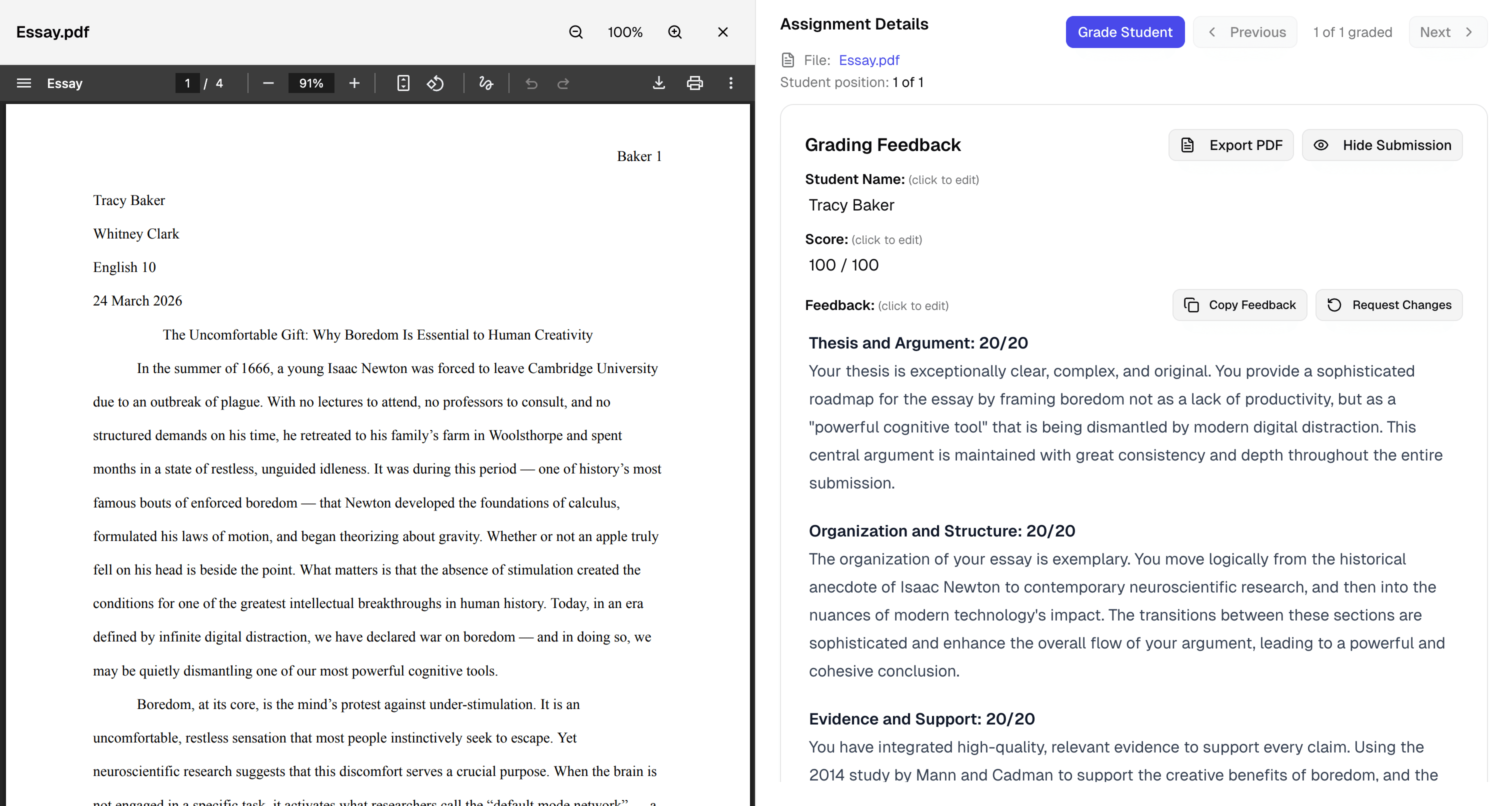
Grade a full stack of essays against your rubric in minutes — not hours. Upload your rubric (or generate one from the prompt) and the AI scores thesis, evidence, organization, and mechanics with quoted line-level feedback. Every grade and comment is editable before anything reaches students.
Free plan · Works with any rubric · Built-in AI detection on every submission
Trusted by 10,000+ teachers for essay grading
Why teachers need an AI essay grader
Good essay feedback takes forever. Consistent feedback takes longer.
Forty essays at seven minutes each is almost five hours — before you write a single comment that a student will actually read twice. Most teachers cut corners: the same three comments rotated across the stack, or a single score with no explanation. That is exactly the gap an AI essay grader has to close — not by replacing your judgment, but by handling the mechanical pass so you can focus on the paragraphs that need a real conversation.
- Drifting rubric interpretation
- Essay #1 and essay #40 get graded by the same person but not the same version of that person. Fatigue changes what a “3” means by Sunday night.
- Feedback that students ignore
- A score with no reasoning does nothing for the student's next essay. A personalized paragraph per student is what moves writing, and that is what takes forever.
- AI-generated submissions
- You cannot grade thesis quality honestly without knowing whether the thesis came from the student. Flagging AI use manually is its own full-time job.
Rubric-based essay scoring
An AI essay grader that applies your rubric identically every time
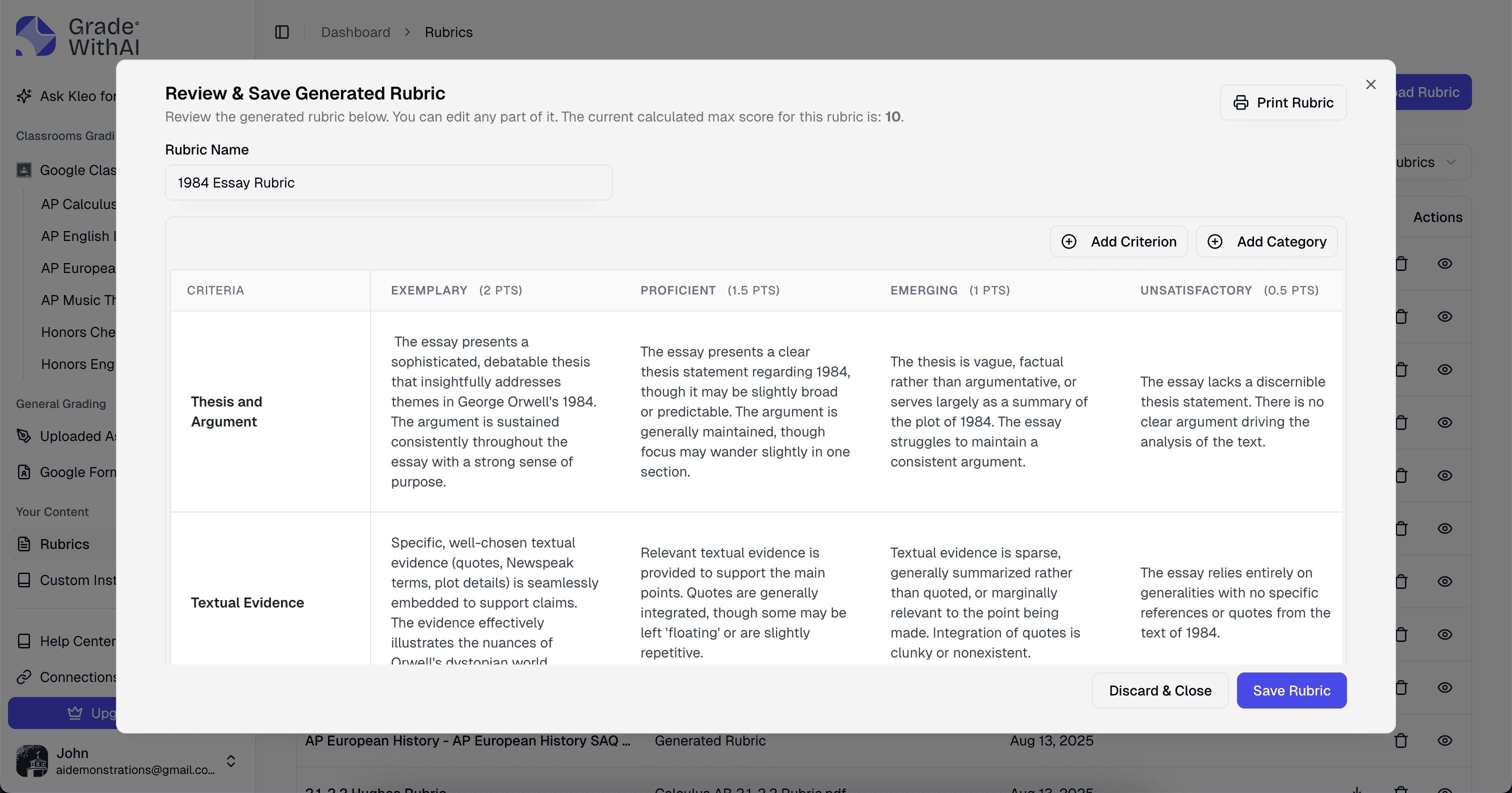
Paste your rubric in, upload a PDF of your department's scoring guide, or generate one from the assignment directions. The AI essay grader scores each criterion separately — thesis, evidence and analysis, organization, and mechanics — and cites lines from the essay that support each decision. Because the criteria never shift, scoring stays consistent between essay #1 and essay #40.
- Quoted evidence for every score
- Each criterion comment cites the specific sentence that earned (or lost) the point, so students can trace the feedback to their own words.
- Department-wide consistency
- Share a rubric once and every teacher grading the same essay uses identical criteria — calibration meetings become five-minute reviews.
- Standards alignment built in
- Map criteria to Common Core, state ELA standards, or AP rubrics so each assignment reports back on standards mastery automatically.
Example rubric
The argumentative essay rubric, ready to edit
Here is the default argumentative rubric the AI uses when you generate one from the prompt. You can add criteria, change point values, or replace it with your own before the first essay is graded.
Essay grading rubric · AI-generated
Thesis & claim
4 ptsA defensible, specific thesis that responds to all parts of the prompt and previews the line of argument.
- Exceeds
- Nuanced claim that acknowledges counterargument and establishes a clear line of reasoning in the first paragraph.
- Meets
- Clear, defensible thesis that responds to the prompt and sets up the body paragraphs.
- Approaching
- Thesis is present but vague, overly broad, or not fully responsive to the prompt.
Evidence & analysis
6 ptsSpecific, relevant evidence is introduced, cited, and connected back to the argument with the student's own reasoning.
- Exceeds
- Multiple pieces of evidence across sources, tightly analyzed, with clear connection to the thesis.
- Meets
- At least two pieces of evidence with explanation of how they support the argument.
- Approaching
- Evidence is present but under-analyzed, over-summarized, or disconnected from the thesis.
Organization & cohesion
4 ptsLogical paragraph structure with clear topic sentences, purposeful transitions, and a conclusion that advances the argument.
- Exceeds
- Ideas build on each other; transitions are purposeful; structure serves the argument.
- Meets
- Clear intro, body, and conclusion; topic sentences are present; paragraphs stay focused.
- Approaching
- Structure is present but paragraphs wander, transitions feel mechanical, or the conclusion only restates the thesis.
Language & mechanics
3 ptsGrammar, syntax, and word choice serve the argument. Errors do not distract from meaning.
- Exceeds
- Precise diction, varied sentence structure, and mechanics that support sophistication.
- Meets
- Clear prose with minor errors that do not impede understanding.
- Approaching
- Frequent errors or awkward phrasing that interrupts meaning at multiple points.
AI detection
Know whether the essay came from the student
Every submission runs through AI-use detection at grade time — no separate tool, no separate workflow. Each essay gets a 0–100% AI score and a plain-language label (Human Written, Mostly Human, Mostly AI, or AI Generated) alongside the rubric feedback, so you can address academic integrity in the same conversation as the writing itself.
Words analyzed: 1,247
Text used for detection
The rapid proliferation of digital platforms has fundamentally altered the landscape of modern discourse, necessitating a reevaluation of longstanding epistemic frameworks.

In my experience, social media makes it easier to find people who think like me, but harder to meet people who don't.

Furthermore, the implications of this paradigm shift extend beyond mere communication into the very structure of civic engagement itself.
- Highlighted passages
- The specific sentences most likely to be AI-generated are marked in the essay, not just a score for the whole paper.
- No separate service or fee
- Detection runs in parallel with grading on the free plan. No uploading to a second tool.
- Teacher discretion preserved
- The label is a signal, not a verdict. You decide how to handle flagged work and can add context to the student comment before returning.
Sample AI feedback
Rubric-aligned comments, not vague praise
Here is the AI feedback for the thesis criterion of an argumentative essay on social media regulation. Notice it quotes the student's actual thesis, names the rubric language, and gives a concrete revision path. This is what every essay in the class gets.
Assignment prompt
Should social media platforms be legally responsible for moderating user content? Write a 4–5 paragraph argumentative essay citing at least two sources.
Student submission
Social media is a big part of people's lives today. Because of that, platforms have some responsibility to make sure that what people post is appropriate. This essay will explain why they should be held responsible.
AI feedback · Thesis & claim
2 / 4The thesis is present but falls into the “Approaching” band. The claim that platforms have “some responsibility” is not specific enough to argue — it does not say what kind of responsibility, under what conditions, or what mechanism. The second sentence also telegraphs (“This essay will explain”), which weakens the opening. A defensible claim needs a specific, arguable position that the rest of the essay will defend.
Revision tip · Try: “Because platforms curate what users see, they share legal responsibility for content that causes measurable harm — though the scope of that responsibility should distinguish between algorithmic amplification and passive hosting.” Notice this names the specific line of argument rather than announcing the essay.
- Quotes the student's actual work
- Feedback points to specific sentences and claims the student wrote, not vague impressions.
- Names the rubric language
- Comments reuse the criteria you set, so students learn what the rubric actually asks for.
- Suggests a concrete revision
- Every comment ends with a specific next step the student can take on the next draft.
Built for essay grading
Every detail, handled
- Any essay type, any length
- Argumentative, narrative, analytical, comparative, literary analysis, research paper, synthesis. The AI grades against the rubric you provide, not a genre template.
- Multi-format submissions
- Google Docs, Word files, PDFs, and scanned handwritten essays read into the same grading pipeline without manual conversion.
- Regrade on revision
- Turn on revision-friendly mode and students can resubmit after reading feedback. The AI grades the new version against the same rubric.
- LMS sync
- Push rubric scores and inline comments back to Canvas SpeedGrader or Google Classroom without re-entering anything.
Why teachers switch
The AI essay grader that saves hours and improves feedback
Teachers who switch to GradeWithAI as their AI essay grader report reading time dropping from five hours a stack to under an hour. The feedback students receive gets longer and more specific, because the AI does the mechanical pass so you can focus on the paragraphs that need a real conversation.
First-pass grades and comments in under ten minutes per class
Evidence-backed comments instead of shorthand marks
Consistent scoring across every essay in every class
AI-use flags paired with rubric feedback in one view
Every score editable before grades go to students
Rubric saved and reusable for future essays
“For Chadwick users, GradeWithAI has improved feedback efficiency and effectiveness, as it is grounded in existing platforms and is highly adaptable.”

Why it matters for essay grading
Teachers who switch to GradeWithAI as their AI essay grader report reading time dropping from five hours a stack to under an hour. The feedback students receive gets longer and more specific, because the AI does the mechanical pass so you can focus on the paragraphs that need a real conversation.
How essay grading works
From submitted to graded in minutes
Setup happens once. After that the grading pass is a confirmation step, not a five-hour evening.
- 1
Pull in the essays
Import from Canvas, Google Classroom, Google Forms, or drag in files directly. Every essay appears in one grading queue.
- 2
Lock the rubric
Use your own rubric, generate one from the prompt, or tweak the argumentative default. The AI uses it identically for every essay.
- 3
Review and return
Scores and comments are already drafted. Approve, edit, or rewrite — then push everything to the gradebook in one click.
Also covered
Essay grading for every course you teach
Whether it is an eighth-grade narrative or an AP Lit prose analysis, the same essay grader adapts to the genre and rubric you use:
- Writing grader
- Short writing — narratives, journals, reflections, one-pagers — graded against your rubric with quoted evidence.
- AP Lang essay grader
- Three AP Lang FRQs graded against the 6-point College Board rubric with sophistication-point feedback.
- AP US History DBQs and LEQs
- APUSH rubrics applied to document analysis, complex understanding, and evidence use — with automatic contextualization checks.
- History & DBQ grader
- Analytical and argumentative history essays graded with historical-thinking skill rubrics across on-level, pre-AP, and AP courses.
Simple, transparent pricing
Start free and upgrade when you’re ready.
Free
Perfect for trying out AI grading.
- 25 AI requests/month
- Google Classroom integration
- Canvas integration
- Google Forms grading
- Handwritten assignment support
- AI rubric generation
- Unlimited Kleo AI assistant
Pro
Unlimited grading for dedicated educators.
- Unlimited AI requests
- Automated submissions grading
- AI detection on every submission
- Custom instructions
- Everything in Free
Schools & Districts
CustomEnterprise features for your entire school.
- Bulk user management
- Admin dashboard & analytics
- SSO / SAML authentication
- Dedicated onboarding & training
- Everything in Pro
Secure by design.
Built for K-12.
FERPA-aligned workflows, encryption everywhere, and no student data in model training. Ready for your district’s IT review from day one.
- FERPA-aligned
- SOC 2 practices
- AES-256 at rest
- TLS 1.2+ in transit
- Role-based access
- No AI training
- FERPA-aligned by default
- Role-based access and audit trails protect student submissions and grades.
- Never used for training
- Student work is processed for grading only — never used to train AI models.
- District-ready docs
- Security documentation and procurement support ready for your IT team.
Questions, answered
Essay grading FAQ
Answers to the questions we hear most from teachers using GradeWithAI for essay grading. Start a free account and explore in minutes, or email john@gradewithai.com for a fast reply.
On rubric-based scoring, our AI achieves 95%+ agreement with experienced human graders on published benchmark essays. More importantly, it is consistent — the 40th essay gets the same treatment as the 1st, which is not true of human graders working late on a Sunday. That said, you always review before grades go live.
By assignment
More grading guides


Ready to try the AI essay grader English teachers actually trust?
Join English teachers who grade a full class stack before dinner — with better feedback than before, not worse.
Free plan available · No credit card required
Teachers using GradeWithAI report grading in a fraction of the time, with richer feedback for every student.