The AI APUSH grader for DBQs, LEQs, and SAQs
Score APUSH essays against the College Board AP US History rubric in minutes. The AI checks thesis, contextualization, document use, HIPP sourcing, and complexity — then explains exactly why each rubric point was earned or missed, with line citations from the student's own essay.
Free plan · Aligned to current College Board rubrics · Works for in-class and practice essays
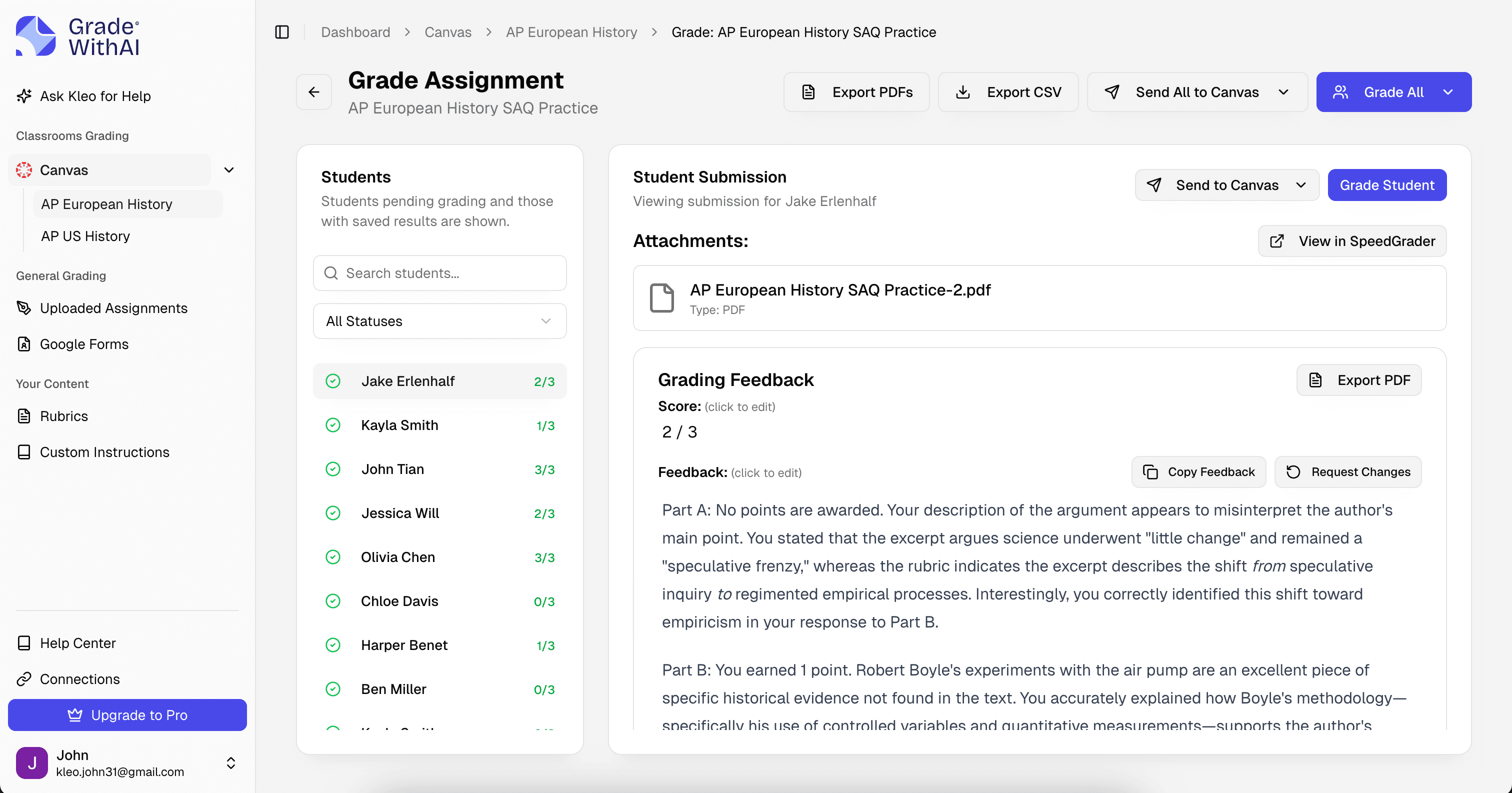
Trusted by 10,000+ teachers for APUSH
Why APUSH teachers need an AI APUSH grader
Two APUSH sections, 60 DBQs per unit, one exhausted teacher.
Most AP US History teachers grade 8–10 APUSH DBQs and a stack of APUSH LEQs per unit, plus weekly APUSH SAQs. The APUSH rubric is tight and the feedback needs to be surgical — students cannot improve on complexity or sourcing unless the feedback names the specific rubric move they are missing. Doing that for 60 students in a week by hand is the single biggest reason APUSH teachers look for an AI APUSH grader.
- HIPP sourcing is slippery
- Historical situation, intended audience, purpose, point of view. Students use the acronym; they don't always use the skill. Feedback has to name which one they missed.
- Nine periods, nine evidence rules
- An essay on Period 5 shouldn't be citing Period 8 events. Catching period-bleed in 60 essays is the kind of thing that gets missed when you're tired.
- Complexity needs a named move
- Students earn the modifier point with a specific move — sustained comparison, nuanced qualification, corroboration across regions. Feedback that says “work on complexity” doesn't teach it.
College Board APUSH rubric alignment
The APUSH DBQ grader that scores every point the way readers do
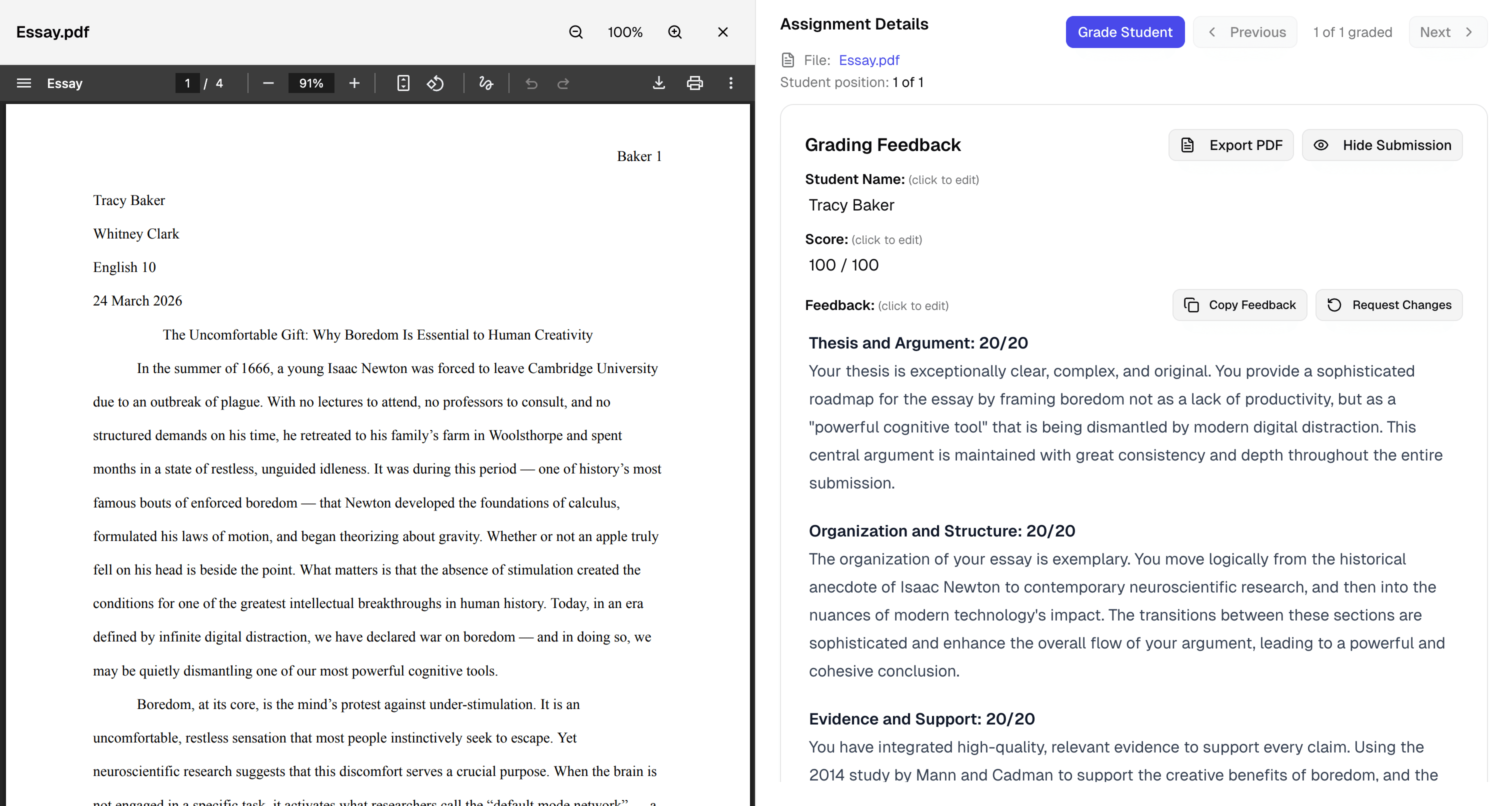
The APUSH grader applies the current College Board rubric exactly: thesis (1), contextualization (1), evidence (3 — documents + outside), and analysis (2 — sourcing + complexity). Each of the 7 rubric points comes back with a plain-language explanation and a line citation from the student's essay, so APUSH feedback is traceable and students know exactly what to revise.
- HIPP sourcing flags
- For the sourcing point, the AI identifies which HIPP move the student made per document and flags superficial “this is a letter written by X” sourcing.
- Outside-evidence verification
- The outside-evidence point requires specific, relevant fact from beyond the documents. The AI flags evidence that's off-period, vague, or inaccurate.
- Complexity-point coaching
- When students come close to the complexity point, the AI names which attempted move — qualification, alternative viewpoint, corroboration, comparative analysis — would push it over.
APUSH DBQ rubric
The 7-point APUSH rubric, applied essay by essay
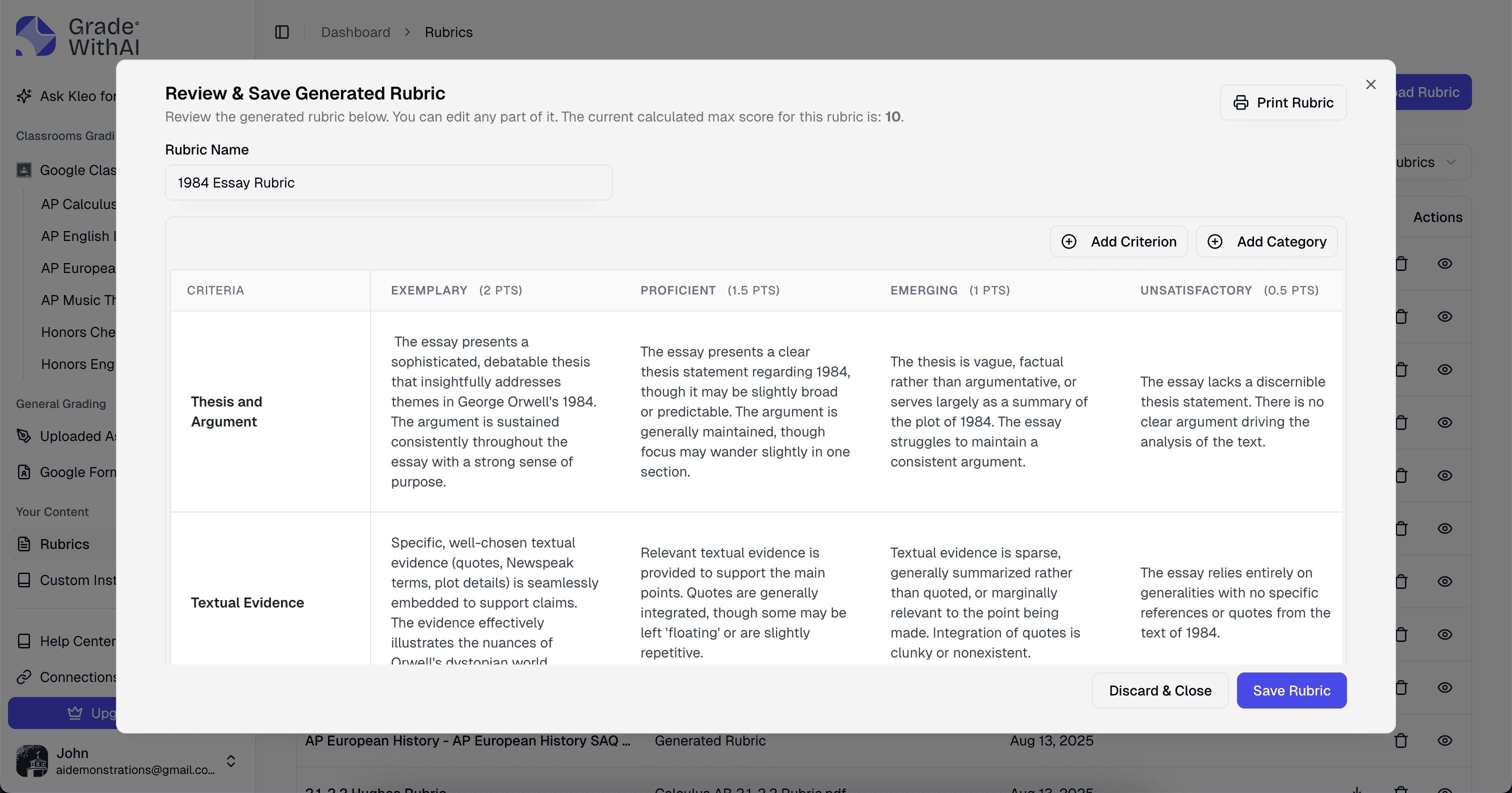
Default to College Board language or paste in your department's modified version. The AI applies whichever rubric is active identically to every essay in the class.
APUSH rubric · AI-generated
Thesis / claim
1 ptHistorically defensible thesis that responds to all parts of the prompt and establishes a line of reasoning.
- Earned
- Defensible, responsive claim that sets up the argument (not a topic list or restatement).
- Developing
- Thesis present but narrow, vague, or not fully responsive to the prompt.
- Not yet
- No defensible claim, or a restated prompt with no position.
Contextualization
1 ptBroader historical context connected to the prompt — not a one-sentence mention.
- Earned
- Specific historical context connects to the prompt and is developed (more than a sentence).
- Developing
- Context mentioned but thin; relies on generalizations or vague phrasing.
- Not yet
- Missing, off-topic, or limited to a sentence that restates the prompt.
Evidence (documents + outside)
3 ptsUses at least 4 documents accurately to support the argument, plus one specific piece of outside evidence.
- Full
- 6+ documents used accurately + specific, relevant outside evidence.
- Partial
- 4–5 documents used accurately; outside evidence thin or missing.
- Low
- Fewer than 4 documents or inaccurate descriptions; no outside evidence.
Analysis (sourcing + complexity)
2 ptsSources at least 3 documents with HIPP analysis and demonstrates complex understanding throughout.
- Full
- 3+ documents sourced with genuine HIPP analysis; complexity sustained across the argument.
- Partial
- 3 documents sourced but superficially; or complexity attempted in isolation.
- Low
- Fewer than 3 documents sourced; no sustained complexity move.
LEQ & SAQ coverage
Every APUSH essay format, not just the DBQ
The same engine handles the LEQ (6-point rubric: thesis, contextualization, evidence, HIPP, complexity) and SAQ (3-point rubric: A, B, C). Switch rubrics per assignment, run full-practice exam packets, or grade a single SAQ from a unit quiz — the rubric and scoring stay calibrated.
- LEQ on any period
- All 9 APUSH periods supported, from pre-Columbian through the contemporary era.
- SAQ scored by part
- A, B, and C scored and commented on independently with line-level evidence citations.
- Period-appropriate evidence checks
- An essay on the Gilded Age shouldn't cite FDR. The AI flags period-bleed and off-prompt evidence.
Sample AI feedback
Sourcing feedback that names the missing move
Here is a sourcing attempt from a student's APUSH DBQ on the American Revolution. The student sources the document — but with what the rubric considers “superficial sourcing.” Notice how the AI names exactly what would push it past the threshold.
Assignment prompt
Evaluate the extent to which Enlightenment ideas influenced the American Revolution (1754–1800).
Student submission
In Document 3, Thomas Paine wrote Common Sense. This was a pamphlet that argued for independence from Britain. Since Thomas Paine wrote this, it shows that people wanted independence because of Enlightenment ideas.
AI feedback · Analysis — sourcing
0 / 1This does not earn the sourcing point. The rubric requires analysis of how the document's historical situation, intended audience, point of view, or purpose affects its use as evidence — not a restatement of what the document says. The student identifies Paine as the author but doesn't explain why Paine's identity, audience (common colonists, not elites), or purpose (moving public opinion in early 1776) matters for the argument.
Revision tip · Try: “Paine wrote Common Sense in January 1776, when most colonists still favored reconciliation — his purpose was to radicalize a mainstream audience, which is why he rejected philosophical jargon and grounded his argument in scripture.” That names purpose, audience, and historical situation.
- Quotes the student's actual work
- Feedback points to specific sentences and claims the student wrote, not vague impressions.
- Names the rubric language
- Comments reuse the criteria you set, so students learn what the rubric actually asks for.
- Suggests a concrete revision
- Every comment ends with a specific next step the student can take on the next draft.
Built for APUSH
Every detail, handled
- All 9 APUSH periods
- From pre-Columbian through globalization, with period-specific evidence verification. Off-period references are flagged automatically.
- Practice + summative modes
- Configure assignments as formative (feedback-heavy, no grade penalty for unfinished complexity) or summative (grade counts, exam-style timing).
- Timed-essay handling
- Exam-simulation mode accounts for handwritten, one-pass production. Feedback weights revision-level polish accordingly.
- Department-wide rubric sharing
- Share a single rubric across APUSH teachers for consistent scoring — useful for midyear calibration and cross-class fairness.
Why teachers switch
An AI APUSH grader that keeps feedback fast without rubric drift
The APUSH calendar doesn't forgive slow feedback. Units stack, exam review starts in March, and students who do not see their DBQ score until after the next one is assigned cannot improve. As your AI APUSH grader, GradeWithAI gets feedback back fast enough for it to matter — while applying the same 7-point DBQ, 6-point LEQ, and 3-point SAQ rubrics the College Board uses.
7-point DBQ, 6-point LEQ, and 3-point SAQ rubrics out of the box
Per-point reasoning with line citations from the essay
HIPP sourcing flags named by type (historical situation / audience / purpose / POV)
Complexity-point coaching with specific next-step moves
Off-period evidence flagged per paragraph
Share one rubric across your whole APUSH department
“Students have also appreciated the consistency and immediacy of the feedback I can provide through GradeWithAI. This has enabled them to make necessary corrections and achieve their desired scores on any assignment.”

Why it matters for APUSH
The APUSH calendar doesn't forgive slow feedback. Units stack, exam review starts in March, and students who do not see their DBQ score until after the next one is assigned cannot improve. As your AI APUSH grader, GradeWithAI gets feedback back fast enough for it to matter — while applying the same 7-point DBQ, 6-point LEQ, and 3-point SAQ rubrics the College Board uses.
How APUSH grading works
From essay collected to feedback back in minutes
Three steps, whether you're grading a full class's DBQ or a single student's SAQ.
- 1
Select the rubric
Default to the current College Board DBQ, LEQ, or SAQ rubric — or paste in your department's version.
- 2
Upload the essays
Drop files, scan blue books, or sync from Canvas / Google Classroom. Mixed-format classes land in one queue.
- 3
Review per-point feedback
Each rubric point shows reasoning and a line citation. Adjust or approve, then sync back to your gradebook.
Also covered
Every APUSH essay format covered
Whether it's a full APUSH DBQ, a quick APUSH SAQ, or a mid-unit APUSH LEQ, the AI APUSH grader handles the format and rubric — and links out to related workflows:
- SAQ grader
- Dedicated 3-point APUSH SAQ scoring with A/B/C part-by-part feedback, plus SAQs across AP World and on-level history.
- AP World History grader
- AP World: Modern rubric variant with period-specific evidence checks across global regions.
- DBQ grader (on-level)
- Non-AP history classes get the same DBQ grader with rubrics scaled to pre-AP and on-level writing expectations.
- AP Lang essay grader
- For students who take AP Lang alongside APUSH — rhetorical analysis, argument, and synthesis essays graded to the 6-point rubric.
Simple, transparent pricing
Start free and upgrade when you’re ready.
Free
Perfect for trying out AI grading.
- 25 AI requests/month
- Google Classroom integration
- Canvas integration
- Google Forms grading
- Handwritten assignment support
- AI rubric generation
- Unlimited Kleo AI assistant
Pro
Unlimited grading for dedicated educators.
- Unlimited AI requests
- Automated submissions grading
- AI detection on every submission
- Custom instructions
- Everything in Free
Schools & Districts
CustomEnterprise features for your entire school.
- Bulk user management
- Admin dashboard & analytics
- SSO / SAML authentication
- Dedicated onboarding & training
- Everything in Pro
Secure by design.
Built for K-12.
FERPA-aligned workflows, encryption everywhere, and no student data in model training. Ready for your district’s IT review from day one.
- FERPA-aligned
- SOC 2 practices
- AES-256 at rest
- TLS 1.2+ in transit
- Role-based access
- No AI training
- FERPA-aligned by default
- Role-based access and audit trails protect student submissions and grades.
- Never used for training
- Student work is processed for grading only — never used to train AI models.
- District-ready docs
- Security documentation and procurement support ready for your IT team.
Questions, answered
APUSH FAQ
Answers to the questions we hear most from teachers using GradeWithAI for APUSH. Start a free account and explore in minutes, or email john@gradewithai.com for a fast reply.
Yes. The default rubric mirrors the current APUSH scoring guidelines — 7-point DBQ, 6-point LEQ, 3-point SAQ. You can modify point language for a practice rubric you use in class, but the default is what AP readers apply on exam day.
By assignment
More grading guides


Ready to try the AI APUSH grader that hands back DBQs before the next unit?
Feedback is only useful if it arrives while the argument is still fresh. See how APUSH teachers grade faster without changing their rubric.
Free plan available · No credit card required
Teachers using GradeWithAI report grading in a fraction of the time, with richer feedback for every student.