4th grade writing prompts
4th grade writing prompts for multi-paragraph opinion, informative, and narrative pieces, from five-minute warm-ups to anchor essays with a rubric.
Free · No account · Copy or print · Kindergarten through 12th grade
Tip: Describe the writing unit or the mood you want. The tool calibrates vocabulary and complexity to the grade you pick.
GradeWithAI is used by 21,000+ teachers, including teachers at
What 4th grade writing standards require
4th grade writing prompts ask students to connect several paragraphs (an introduction, body paragraphs, and a conclusion) and support their points with facts, details, and examples. The generator writes them in any genre, sized for warm-ups or multi-week anchor pieces. For opinion writing, set the genre to Opinion.
Fourth-grade writing standards unpacked
Under the W.4 standards, fourth graders support opinions with facts and details, group informative writing into paragraphs and sections, and use dialogue and description in narratives. Students also gather information from print and digital sources, take notes, and list their sources (W.4.8).
Multi-paragraph organization with a clear introduction and conclusion
Claims supported by facts, examples, or quotations
Precise vocabulary and subject-specific words
Linking words: 'for instance,' 'in order to,' 'in addition,' 'another'
Building structure into 4th grade prompts
A fourth-grade prompt should ask for more than a paragraph and less than a full essay on a first draft. Use the description to name the number of paragraphs, refer to a short passage you paste in, or leave structure open for assessment practice.
A fourth-grade anchor essay workflow
A typical three-week essay unit runs from one anchor prompt. Weekly paragraph drafts in between each target one skill, such as a strong topic sentence, and daily warm-ups fill the remaining writing time.
Week one: brainstorm and outline from the anchor prompt
Week two: draft body paragraphs, with conferences
Week three: revise for evidence and organization, then edit and publish
How the writing prompt generator works
- 1
Describe what you need
For example, narrative prompts about resilience for 5th graders, or journal starters for the first week of school.
- 2
Set the details
Grade, genre, theme, tone, and how many prompts, from 1 to 25.
- 3
Copy or print
Copy the set into a doc or your LMS post, or print a handout.
What teachers say
Teachers across subjects, from AP history to astrophysics, on grading with GradeWithAI.
“I've really enjoyed using the GradeWithAI program. It saves me a ton of time, especially when I have class sizes of 35 or 36 students times five.”

“GradeWithAI doesn't just grade. It gives the student reasoning as to why every point is awarded or not awarded. That is a very valuable thing for the students.”

“More impressive though is that it corrects student answers not simply using a pre-written answer, but by following the thought process they've pursued.”

“For Chadwick users, GradeWithAI has improved feedback efficiency and effectiveness, as it is grounded in existing platforms and is highly adaptable.”

“GradeWithAI [provides] students with timely individualized feedback on their homework assignments and formative assessments. This is a job that is virtually impossible for a teacher to do on a regular basis.”

“Students have also appreciated the consistency and immediacy of the feedback I can provide through GradeWithAI. This has enabled them to make necessary corrections and achieve their desired scores on any assignment.”

Grading the responses?
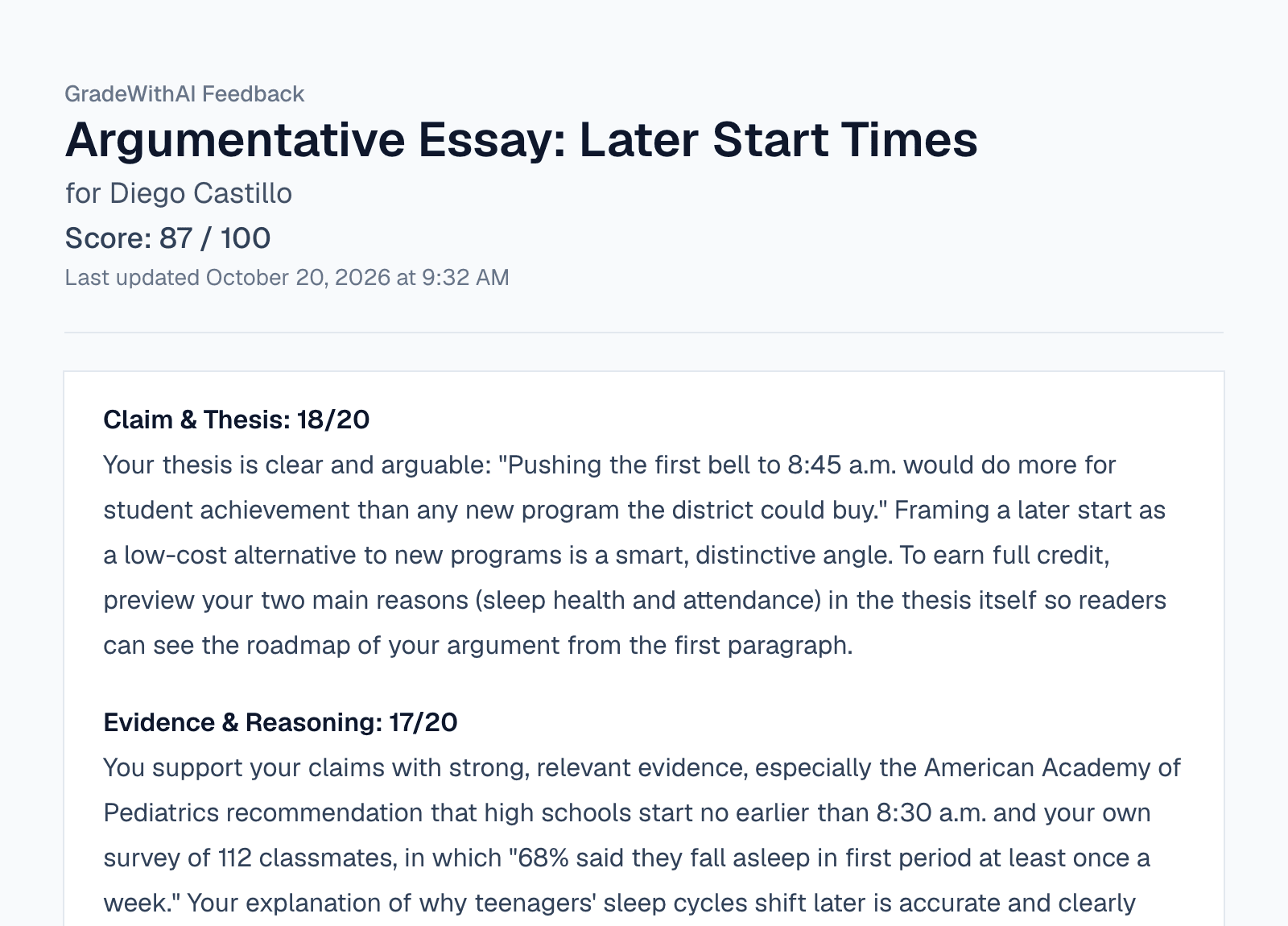
GradeWithAI grades narratives, journals, and essays, typed or handwritten, against your rubric, and you review the feedback before students see it.
Grading student writing every week? See how the AI writing grader works
Start with simple attribution: 'The article said ___' or 'According to the text, ___.' Teach students to pull one specific phrase, put it in quotation marks, and explain it in their own words. A three-column organizer ('quote,' 'my words,' 'why it matters') helps. Formal citation can wait until middle school.
They can, informally. Common Core doesn't require counterclaims until 7th grade (W.7.1a), but 4th grade is a reasonable place to introduce them. A simple 'Some people might say ___, but I still think ___' gives students first practice acknowledging another view. Ask the generator for opinion prompts that tell students to 'name one reason someone might disagree.'
Up to 25 prompts per set, and you can generate as many sets as you need. No account required.
Yes. Use them in handouts, journals, or your LMS. No attribution needed.
Kindergarten through 12th grade, plus college and adult writers. Genres: narrative, opinion, persuasive, argumentative, descriptive, expository, creative fiction, fantasy, poetry, and journal or reflection.
Yes. Type a theme, such as Halloween, kindness, or the first week of school, and the prompts use it. Leave it blank for a general set.
Yes. Each set is written fresh, so the same request gives new prompts. The tool doesn't pull from a fixed list.
Yes, by copying them. Paste the set into a Google Doc, a slide, or an assignment post, or print a handout. The generator doesn't connect to an LMS.
Writing prompts by grade, genre, and theme
Starting points with the grade, genre, or theme filled in.
By audience
By grade
By genre
By theme
By format
By tone
By cadence
Grade the writing your students turn in
21,000+ teachers use GradeWithAI to grade essays, tests, and handwritten work, and report saving 10+ hours a week.
The free plan grades 25 submissions every 30 days. No credit card.
Reported by teachers using GradeWithAI, with feedback on every submission they grade.