The AI AP Lit essay grader for every rubric point
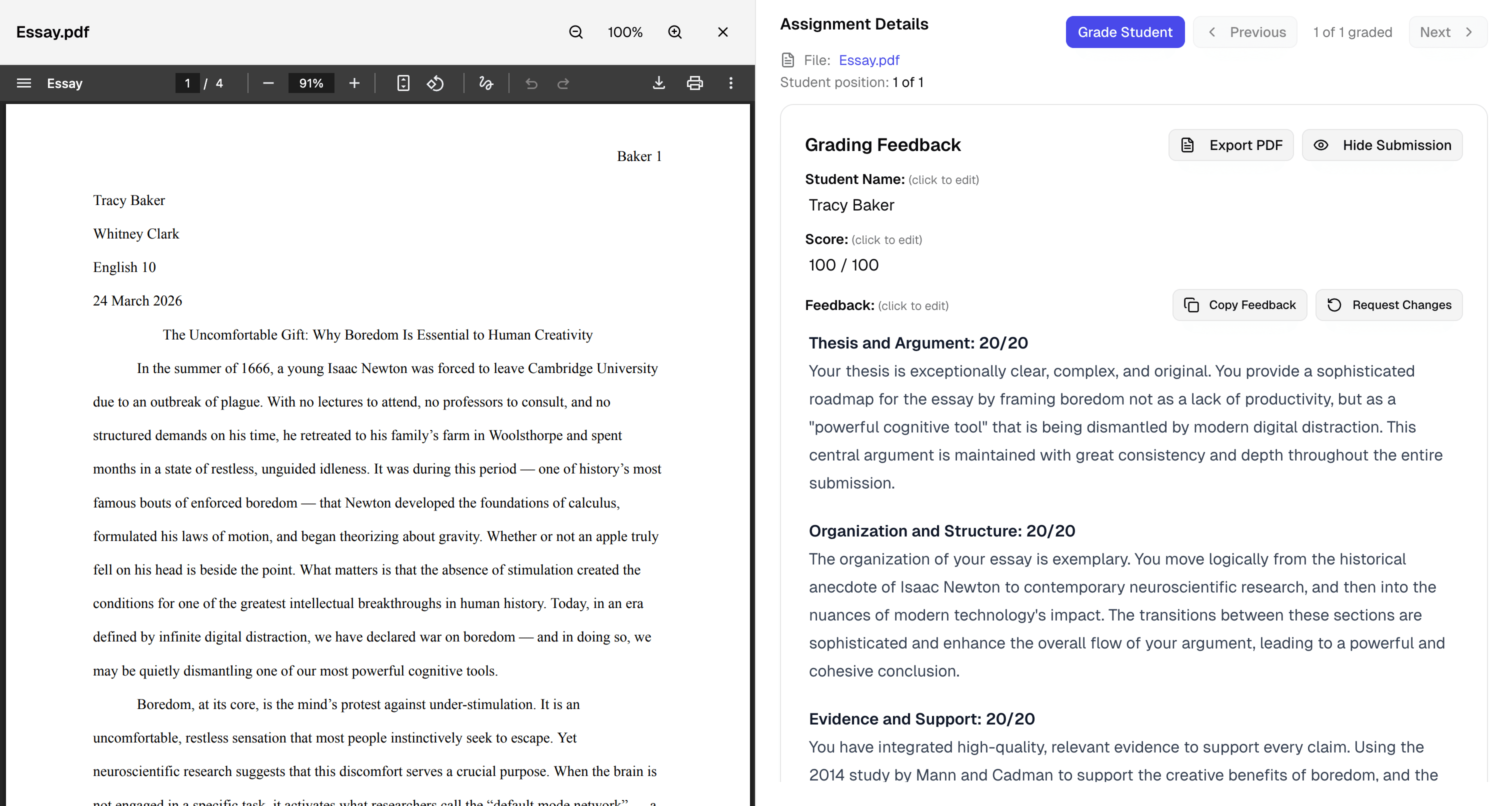
Score poetry analysis (FRQ 1), prose fiction analysis (FRQ 2), and literary argument (FRQ 3) essays against the current College Board AP Lit rubric. Thesis, evidence and commentary, and the sophistication point — each explained with line citations from the student's own essay.
Free plan · 6-point College Board rubric · All three AP Lit essay types
Trusted by 10,000+ teachers for AP Lit grader
The AP Lit grading problem
Three FRQs, one rubric, and sophistication — the point most essays miss.
AP Lit teachers grade all three AP Lit FRQs — poetry analysis, prose fiction analysis, and literary argument — against the same 6-point AP Lit rubric (thesis / evidence and commentary / sophistication). The three essay types require different reading moves but share the rubric, which makes consistency hard. The sophistication point is the one most essays miss, and students cannot improve on it unless feedback names which sophisticated move they attempted and whether it landed. An AI AP Lit essay grader has to apply the rubric identically across poetry, prose, and argument FRQs — without drifting by the time you hit the last essay in the stack.
- Sophistication is a moving target
- Between teachers, between essays, sometimes between drafts. Students can't aim at sophistication unless feedback is specific about which move they attempted and whether it held up.
- Poetry and prose need different eyes
- Poetry analysis rewards attention to form (meter, enjambment, imagery); prose analysis rewards attention to narrative elements (point of view, characterization, shifts). The rubric is identical; the reading is not.
- Evidence and commentary interlock
- The rubric scores evidence and commentary as a 4-point bundle. A student can pull strong textual evidence and write shallow commentary that restates rather than interprets — and miss the whole band.
6-point AP Lit rubric
Scored the way AP readers score — with the sophistication point named
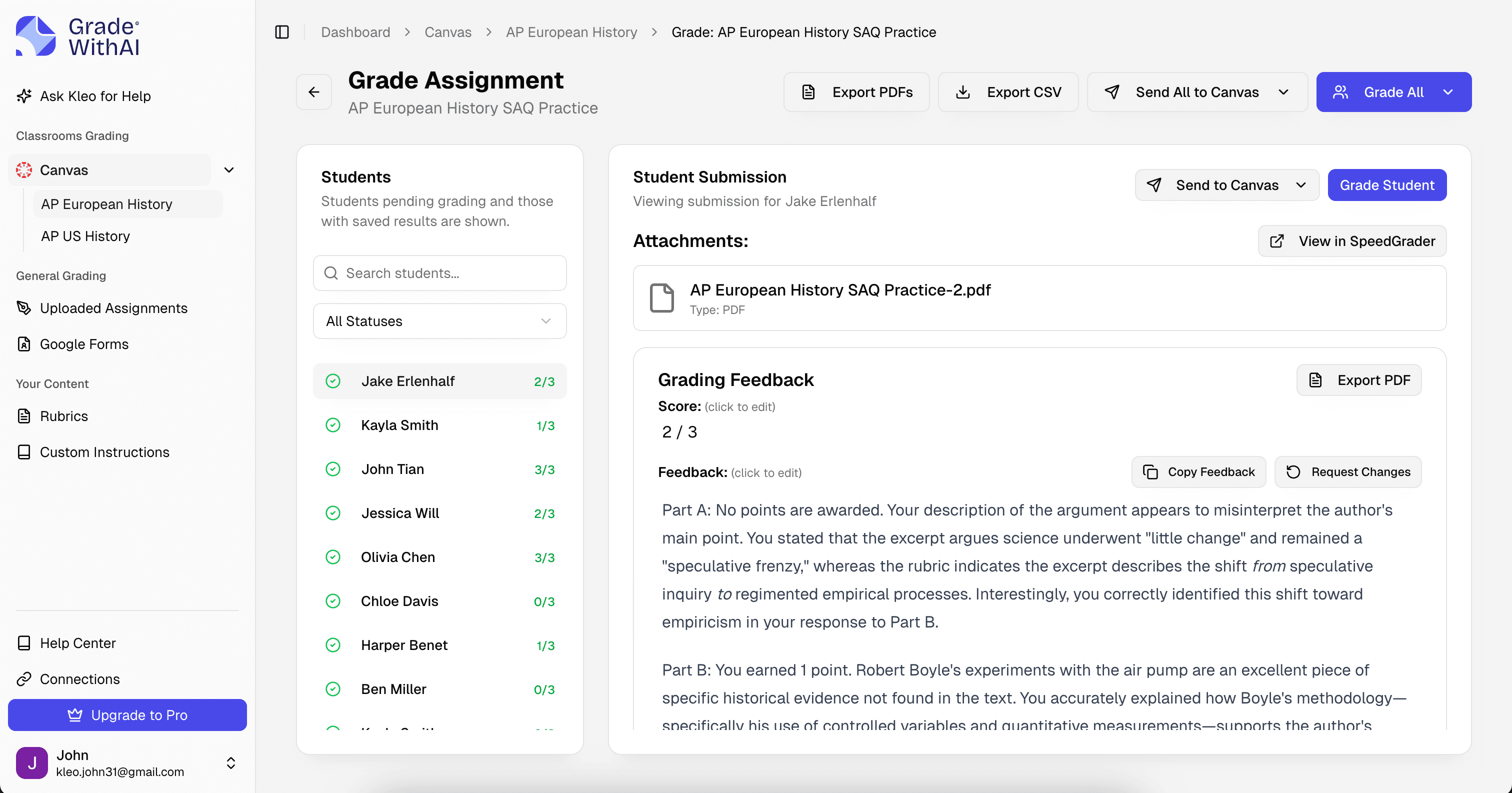
The AI AP Lit essay grader evaluates against the current AP Lit rubric: 1 point for thesis, 4 points for evidence and commentary, 1 point for sophistication. Each point is justified with the specific rubric language and a citation from the student's essay. The sophistication point gets dedicated treatment — the AI names which sophisticated move the student attempted (nuance, tension, broader implications, precise language about the text's complexity) and whether it sustained across the essay.
- Sophistication-point coaching
- The AI identifies the move — naming tension in the text, tracking a shift, framing the work's complexity, using precise literary language — and explains whether it sustained.
- Evidence + commentary together
- The 4-point band is scored as a bundle. Strong textual evidence with thin commentary gets specific feedback on which interpretive move would move the score up.
- FRQ-type awareness
- Poetry analysis, prose fiction analysis, and literary argument each get genre-specific feedback on top of the shared rubric — form for poetry, narrative craft for prose, theme and motif tracking for the argument FRQ.
AP Lit rubric
The 6-point AP Lit rubric, applied essay by essay
Default matches the current College Board rubric. The rubric is identical across poetry analysis, prose fiction analysis, and literary argument, with genre-specific interpretation layered on top.
AP Lit rubric · AI-generated
Thesis / claim
1 ptDefensible interpretation that responds to the prompt and establishes a line of literary reasoning.
- Earned
- Defensible interpretive claim that establishes a line of reasoning about the text's meaning — not a restatement of the prompt or a summary of plot.
- Developing
- Thesis present but vague, too broad, or describes the text's content rather than making an interpretive claim.
- Not yet
- No defensible interpretive claim, or a thesis that summarizes rather than interprets.
Evidence & commentary
4 ptsSpecific textual evidence with commentary that explains how literary elements create meaning.
- Full (4)
- Multiple specific pieces of textual evidence; commentary consistently explains how literary elements (imagery, diction, structure, point of view, etc.) create meaning in the text.
- Mid (2–3)
- Evidence present; commentary partly explains significance but may slip into paraphrase or leave the connection between evidence and interpretation implicit.
- Low (0–1)
- Evidence thin or generic; commentary largely summary or plot restatement, with weak connection to any interpretive claim.
Sophistication
1 ptDemonstrates sophisticated thought through nuance, tension, broader implications, or precise literary language.
- Earned
- Sustained sophisticated thought: identifies tension or ambiguity in the text, traces a shift, situates the work in broader literary or cultural context, or uses consistently precise literary language about the text's complexity.
- Not yet
- Sophistication attempted in a single sentence or moment but not sustained — a passing mention of nuance, a vague gesture toward complexity, or precise vocabulary used once.
Per-point feedback
See exactly which rubric point the class missed
After every AP Lit essay set, the dashboard shows class-wide performance per rubric point. Which point did most students miss — thesis, evidence and commentary, sophistication? That's what you need for tomorrow's mini-lesson, not a single aggregate score. The AI groups common misses so you can reteach directly to the pattern.
Project total
83 / 100
- Research & evidence
- 70%
- Written product
- 88%
- Visual / creative
- 96%
- Creativity & originality
- 80%
Feedback pack · Student sees per-component scores and which component dragged the grade down.
- Per-point score distribution
- See the distribution of earned / not earned across all three rubric points for the whole class — and across the three FRQ types.
- Common sophistication attempts
- The AI groups students by which sophistication move they attempted — tension, shift, broader implications, precise language — and whether it landed. Perfect for next-day reteaching.
- Individual progress across FRQ types
- Follow each student: are they stronger on poetry or prose? Are they earning thesis consistently? Which move still blocks the sophistication point?
Sample AI feedback
Feedback specific enough that students can rewrite
Here is an AP Lit poetry analysis response graded against the 6-point rubric. Notice the comment names the specific sophistication attempt, explains why it didn't sustain, and points to the exact line in the student's essay.
Assignment prompt
Read the following poem carefully. Then write an essay analyzing how the poet uses literary devices to convey the speaker's attitude toward memory.
Student submission
Throughout the poem, the speaker uses imagery and enjambment to convey a conflicted attitude toward memory — one that is both painful and cherished. The imagery of 'the yellowed photograph' in line 4 evokes the fading quality of memory...
AI feedback · Sophistication (6th point)
4 / 6Thesis (earned): defensible interpretive claim — memory as conflicted (painful and cherished) — establishes a line of reasoning. Evidence and commentary (3 of 4): strong textual evidence from lines 4, 9, and 12; commentary explains how the imagery creates the conflicted attitude, but paragraphs 2 and 3 slip toward paraphrase rather than sustained interpretation. Sophistication (not earned): the tension is named once in the intro but treated as a static binary across the body. To earn sophistication, trace how the tension shifts across the poem — the tonal turn at line 9, the unresolved return in the final stanza — or situate the speaker's relationship with memory within a broader elegiac tradition.
Revision tip · The student earns thesis and mid-band evidence and commentary (3 of 4). Sophistication is attempted through naming tension (painful and cherished) but not sustained — the body paragraphs treat the tension as a single binary rather than tracing how it shifts across the poem. Tracking the tonal shift at the volta, or naming a specific literary tradition the speaker sits within, would sustain the point.
- Quotes the student's actual work
- Feedback points to specific sentences and claims the student wrote, not vague impressions.
- Names the rubric language
- Comments reuse the criteria you set, so students learn what the rubric actually asks for.
- Suggests a concrete revision
- Every comment ends with a specific next step the student can take on the next draft.
Built for AP Lit grader
Every detail, handled
- Poetry, prose, and literary argument built in
- All three AP Lit FRQ types get rubric-aligned feedback. Poetry analysis rewards attention to form; prose analysis rewards narrative craft; literary argument rewards theme and motif tracking across a work the student knows.
- Handwritten exam essays supported
- Timed AP Lit essays are usually handwritten. Scan and upload — the AI transcribes before grading, with illegible sections flagged for clarification.
- Paired with AP Lang grading
- English departments that teach both AP Lang and AP Lit use the same grading workspace. Rubrics calibrate independently, and feedback language is tuned per course.
- LMS sync
- Push AP Lit essay scores and per-point comments to Canvas, Google Classroom, or Schoology in one click.
Why teachers switch
The AI AP Lit essay grader that makes weekly essays sustainable
Weekly AP Lit essays are how students build the reading-into-writing habit that the May exam rewards — and they're the first thing to disappear when grading gets heavy. As your AI AP Lit essay grader, GradeWithAI makes weekly FRQ practice sustainable, which is the only cadence that actually builds the sophistication point.
Grade a class set of AP Lit FRQs in under an hour
Every rubric point justified with a specific citation
Sophistication-point coaching named by move
Poetry, prose, and literary argument FRQs pre-loaded
Per-point class analytics for next-day reteaching
Editable scores and comments before grades post
“Students have also appreciated the consistency and immediacy of the feedback I can provide through GradeWithAI. This has enabled them to make necessary corrections and achieve their desired scores on any assignment.”

Why it matters for AP Lit grader
Weekly AP Lit essays are how students build the reading-into-writing habit that the May exam rewards — and they're the first thing to disappear when grading gets heavy. As your AI AP Lit essay grader, GradeWithAI makes weekly FRQ practice sustainable, which is the only cadence that actually builds the sophistication point.
How AP Lit grading works
From handwritten timed essays to returned scores in one sitting
The same three steps whether it's a timed in-class FRQ or an at-home practice essay.
- 1
Pick the AP Lit rubric
Select the current College Board AP Lit rubric (default) or upload a department-specific variant — e.g., one with expanded sophistication-point criteria.
- 2
Upload the essays
Scan handwritten FRQs or drag in typed responses. Mixed formats go in one queue, with automatic student name extraction.
- 3
Review and return
Scores per rubric point and full feedback are drafted. Approve, edit, or rewrite, then sync to your gradebook.
Also covered
AP English grading across courses
AP Lit and AP Lang share a department and often a teacher, but the rubrics and reading moves differ. Same grader, different rubric:
- AP Lang essays
- Rhetorical analysis, argument, and synthesis essays graded against the AP Lang 6-point rubric.
- AP essay grading (all courses)
- One hub to pick the right AP essay grader — Lang, Lit, APUSH DBQ, AP World LEQ, and more.
- APUSH LEQs & DBQs
- AP US History Long Essay and Document-Based Questions graded with period-aware evidence checks.
- LEQ grader
- The 6-point LEQ rubric for AP US History, AP World, and AP Euro Long Essay Questions.
Simple, transparent pricing
Start free and upgrade when you’re ready.
Free
Perfect for trying out AI grading.
- 25 AI requests/month
- Google Classroom integration
- Canvas integration
- Google Forms grading
- Handwritten assignment support
- AI rubric generation
- Unlimited Kleo AI assistant
Pro
Unlimited grading for dedicated educators.
- Unlimited AI requests
- Automated submissions grading
- AI detection on every submission
- Custom instructions
- Everything in Free
Schools & Districts
CustomEnterprise features for your entire school.
- Bulk user management
- Admin dashboard & analytics
- SSO / SAML authentication
- Dedicated onboarding & training
- Everything in Pro
Secure by design.
Built for K-12.
FERPA-aligned workflows, encryption everywhere, and no student data in model training. Ready for your district’s IT review from day one.
- FERPA-aligned
- SOC 2 practices
- AES-256 at rest
- TLS 1.2+ in transit
- Role-based access
- No AI training
- FERPA-aligned by default
- Role-based access and audit trails protect student submissions and grades.
- Never used for training
- Student work is processed for grading only — never used to train AI models.
- District-ready docs
- Security documentation and procurement support ready for your IT team.
Questions, answered
AP Lit FAQ
Answers to the questions we hear most from teachers using GradeWithAI for AP Lit grader. Start a free account and explore in minutes, or email john@gradewithai.com for a fast reply.
The current 6-point College Board AP Lit rubric: 1 point for thesis, 4 points for evidence and commentary, 1 point for sophistication. The rubric is identical across poetry analysis (FRQ 1), prose fiction analysis (FRQ 2), and literary argument (FRQ 3), with FRQ-specific interpretation layered on top.
By assignment
More grading guides


Ready to try the AI AP Lit essay grader that names sophistication?
Teachers who move weekly AP Lit FRQ grading to GradeWithAI report reading every essay in detail instead of skimming. That's what moves the sophistication point — and that's the point the May exam rewards most.
Free plan available · No credit card required
Teachers using GradeWithAI report grading in a fraction of the time, with richer feedback for every student.