The AI LEQ grader for every rubric point
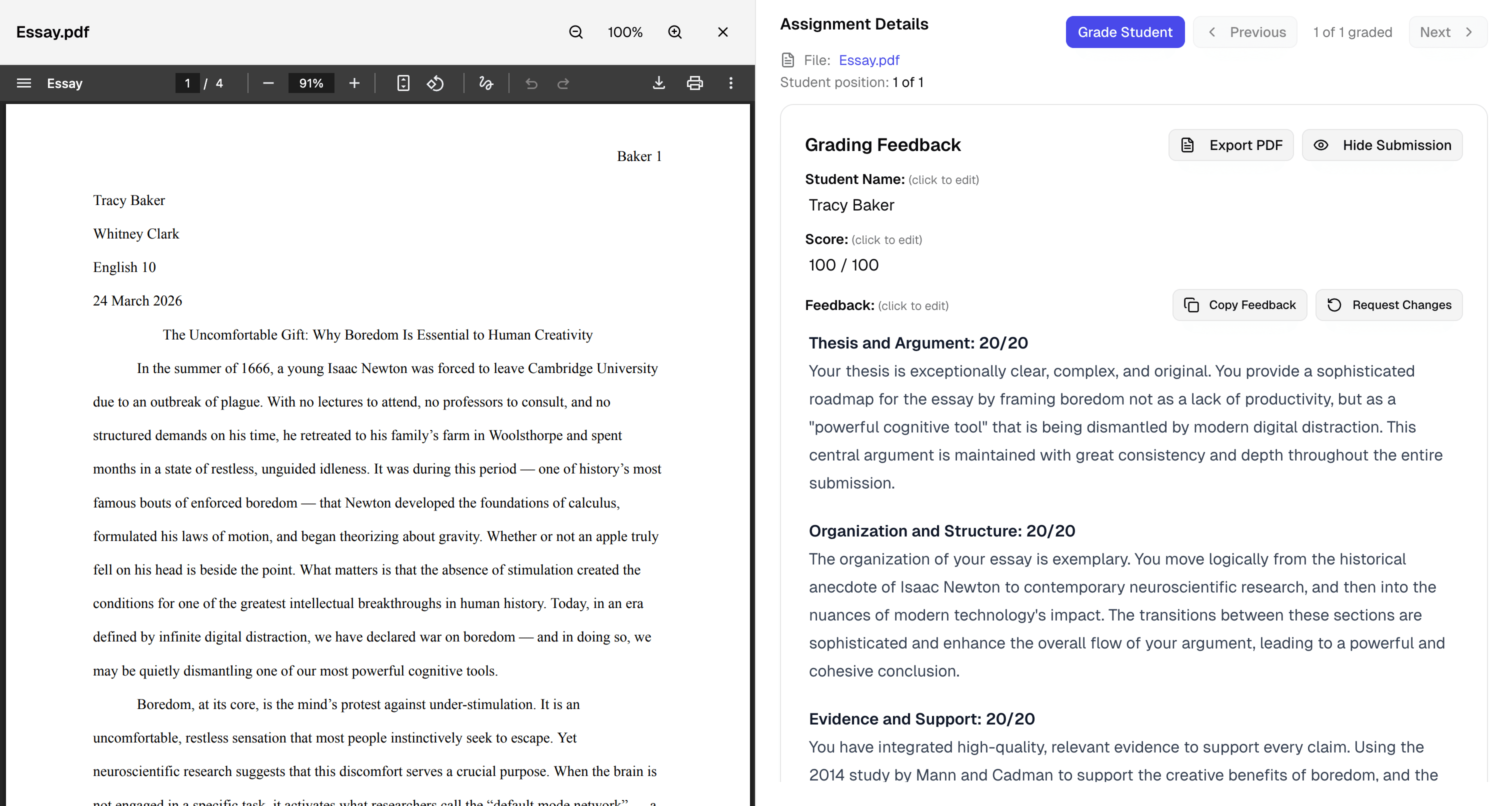
Score AP US History, AP World, and AP Euro Long Essay Questions against the current 6-point College Board LEQ rubric. Thesis, contextualization, evidence, analysis and reasoning, and the complexity point — each explained with line citations from the student's own essay.
Free plan · 6-point College Board LEQ rubric · APUSH, AP World & AP Euro
Trusted by 10,000+ teachers for LEQ grader
The LEQ grading problem
Six points. Forty-minute essays. A class set you're grading on a Saturday.
AP history teachers grade Long Essay Questions on the same 6-point LEQ rubric — thesis, contextualization, evidence, analysis and reasoning, and the complexity point — across APUSH, AP World, and AP Euro. Students have 40 minutes to write one. You have a weekend to grade 90 of them. The complexity point is the hardest to train on and the hardest to calibrate, and students cannot improve on it unless feedback names which complex move they attempted and whether it landed. An AI LEQ grader has to apply the rubric identically across that entire stack, essay after essay, without drifting by the time you hit the last one.
- Complexity is the invisible point
- Most LEQ responses miss the complexity point not because students can't do it, but because they never got feedback naming what they attempted. Generic comments like 'add more nuance' don't move scores.
- Contextualization has to precede the thesis
- The rubric is specific: contextualization must establish broader historical context relevant to the prompt, and it has to be sustained — not a throwaway first sentence. AI feedback has to flag when students conflate a hook with contextualization.
- Evidence without reasoning is 2 of 6
- A student can name four pieces of specific evidence and still miss the analysis and reasoning point. The AI has to score evidence and analysis separately and name the gap between them.
6-point LEQ rubric
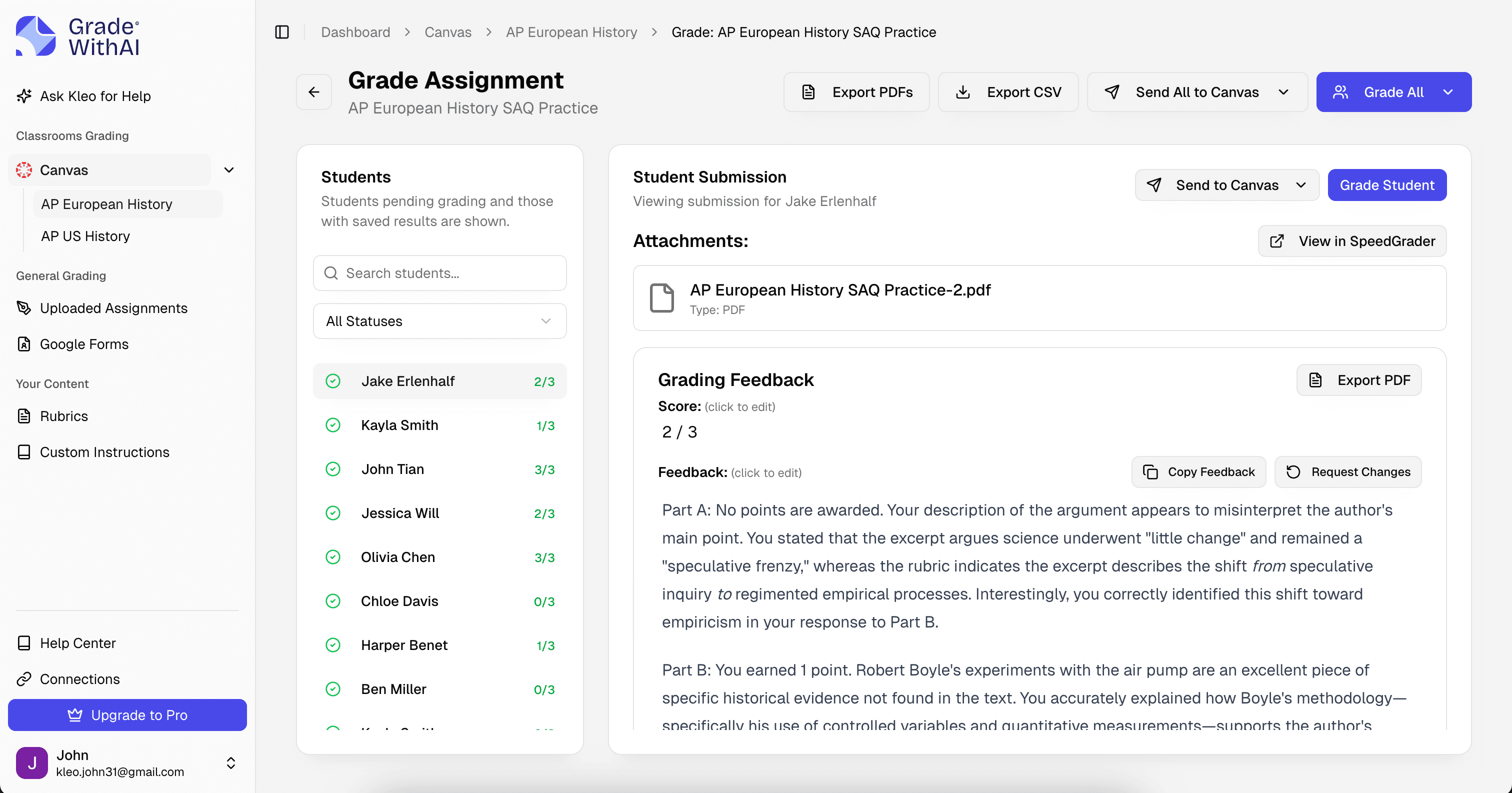
Scored the way AP readers score — with the complexity point named
The AI LEQ grader evaluates against the current College Board LEQ rubric: 1 point for thesis, 1 point for contextualization, 2 points for evidence, 1 point for analysis and reasoning, and 1 point for complexity. Each point is justified with the specific rubric language and a citation from the student's essay. The complexity point gets dedicated treatment — the AI names which complex move the student attempted (corroboration, qualification, synthesis across periods or regions, connection to broader historical processes) and whether it sustained across the essay.
- Complexity-point coaching
- The AI identifies the complexity move — corroboration, qualification, synthesis, connection to broader processes — and explains whether it sustained or fizzled mid-essay.
- Evidence and reasoning scored separately
- The 2-point evidence band and the 1-point analysis band are evaluated as distinct criteria. Strong evidence with weak reasoning gets feedback on which reasoning move would connect them.
- Course-aware calibration
- APUSH, AP World, and AP Euro each get course-specific interpretation of the same rubric — APUSH chronological reasoning, AP World regional comparison, AP Euro continuity and change — layered on top.
LEQ rubric
The 6-point LEQ rubric, applied essay by essay
Default matches the current College Board LEQ rubric. The rubric is identical across APUSH, AP World, and AP Euro, with course-specific interpretation on top.
LEQ grader rubric · AI-generated
Thesis / claim
1 ptHistorically defensible thesis that responds to the prompt and establishes a line of reasoning.
- Earned
- Historically defensible claim that establishes a clear line of reasoning, located in the introduction or conclusion, not a restatement of the prompt.
- Developing
- Thesis present but not defensible, too vague, or merely summarizes without establishing a line of reasoning.
- Not yet
- No thesis, or the thesis restates the prompt.
Contextualization
1 ptBroader historical context relevant to the prompt, established beyond a single phrase or reference.
- Earned
- Describes broader historical context — events, developments, or processes — relevant to the prompt, sustained across multiple sentences.
- Not yet
- Context is a passing reference, a throwaway hook, or only tangentially related to the prompt.
Evidence
2 ptsSpecific historical evidence used to support the argument.
- Full (2)
- Multiple pieces of specific historical evidence used to support the thesis.
- Partial (1)
- At least two pieces of specific historical evidence, but not consistently used to support the thesis.
- Not yet (0)
- Evidence is vague, generic, or factually incorrect.
Analysis & reasoning
1 ptUses historical reasoning (comparison, causation, or continuity and change) to frame the argument.
- Earned
- Frames or structures the argument around the targeted reasoning process — comparison, causation, or continuity and change.
- Not yet
- Argument is descriptive only, or the reasoning process is named but not sustained.
Complexity
1 ptDemonstrates complex understanding through corroboration, qualification, synthesis, or connection across topics or periods.
- Earned
- Sustained complex understanding: corroboration from multiple angles, qualification of the thesis, synthesis across periods or regions, or connection to broader historical processes.
- Not yet
- Complexity attempted but not sustained — a single qualifying sentence, an unsupported counterargument, or a gesture at nuance that doesn't land.
Per-point feedback
See exactly which rubric point the class missed
After every LEQ set, the dashboard shows class-wide performance per rubric point. Which point did 80% of the class miss — contextualization, analysis and reasoning, complexity? That is what you need for tomorrow's mini-lesson, not a single aggregate LEQ score. The AI groups common misses so you can teach directly to the pattern.
Project total
83 / 100
- Research & evidence
- 70%
- Written product
- 88%
- Visual / creative
- 96%
- Creativity & originality
- 80%
Feedback pack · Student sees per-component scores and which component dragged the grade down.
- Per-point score distribution
- See the distribution of earned / not earned across all six rubric points for the whole class, at a glance.
- Common complexity attempts
- The AI groups students by which complexity move they attempted — corroboration, qualification, synthesis — and whether it landed. Perfect for next-day reteaching.
- Individual progress over time
- Follow each student across LEQ attempts: are they earning contextualization consistently now? Did the thesis point come back? Which rubric point is still blocking the score?
Sample AI feedback
Feedback specific enough that students can rewrite
Here is an APUSH LEQ response graded against the 6-point rubric. Notice the comment names the specific complexity attempt, explains why it didn't sustain, and points to the exact passage.
Assignment prompt
Evaluate the extent to which the American Revolution changed American society in the period from 1775 to 1800.
Student submission
The American Revolution significantly changed American society between 1775 and 1800 by creating new political structures, shifting ideas about liberty, and expanding civic participation for white men. However, for enslaved people and women, the changes were more limited...
AI feedback · Complexity (6th point)
4 / 6Thesis (earned): defensible claim that establishes a line of reasoning around political, ideological, and civic change. Contextualization (earned): sustained setup of Enlightenment thought and colonial grievances. Evidence (2): multiple specific pieces — the Articles of Confederation, the Virginia Statute for Religious Freedom, expansion of state voting rights. Analysis and reasoning (earned): continuity and change reasoning structures the body. Complexity (not earned): the introduction qualifies the thesis, but the body returns to a single-angle argument. To earn complexity, sustain the qualification with a specific counter-development — e.g., the westward expansion of slavery after 1790, or the persistence of coverture law limiting women's property rights.
Revision tip · The student earns thesis, contextualization, evidence, and analysis. Complexity is attempted through qualification (changes were more limited for enslaved people and women) but not sustained — the body paragraphs return to a single-angle argument. Naming a specific counter-development (the expansion of slavery into new territories, the Revolution's limited effect on gender roles after coverture law survived) would sustain the complexity point.
- Quotes the student's actual work
- Feedback points to specific sentences and claims the student wrote, not vague impressions.
- Names the rubric language
- Comments reuse the criteria you set, so students learn what the rubric actually asks for.
- Suggests a concrete revision
- Every comment ends with a specific next step the student can take on the next draft.
Built for LEQ grader
Every detail, handled
- APUSH, AP World & AP Euro rubrics built in
- The LEQ rubric is identical across all three AP history courses. The AI layers course-specific interpretation — APUSH chronological reasoning, AP World regional comparison, AP Euro continuity — on top.
- Handwritten LEQs supported
- Timed in-class LEQs are usually handwritten. Scan and upload — the AI transcribes before grading, and illegible sections are flagged for clarification.
- Score calibration across teachers
- When multiple teachers co-grade, the AI gives each essay a consistent score based on the rubric — no drift between period 1 and period 6.
- LMS sync
- Push LEQ scores and per-point comments to Canvas, Google Classroom, or Schoology in one click.
Why teachers switch
The AI LEQ grader that makes weekly LEQs sustainable
Long Essay Questions are the practice reps AP history students need before the exam, and the first assignment to disappear when the grading pile gets heavy. As your AI LEQ grader, GradeWithAI makes weekly LEQs sustainable — which is the only cadence that actually builds the writing.
Grade a class set of LEQs in under an hour
Every rubric point justified with a specific citation
Complexity-point coaching named by move
APUSH, AP World, and AP Euro rubrics pre-loaded
Per-point class analytics for next-day reteaching
Editable scores and comments before grades post
“Students have also appreciated the consistency and immediacy of the feedback I can provide through GradeWithAI. This has enabled them to make necessary corrections and achieve their desired scores on any assignment.”

Why it matters for LEQ grader
Long Essay Questions are the practice reps AP history students need before the exam, and the first assignment to disappear when the grading pile gets heavy. As your AI LEQ grader, GradeWithAI makes weekly LEQs sustainable — which is the only cadence that actually builds the writing.
How LEQ grading works
From handwritten drafts to returned scores in one sitting
The same three steps whether it's a timed in-class LEQ or an at-home practice set.
- 1
Pick the LEQ rubric
Select the current College Board LEQ rubric (default) or upload your own scoring version — e.g., a department variant with different weighting.
- 2
Upload the essays
Scan handwritten LEQs or drag in typed responses. Mixed formats go in one queue. Student name extraction happens automatically.
- 3
Review and return
Scores per rubric point and full feedback are drafted. Approve, edit, or rewrite, then sync to your gradebook.
Also covered
LEQ grading across AP history courses
The 6-point LEQ rubric is identical across AP US History, AP World History, and AP Euro. Course-specific interpretation is layered on top:
- APUSH LEQs
- AP US History Long Essay Questions graded with period-aware evidence checks and American political/economic/social reasoning frames.
- AP World LEQs
- AP World: Modern Long Essay Questions graded with regional comparison and cross-period synthesis frames.
- AP SAQs
- The 3-part AP SAQ rubric for short answer questions across APUSH and AP World.
- AP FRQs
- AP Biology, Chemistry, Physics, Stats, Gov, and Psych free-response questions graded point-by-point.
Simple, transparent pricing
Start free and upgrade when you’re ready.
Free
Perfect for trying out AI grading.
- 25 AI requests/month
- Google Classroom integration
- Canvas integration
- Google Forms grading
- Handwritten assignment support
- AI rubric generation
- Unlimited Kleo AI assistant
Pro
Unlimited grading for dedicated educators.
- Unlimited AI requests
- Automated submissions grading
- AI detection on every submission
- Custom instructions
- Everything in Free
Schools & Districts
CustomEnterprise features for your entire school.
- Bulk user management
- Admin dashboard & analytics
- SSO / SAML authentication
- Dedicated onboarding & training
- Everything in Pro
Secure by design.
Built for K-12.
FERPA-aligned workflows, encryption everywhere, and no student data in model training. Ready for your district’s IT review from day one.
- FERPA-aligned
- SOC 2 practices
- AES-256 at rest
- TLS 1.2+ in transit
- Role-based access
- No AI training
- FERPA-aligned by default
- Role-based access and audit trails protect student submissions and grades.
- Never used for training
- Student work is processed for grading only — never used to train AI models.
- District-ready docs
- Security documentation and procurement support ready for your IT team.
Questions, answered
LEQ grader FAQ
Answers to the questions we hear most from teachers using GradeWithAI for LEQ grader. Start a free account and explore in minutes, or email john@gradewithai.com for a fast reply.
The current 6-point College Board LEQ rubric: 1 point for thesis, 1 point for contextualization, 2 points for evidence, 1 point for analysis and reasoning, and 1 point for complexity. The rubric is identical across APUSH, AP World, and AP Euro — the AI layers course-specific interpretation on top.
By assignment
More grading guides


Ready to try the AI LEQ grader that reads for complexity, not just keywords?
Teachers who move weekly LEQ grading to GradeWithAI report reading every essay in detail instead of skimming. That's what moves the complexity point — and that's the point the exam rewards most.
Free plan available · No credit card required
Teachers using GradeWithAI report grading in a fraction of the time, with richer feedback for every student.