AI recommendation letter generator
Enter the student's name, what they did, and how you know them. You get a draft for a college, scholarship, job, or graduate school letter to edit and sign.
Free · No account · Copy or download as PDF
0/5,000 · More detail produces better letters.
Tip: Include specific examples and concrete achievements for the best results.
GradeWithAI is used by 21,000+ teachers, including teachers at
A complete draft from your notes
This college letter was written from notes about a student's lab work and her role on the Science Olympiad team.
Dear Admissions Committee,
I am pleased to recommend Maya Thompson for admission. I taught Maya in AP Biology during her junior year and have advised her on the Science Olympiad team for two years.
Maya asks the questions that move a class forward. During our enzyme lab, she noticed that her group's reaction rates dropped at a lower temperature than the textbook predicted, and she designed a follow-up trial to find out why. Her lab report was the clearest in the class.
She is also a generous teammate. As Science Olympiad captain, Maya wrote a shared study guide for the anatomy event and spent lunch periods quizzing newer members, two of whom placed at the regional tournament this spring.
Maya will bring curiosity and steady work habits to your campus. I recommend her without reservation and would be glad to answer any questions.
Sincerely,
Elena Rivera
AP Biology Teacher
What the letter generator does
- Nine letter types
- College, scholarship, job or internship, graduate school, awards, and several kinds of character and reference letters.
- Four tones
- Formal, warm and professional, enthusiastic, or measured, to match how you write.
- Built from your details
- Paste up to 5,000 characters of notes. The more specific they are, the more specific the letter.
- Copy or download
- Copy the letter into Google Docs or Word to edit and sign it, or download it as a PDF.
What is an AI recommendation letter generator?
An AI recommendation letter generator drafts a letter from your notes about a student or colleague. This one writes a complete letter, from salutation to sign-off, for college, scholarship, job, graduate school, award, or character reference requests, in the tone you choose.
What goes into the letter
The letter uses the person's name, the letter type, your examples of their work, your relationship, and your name and title. A specific project, or what changed over the year, makes a stronger letter than adjectives.
An opening that says how you know the person
Body paragraphs built on your examples
A closing matched to the letter type
Before you send it
The generator is instructed to use only the details you enter, but check every claim anyway. The letter is read-only on the page, so copy it into your document to edit and sign it, or download a PDF.
Letter types
College application, scholarship, job or internship, graduate school or fellowship, awards nomination, character reference, character reference for court, immigration, and landlord or rental reference. The opening and closing change to fit the type.
What a strong recommendation letter includes
Readers skim many letters. The ones that help are specific.
How long you have known the person, and in what role
Two or three specific examples, not a list of traits
A comparison to peers, if you can make one honestly
A clear statement that you recommend them
Your title and contact details
How long a recommendation letter should be
Most letters fit on one page, about 300 to 500 words. Scholarship and graduate school letters can run longer when the program asks for detail. Check the request for a word limit or a form before you write.
How the letter generator works
- 1
Enter the details
The person's name, the letter type, what they did, and how you know them.
- 2
Pick a tone
The draft usually takes 10 to 20 seconds.
- 3
Edit and sign
Check every claim, add your own details, then copy the letter into your document and sign it.
Also grading your students' essays?
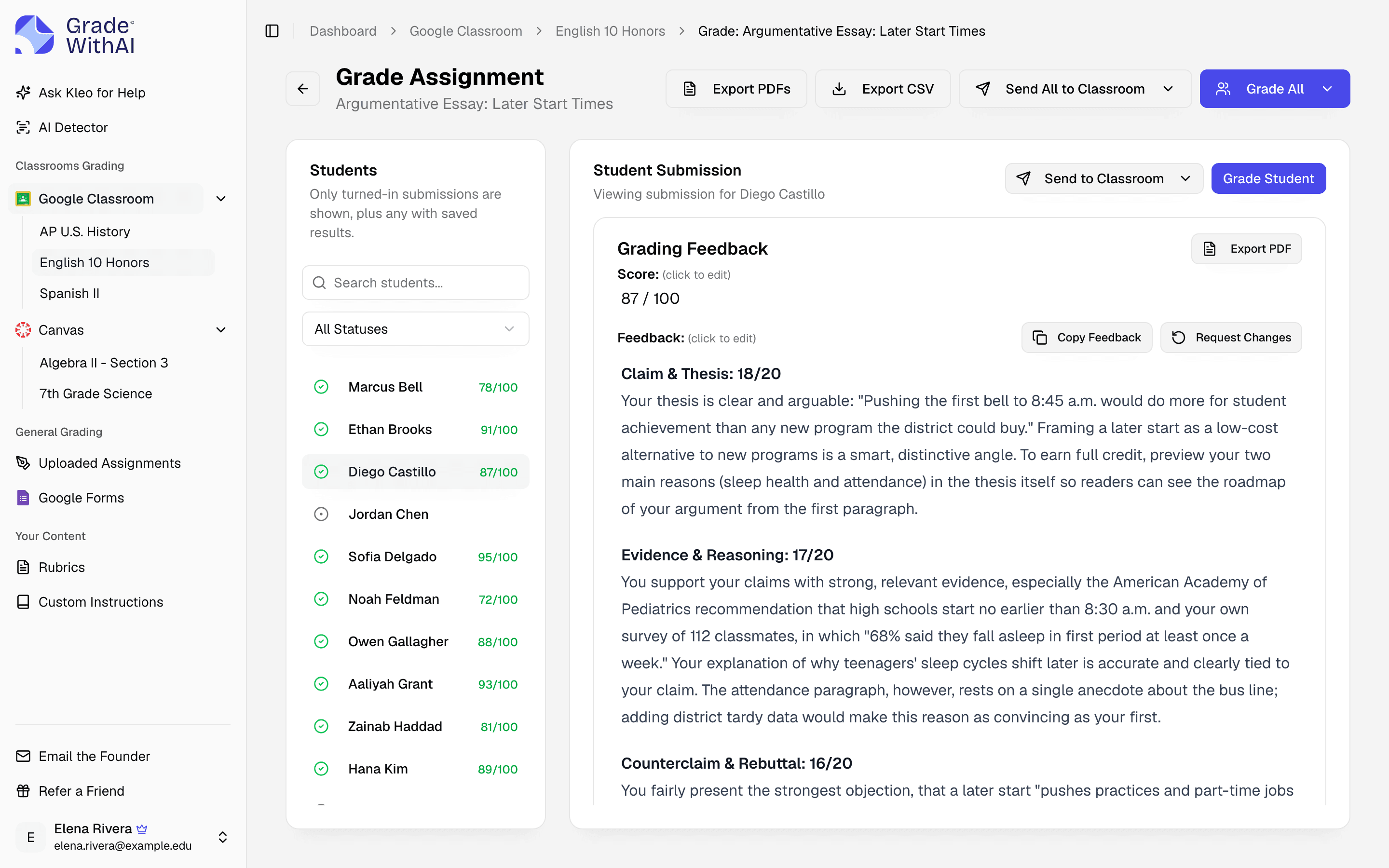
GradeWithAI grades essays, short answers, and handwritten work against your rubric and drafts feedback you review before students see it.
Grading a class set of essays? See how the AI essay grader works
It writes only from what you enter: the person's name, the letter type, your notes (up to 5,000 characters), the tone, and optionally your name, title, and relationship. It is instructed not to invent details. Specific notes produce a specific letter, and vague notes produce a vague one. Read every sentence before you send it.
It can be, if you treat the draft like a template: every statement must be accurate and the final wording yours. Follow any AI policy from your school, employer, or the program receiving the letter.
Concrete examples: a project, a revised essay, a time they helped a classmate. Add how long you've known them, in what role, and what they're applying for. Your notes go to an AI model, so leave out details the letter doesn't need, such as health information or ID numbers.
Nine types: college, scholarship, job or internship, graduate school, awards nomination, character reference, character reference for court, immigration, and landlord. Four tones: formal, warm and professional, enthusiastic, and measured. The type changes the emphasis. A college letter stresses academic work; a job reference stresses work habits.
About one page, or 300 to 500 words, for most college, job, and scholarship letters. Graduate school letters can run longer. Follow any word limit or form the program gives you.
No. Copy it into your document or download the PDF, then edit and sign it there. To get a new draft, select New Letter; your entries stay in the form.
Only if your notes are generic. Real examples produce a letter about one person; a list of adjectives produces a letter about anyone. Edit the draft so it sounds like you.
Follow the instructions of the program receiving the letter and any AI policy at your school or workplace. Either way, the letter goes out under your name, so every statement should be accurate.
Yes, and it needs no account. Letters aren't saved, so copy the text or download the PDF before you leave the page.
Recommendation letters by type
Starting points with the letter type and form labels set for the request.
Recipients
- Letter of recommendation for student
- Letter of recommendation for graduate school
- Scholarship recommendation letter generator
- Letter of recommendation for coworker
- Letter of recommendation for a friend
- College recommendation letter generator
- Teacher recommendation letter generator
- Immigration recommendation letter generator
- Medical school recommendation letter generator
- Job recommendation letter generator
Personal
Grade your students' essays with GradeWithAI
21,000+ teachers use GradeWithAI to grade essays, tests, and handwritten work, and report saving 10+ hours a week.
The free plan grades 25 submissions every 30 days. No credit card.
Reported by teachers using GradeWithAI, with feedback on every submission they grade.