Persuasive writing prompts
Persuasive writing prompts that name a real audience and a specific request, for letters, speeches, and op-eds that practice ethos, pathos, and logos.
Free · No account · Copy or print · Kindergarten through 12th grade
Tip: Describe the writing unit or the mood you want. The tool calibrates vocabulary and complexity to the grade you pick.
GradeWithAI is used by 21,000+ teachers, including teachers at
What the writing prompt generator does
- Any grade
- Kindergarten through 12th grade, plus college and adult writers.
- Ten genres
- Narrative, opinion, persuasive, argumentative, descriptive, expository, creative fiction, fantasy, poetry, and journal or reflection.
- Theme and tone
- Add a theme such as Halloween or kindness, and choose a fun, thoughtful, serious, or playful tone.
- Up to 25 prompts
- Copy the set or print it as a handout. Generate again for new prompts.
What is persuasive writing?
Persuasive writing targets a specific audience and asks them to act. Unlike opinion writing, it is written for someone, such as a principal or a city council, with concerns of their own. The generator writes persuasive writing prompts that name the audience and the request.
Rhetorical moves a persuasive prompt should call for
Persuasion works in the gap between a writer and an audience that doesn't already agree. A strong prompt names the audience, hints at what they care about, and gives the writer a reason to use appeals.
Audience: a specific reader (principal, city council, parent, peer group)
Ethos: credibility built through tone and respect for the audience
Pathos: an emotional appeal that fits the audience's values
Logos: at least one data point, example, or chain of reasoning
Call to action: what exactly the audience should do after reading
Getting audience and format into the prompts
Choose Persuasive as the genre and name a format (letter, speech, or op-ed) in the description. You'll get prompts like 'Draft a three-minute speech for your school board about later start times.' Without the audience's worries in view, 'convince your parents to get a puppy' becomes a wish list.
Pairing prompts with a rhetoric mini-lesson
Teach ethos, pathos, and logos on Monday with a sample speech or local op-ed. On Tuesday, students draft from a prompt and label the appeal in each part. On Wednesday, partners mark where each appeal worked and where it felt forced, which turns 'be more persuasive' into specific revisions.
How the writing prompt generator works
- 1
Describe what you need
For example, narrative prompts about resilience for 5th graders, or journal starters for the first week of school.
- 2
Set the details
Grade, genre, theme, tone, and how many prompts, from 1 to 25.
- 3
Copy or print
Copy the set into a doc or your LMS post, or print a handout.
What teachers say
Teachers across subjects, from AP history to astrophysics, on grading with GradeWithAI.
“I've really enjoyed using the GradeWithAI program. It saves me a ton of time, especially when I have class sizes of 35 or 36 students times five.”

“GradeWithAI doesn't just grade. It gives the student reasoning as to why every point is awarded or not awarded. That is a very valuable thing for the students.”

“More impressive though is that it corrects student answers not simply using a pre-written answer, but by following the thought process they've pursued.”

“For Chadwick users, GradeWithAI has improved feedback efficiency and effectiveness, as it is grounded in existing platforms and is highly adaptable.”

“GradeWithAI [provides] students with timely individualized feedback on their homework assignments and formative assessments. This is a job that is virtually impossible for a teacher to do on a regular basis.”

“Students have also appreciated the consistency and immediacy of the feedback I can provide through GradeWithAI. This has enabled them to make necessary corrections and achieve their desired scores on any assignment.”

Grading the responses?
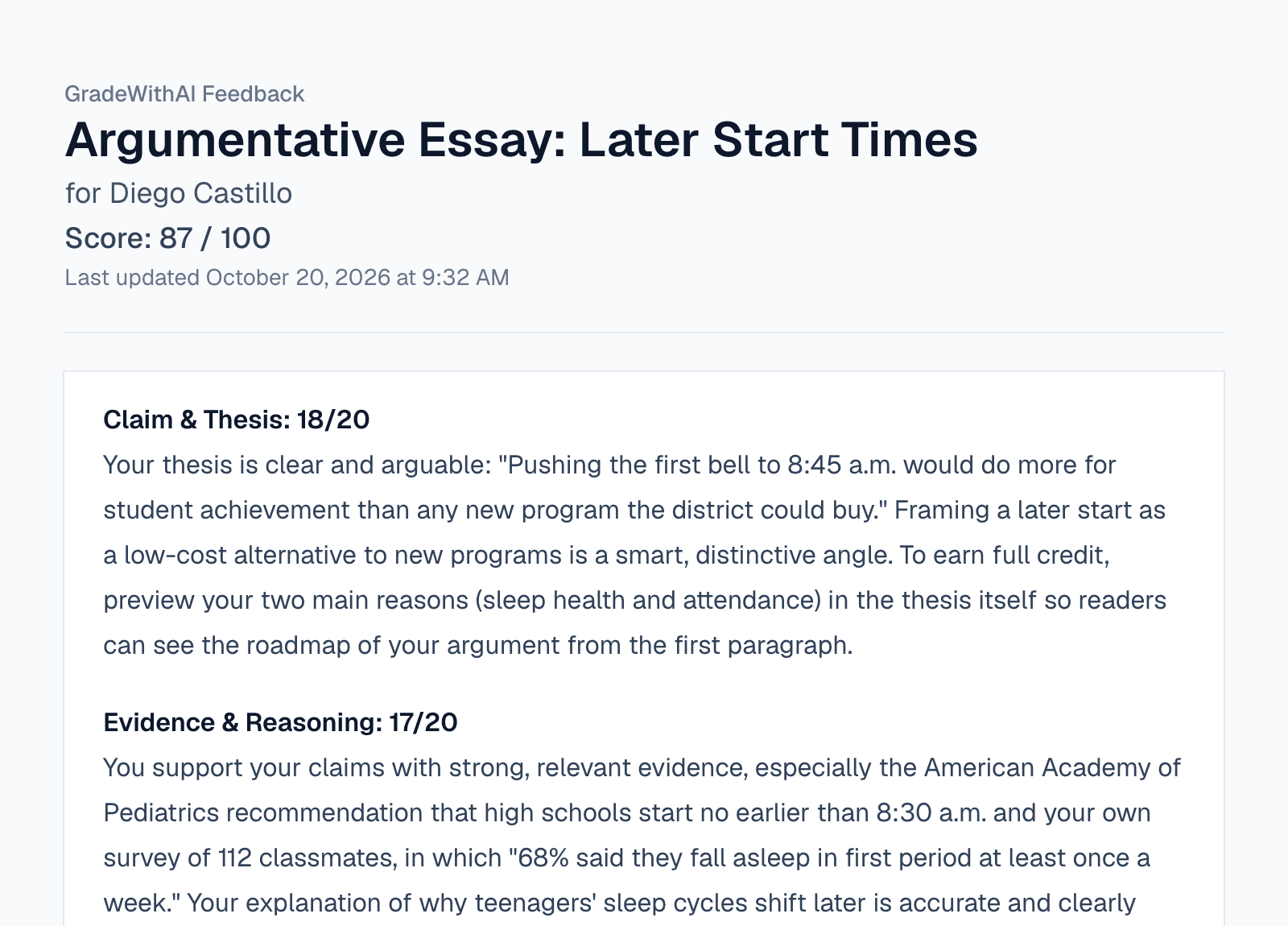
GradeWithAI grades narratives, journals, and essays, typed or handwritten, against your rubric, and you review the feedback before students see it.
Grading student writing every week? See how the AI writing grader works
Yes. Add 'formatted as a letter to the school board' or 'as a three-minute speech' to the description, and the prompts will be built around that format, often with notes on the greeting, length, and audience.
By default they allow any appeal. If you're teaching one appeal that week, say so: 'prompts that need data and logical reasoning' or 'prompts where an emotional appeal fits best.' The generator will write situations where that appeal is the natural choice.
Up to 25 prompts per set, and you can generate as many sets as you need. No account required.
Yes. Use them in handouts, journals, or your LMS. No attribution needed.
Kindergarten through 12th grade, plus college and adult writers. Genres: narrative, opinion, persuasive, argumentative, descriptive, expository, creative fiction, fantasy, poetry, and journal or reflection.
One clear task, a situation the writer can picture, and room for more than one good answer. Persuasive and argumentative prompts also name an audience or a position to respond to.
Yes. Type a theme, such as Halloween, kindness, or the first week of school, and the prompts use it. Leave it blank for a general set.
Yes. Each set is written fresh, so the same request gives new prompts. The tool doesn't pull from a fixed list.
Yes, by copying them. Paste the set into a Google Doc, a slide, or an assignment post, or print a handout. The generator doesn't connect to an LMS.
Writing prompts by grade, genre, and theme
Starting points with the grade, genre, or theme filled in.
By audience
By grade
By genre
By theme
By format
By tone
By cadence
Grade the writing your students turn in
21,000+ teachers use GradeWithAI to grade essays, tests, and handwritten work, and report saving 10+ hours a week.
The free plan grades 25 submissions every 30 days. No credit card.
Reported by teachers using GradeWithAI, with feedback on every submission they grade.