Job recommendation letter generator
Draft a job or internship recommendation letter as a teacher, professor, mentor, or former supervisor. Describe the candidate's work and the role they want.
Free · No account · Copy or download as PDF
0/5,000 · More detail produces better letters.
Tip: Include specific examples and concrete achievements for the best results.
GradeWithAI is used by 21,000+ teachers, including teachers at
What the letter generator does
- Nine letter types
- College, scholarship, job or internship, graduate school, awards, and several kinds of character and reference letters.
- Four tones
- Formal, warm and professional, enthusiastic, or measured, to match how you write.
- Built from your details
- Paste up to 5,000 characters of notes. The more specific they are, the more specific the letter.
- Copy or download
- Copy the letter into Google Docs or Word to edit and sign it, or download it as a PDF.
What is a job recommendation letter?
A job recommendation letter is a reference written for someone applying to a specific job or internship. The writer can be a former supervisor, a mentor, a professor, or a teacher writing for a student's first job, and the letter connects what they saw to the role the candidate wants.
Match the letter to the role
Hiring managers read a reference letter quickly and alongside a resume, so speak to what the job needs. For a customer-facing role, describe how the candidate deals with people; for an analytical role, how they work through a problem.
Your relationship to the candidate and how long you've known them
One example of work relevant to the target role
One working habit, such as reliability or follow-through, shown through an example
A direct statement that you recommend them for the role
Writing a first-job or internship reference for a student
Students applying for a first job have little work history, so the letter fills the gap with school evidence: meeting deadlines, leading a group project, managing a club budget, tutoring younger students. Keep it to 300 to 400 words and stick to what you saw as a teacher.
Using the generator for a job letter
Choose Job / Internship Reference and describe the target role, the work you saw, and one or two results; naming the role lets the closing tie your recommendation to it. Choose Formal or Warm & Professional to match the field.
How the letter generator works
- 1
Enter the details
The person's name, the letter type, what they did, and how you know them.
- 2
Pick a tone
The draft usually takes 10 to 20 seconds.
- 3
Edit and sign
Check every claim, add your own details, then copy the letter into your document and sign it.
Also grading your students' essays?
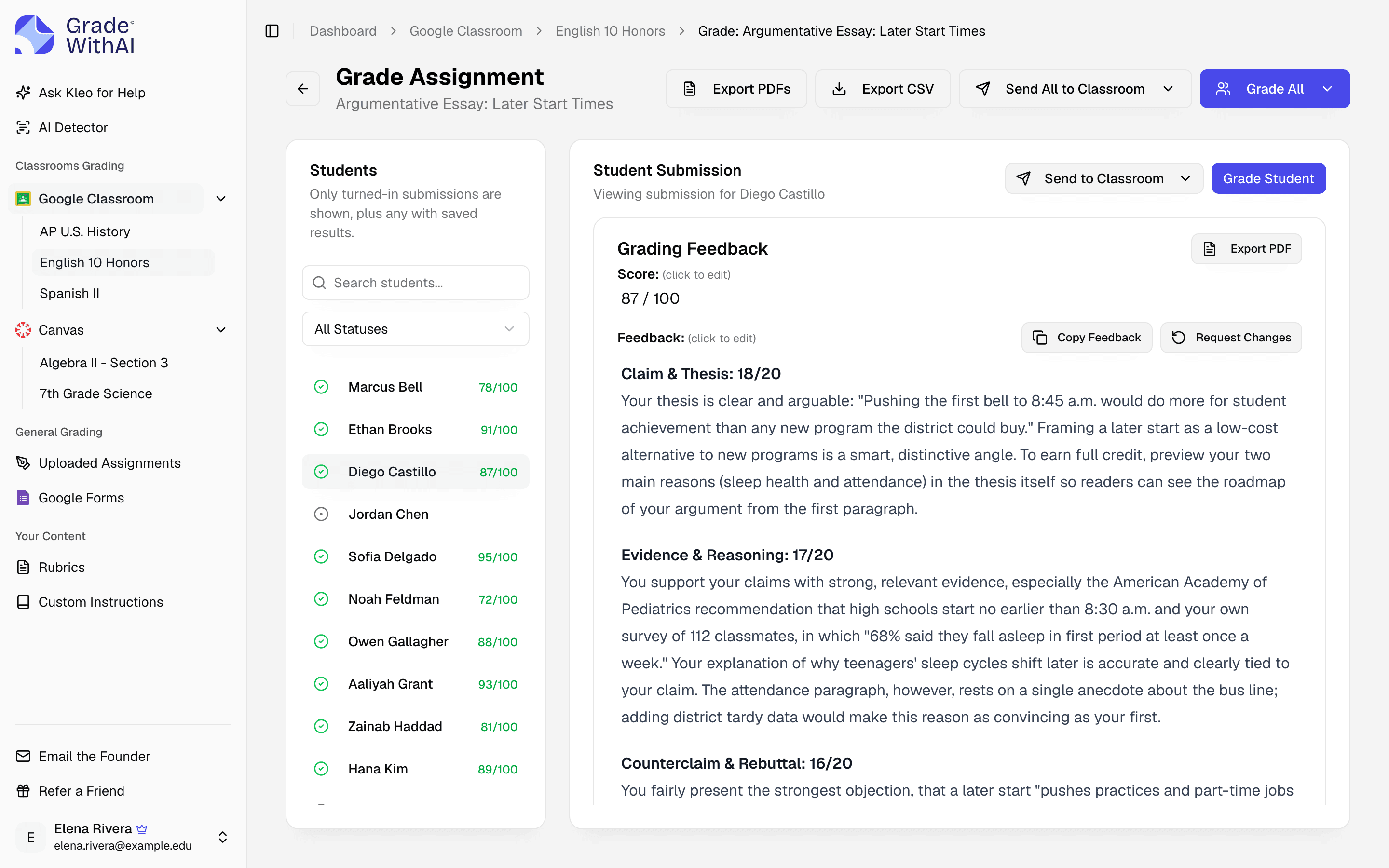
GradeWithAI grades essays, short answers, and handwritten work against your rubric and drafts feedback you review before students see it.
Grading a class set of essays? See how the AI essay grader works
An employment verification letter, usually issued by HR, confirms facts such as job title and dates. A reference letter is personal: the writer describes the candidate's work and recommends them. The generator drafts reference letters.
Many read the letter alongside the resume and then contact the writer to confirm details. Include your email or phone number in your document so they can reach you.
It writes only from what you enter: the person's name, the letter type, your notes (up to 5,000 characters), the tone, and optionally your name, title, and relationship. It is instructed not to invent details. Specific notes produce a specific letter, and vague notes produce a vague one. Read every sentence before you send it.
It can be, if you treat the draft like a template: every statement must be accurate and the final wording yours. Follow any AI policy from your school, employer, or the program receiving the letter.
Concrete examples: a project, a revised essay, a time they helped a classmate. Add how long you've known them, in what role, and what they're applying for. Your notes go to an AI model, so leave out details the letter doesn't need, such as health information or ID numbers.
Nine types: college, scholarship, job or internship, graduate school, awards nomination, character reference, character reference for court, immigration, and landlord. Four tones: formal, warm and professional, enthusiastic, and measured. The type changes the emphasis. A college letter stresses academic work; a job reference stresses work habits.
About one page, or 300 to 500 words, for most college, job, and scholarship letters. Graduate school letters can run longer. Follow any word limit or form the program gives you.
No. Copy it into your document or download the PDF, then edit and sign it there. To get a new draft, select New Letter; your entries stay in the form.
Only if your notes are generic. Real examples produce a letter about one person; a list of adjectives produces a letter about anyone. Edit the draft so it sounds like you.
Follow the instructions of the program receiving the letter and any AI policy at your school or workplace. Either way, the letter goes out under your name, so every statement should be accurate.
Yes, and it needs no account. Letters aren't saved, so copy the text or download the PDF before you leave the page.
Recommendation letters by type
Starting points with the letter type and form labels set for the request.
Recipients
- Letter of recommendation for student
- Letter of recommendation for graduate school
- Scholarship recommendation letter generator
- Letter of recommendation for coworker
- Letter of recommendation for a friend
- College recommendation letter generator
- Teacher recommendation letter generator
- Immigration recommendation letter generator
- Medical school recommendation letter generator
Personal
Grade your students' essays with GradeWithAI
21,000+ teachers use GradeWithAI to grade essays, tests, and handwritten work, and report saving 10+ hours a week.
The free plan grades 25 submissions every 30 days. No credit card.
Reported by teachers using GradeWithAI, with feedback on every submission they grade.