Free thesis statement checker
Paste a thesis statement to see whether it makes an arguable claim, is specific enough, fits the essay, and signals the reasons you'll develop. You get a score for each, notes on what to fix, and revised versions to try.
Free · No account · Any essay type · Download as PDF
0/2,000 characters
Tip: Add the essay prompt so the checker can tell whether your thesis answers it.
GradeWithAI is used by 21,000+ teachers, including teachers at
A score for each part of the thesis, and revisions to try
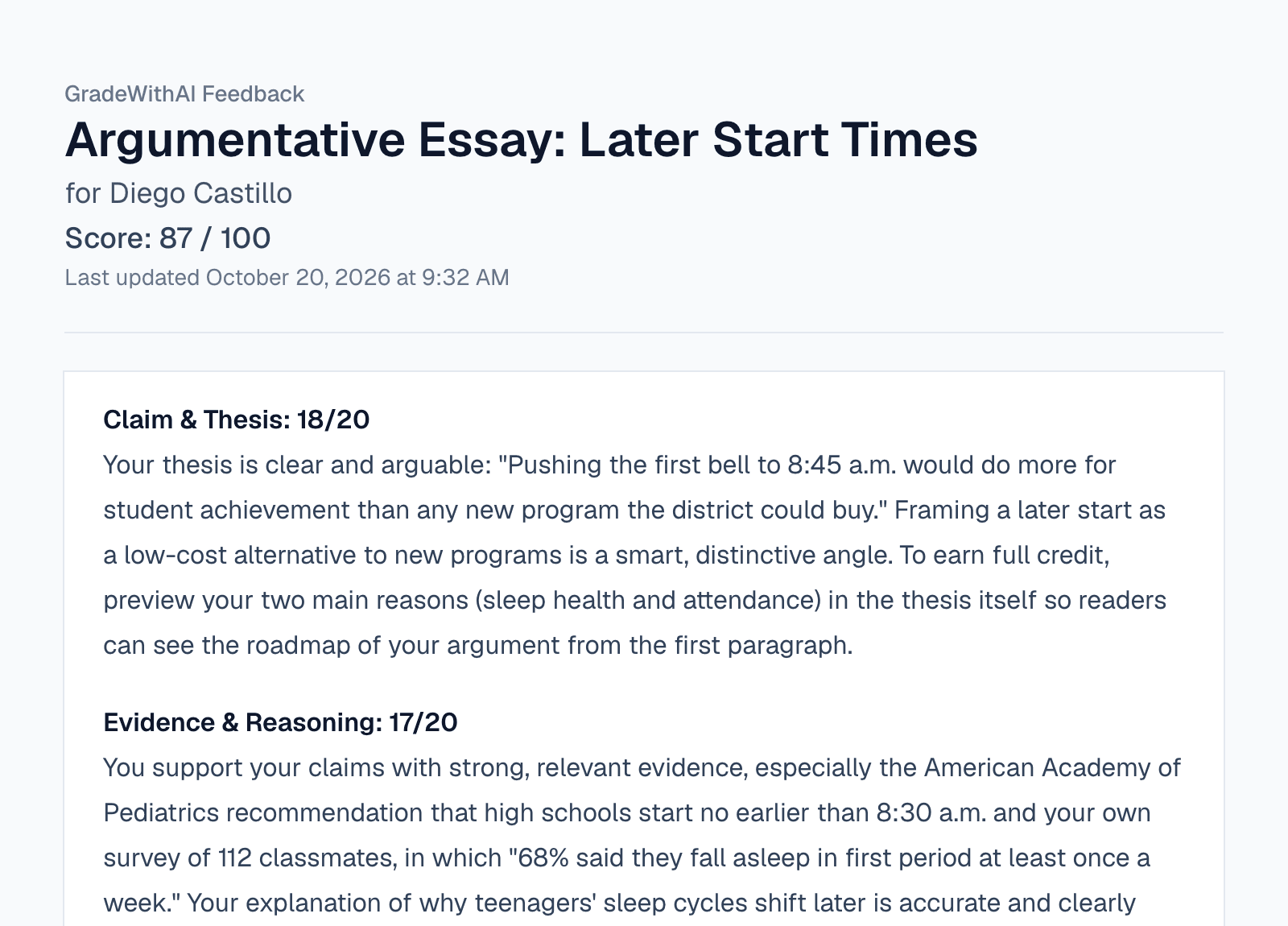
The checker says which part of the thesis is weak and why, then shows stronger versions that keep your position.
Overall
13/20
The thesis takes a clear side on school start times and names a specific change. "Better for students" is too vague to argue, though, and the thesis doesn't name the reasons the body paragraphs will prove.
Strengths
- It takes a position a reader could disagree with: high schools should start later.
- It names a specific change, "8:30 a.m.", instead of a vague "later."
Suggestions for revision
- "Better for students" could mean anything. Name the two or three benefits your body paragraphs will prove.
- Try: "High schools should start at 8:30 a.m. because teenagers would get the sleep pediatricians recommend, miss fewer first-period classes, and drive to school more alert."
- Try: "Moving high school start times to 8:30 a.m. would do more for students' health than any new wellness program, because it targets the sleep loss behind many of their problems."
By criterion
Arguable claim
4/4
School boards debate this, so it's a real position rather than a fact or an announcement.
Specificity
2/4
The change is specific, but the reason is not. "Better" doesn't tell the reader what you will prove.
Scope
3/4
Start times fit a five-paragraph essay. "Students" is broad; "teenagers" matches the sleep research you're likely to cite.
Clarity
3/4
Easy to follow in one read. "It would be" leaves the subject unclear; "a later start would be" fixes that.
Reasons
1/4
No reasons are named, so the reader can't predict what each body paragraph will argue.
What the thesis check covers
- An arguable claim
- Whether the thesis takes a position someone could disagree with, rather than stating a fact or announcing a topic.
- Specific and right-sized
- Whether the claim is narrow enough to prove in the essay you're writing, and precise enough to argue.
- Clear reasons
- Whether the thesis tells the reader what the body paragraphs will prove, in an order the essay can follow.
- Revisions that keep your argument
- One or two rewritten versions that keep your topic and position, so you can compare them with your own.
What makes a strong thesis statement?
A strong thesis statement makes a claim someone could disagree with, says it specifically enough to prove in the space you have, and tells the reader the reasons the essay will develop. Weak thesis statements usually fail in one of three ways: they state a fact, they announce a topic, or they are too broad to prove.
Weak and strong thesis examples
The same topic can produce a thesis that goes nowhere or one that sets up the whole essay.
Announces a topic: "This essay is about school start times."
States a fact: "Many high schools start before 8 a.m."
Too broad: "Schools should change to help students."
Strong: "High schools should start at 8:30 a.m. because teenagers would get the sleep they need, miss fewer first-period classes, and drive to school more alert."
When to check your thesis
Check it before you outline, and again after you finish the draft. A thesis often shifts as you write, so make sure the final version matches what your body paragraphs actually argue.
Who uses it
Middle school, high school, and college students check a thesis before drafting, and teachers use it for a quick second opinion during writing conferences. For feedback on the full essay, use the essay checker.
How the thesis checker works
- 1
Paste your thesis
One or two sentences. Choose your grade level.
- 2
Add the prompt
Optional. The checker tells you whether the thesis answers it.
- 3
Revise and check again
Results take about 20 seconds. Try a revision, then check the new version.
Teachers: grade the essays that follow
The thesis checker reads one statement. GradeWithAI grades every essay in an assignment against your rubric, thesis included.
Sync assignments from Canvas, Google Classroom, or Google Forms, or upload files from any other LMS
Reads typed work and handwritten pages from scans or phone photos
Edit any score or comment before students see it
Send scores and comments back to Canvas or Google Classroom, or export a CSV
Grading a class set of essays? See how the AI essay grader works
Five things: whether the thesis makes an arguable claim, whether it is specific, whether its scope fits the essay, whether it is clear, and whether it signals the reasons the essay will develop. Each is scored out of 4, for a total out of 20.
It suggests one or two revised versions that keep your topic and your position, so you can see what a stronger thesis looks like. It doesn't pick a side or change your argument.
Argumentative, persuasive, analytical, expository, compare-and-contrast, and literary analysis essays, and research papers. Personal and narrative essays usually don't need a formal thesis.
Paste only the thesis, up to 2,000 characters. To get feedback on the whole essay, use the free essay checker.
Yes. A thesis can be strong in general and still miss the question. Add the prompt and the checker tells you whether the thesis answers it.
Yes, with no account. Check as many drafts of your thesis as you like.
It is sent to an AI model to write the feedback, and nothing is saved to an account.
Yes, students can use it on their own without an account. When the essays come in, GradeWithAI grades the whole class set in Google Classroom, Canvas, or any LMS, and you review every score before students see it.
Teachers: grade the whole class set
21,000+ teachers use GradeWithAI to grade essays, tests, and handwritten work, and report saving 10+ hours a week.
The free plan grades 25 submissions every 30 days. No credit card.
Reported by teachers using GradeWithAI, with feedback on every submission they grade.