The AI SAQ grader for short-answer questions at scale
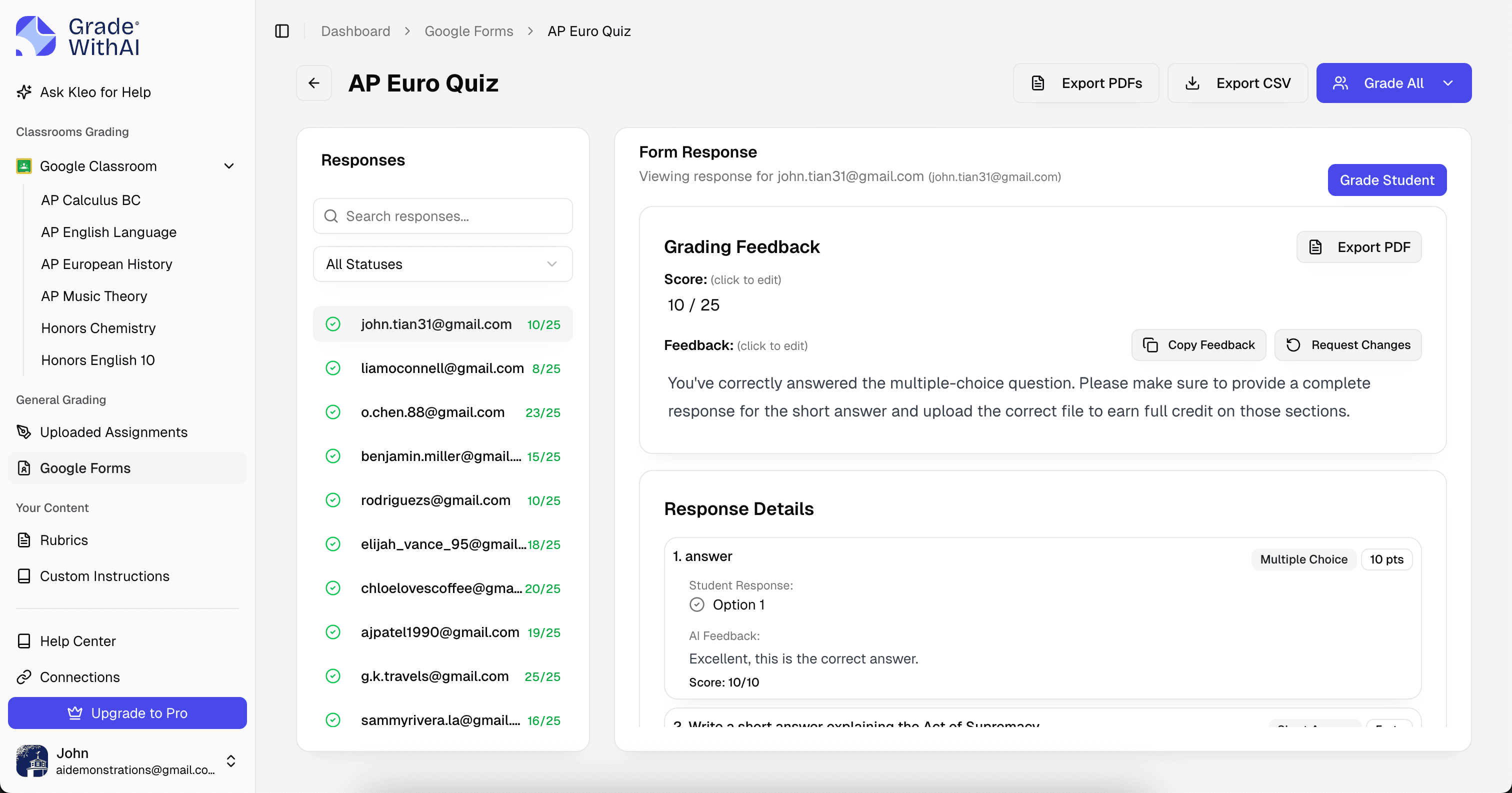
From AP short-answer questions to exit tickets and unit quizzes, grade constructed responses in bulk with semantic matching and per-question accuracy flags. Students who phrase things differently still get credit when both answers are right.
Free plan · Semantic grading, not keyword matching · Works across subjects
Trusted by 10,000+ teachers for SAQ grader
Why teachers need an AI SAQ grader
Short answers are short. The stack is not.
A history teacher with five sections collects 150 short-answer responses on a typical Thursday — plus AP SAQs on top if they teach APUSH or AP World. At 45 seconds per response, that is two hours of reading, mostly to write the same three comments. Keyword-matching tools get it wrong because students phrase correct answers in hundreds of ways. You need an AI SAQ grader (or short answer grader) that actually reads what the student wrote.
- Volume is the real problem
- One short answer per student per day across five sections is 150 responses. A week of that is 750 responses — the majority of weekly grading for most teachers.
- Keyword matching fails
- “The Columbian Exchange spread diseases” and “epidemics decimated indigenous populations” are the same answer, phrased differently. A grader that only matches keywords punishes the stronger writer.
- Accuracy needs to be flagged
- A wrong date, wrong figure, or wrong region changes the meaning of the answer. Feedback has to name the specific error, not deduct from a total and leave the student guessing.
Semantic short-answer grading
The AI short answer grader that reads meaning, not just keywords
The AI SAQ grader evaluates semantic match against the expected answer, not surface keyword overlap. Students who paraphrase, synthesize across sources, or use advanced vocabulary get full credit when the underlying claim is correct. Students who string the right keywords together without coherent reasoning get partial credit and specific feedback explaining the gap.
- Question 1
- 92%
- On track
- Question 2
- 78%
- On track
- Question 3
- 41%
- Reteach
- Question 4
- 85%
- On track
- Question 5
- 36%
- Reteach
- Question 6
- 69%
- Watch
Reteach focus · Questions 3 and 5 flagged for class-wide review tomorrow.
- Paraphrase recognized as correct
- Two answers that mean the same thing get the same score — even when the wording is completely different.
- Per-question accuracy flags
- Factual errors (wrong date, wrong name, wrong region) are flagged with the specific correction, separate from the rubric score.
- Rubric-aligned comments
- Every comment ties back to the rubric criterion — specificity, accuracy, evidence use — so students know what to improve, not just that they missed points.
Example rubric
A scalable short-answer rubric
A general three-criterion rubric the AI uses when no other rubric is provided. Swap in an AP SAQ rubric (A/B/C parts), a state assessment rubric, or your own.
SAQ grader rubric · AI-generated
Accuracy
2 ptsFactual content of the response is correct.
- Strong
- All factual claims are correct and specific to the question.
- Developing
- Most claims are correct; one or two have minor factual slips.
- Beginning
- Significant factual errors or answer is off-topic.
Specificity
2 ptsResponse names specific examples, evidence, or details rather than general statements.
- Strong
- Cites specific examples, evidence, or details that directly support the answer.
- Developing
- Some specifics are present but the response leans on generalities.
- Beginning
- Only general statements — no specific evidence or example.
Task fit
1 ptResponse addresses what the question actually asks.
- Earned
- Directly answers the specific question, including every part.
- Not earned
- Partially off-prompt, addresses only part of the question, or answers a different question.
Per-question analytics
See exactly which question the class missed
After every short-answer set, the dashboard shows class-wide performance per question. Which question did 70% of the class get wrong? Which one did the whole class nail? That is what you need for tomorrow's mini-lesson — not a single aggregate quiz score.
Project total
83 / 100
- Research & evidence
- 70%
- Written product
- 88%
- Visual / creative
- 96%
- Creativity & originality
- 80%
Feedback pack · Student sees per-component scores and which component dragged the grade down.
- Per-question distribution
- See the score distribution and common errors for every question in the set, at a glance.
- Common error patterns
- The AI groups similar errors — e.g., ten students who all confused the Columbian Exchange's effect on Europe vs. the Americas — so you can address the misconception directly.
- Student-level trends
- Follow individual students across weeks: which rubric criterion are they landing on, which one still needs work?
Sample AI feedback
Credit for the real answer, feedback for the real gap
Here is an AP US History SAQ response graded against the three-part SAQ rubric. Notice the comment treats the paraphrase as correct content, then names the specificity gap rather than deducting for vocabulary choice.
Assignment prompt
Identify ONE specific historical continuity in immigration policy in the United States between 1880 and 1924.
Student submission
Between 1880 and 1924, the United States kept limiting who could come to the country based on where they were from. Laws were passed that stopped certain groups from immigrating.
AI feedback · Specificity (part B)
1 / 2Part A (identify) is earned: “limiting who could come to the country based on where they were from” correctly names an ethnic/national-origin pattern of restriction, which is a valid continuity across this period. Part B (specific evidence) is not earned because no specific law, event, or figure is named. The AP SAQ rubric requires at least one concrete historical reference to earn this point — mentioning the Chinese Exclusion Act of 1882 or the National Origins Act of 1924 would be sufficient.
Revision tip · The continuity identified — ethnic/national-origin-based restriction — is correct and would earn part A on the AP SAQ rubric. But the SAQ rubric part B requires a specific historical example: naming the Chinese Exclusion Act (1882), the Immigration Act of 1917, or the Immigration Act of 1924 would earn the second point.
- Quotes the student's actual work
- Feedback points to specific sentences and claims the student wrote, not vague impressions.
- Names the rubric language
- Comments reuse the criteria you set, so students learn what the rubric actually asks for.
- Suggests a concrete revision
- Every comment ends with a specific next step the student can take on the next draft.
Built for SAQ grader
Every detail, handled
- AP SAQ rubrics built in
- AP US History and AP World History SAQ rubrics (A/B/C part structure) are pre-loaded. Swap in custom rubrics for on-level or middle school short answers.
- Cross-subject coverage
- Works for history, science, ELA, civics, geography, world language — anywhere short constructed responses appear. The grader matches content against what the rubric defines.
- Handwritten support
- Scanned short answers and photographed exit tickets are transcribed before grading, so paper-and-digital mixed classes land in one queue.
- LMS sync
- Push scores and per-question comments to Canvas, Google Classroom, or Schoology in one click.
Why teachers switch
The AI SAQ grader that makes daily short answers sustainable
Short-answer grading is the most frequent, most volume-heavy, most repetitive grading teachers do — and the first thing to disappear when the week gets busy. As your AI SAQ grader, GradeWithAI makes daily short answers sustainable, which is the only cadence where they actually teach anything.
Grade 150 short answers faster than a coffee break
Semantic matching, not keyword matching
Accuracy flags named specifically, not hidden in the score
AP SAQ rubric structures pre-loaded (APUSH, AP World)
Per-question class analytics for next-day reteaching
Editable scores and comments before grades post
“Students have also appreciated the consistency and immediacy of the feedback I can provide through GradeWithAI. This has enabled them to make necessary corrections and achieve their desired scores on any assignment.”

Why it matters for SAQ grader
Short-answer grading is the most frequent, most volume-heavy, most repetitive grading teachers do — and the first thing to disappear when the week gets busy. As your AI SAQ grader, GradeWithAI makes daily short answers sustainable, which is the only cadence where they actually teach anything.
How short-answer grading works
From collected to graded in one prep period
The same three steps whether the short-answer set is a four-question exit ticket or an eight-question AP SAQ practice.
- 1
Set the question and rubric
Pick a pre-loaded AP SAQ rubric, use your own, or generate one from the question. The AI uses it identically for every response.
- 2
Upload responses
Scan exit tickets, import from Google Forms or Canvas, or drag in files. Mixed paper and digital classes go in one queue.
- 3
Review and return
Scores and comments are drafted per question. Approve, edit, or rewrite, then sync grades to your gradebook.
Also covered
Short-answer grading across courses
Different courses use short answers differently. Same grader, different rubric:
- APUSH SAQs
- AP US History short-answer questions graded against the three-part SAQ rubric with period-aware evidence checks.
- AP World SAQs
- AP World: Modern short-answer questions graded with regional and period-specific evidence verification.
- AP FRQs
- AP Biology, Chemistry, Physics, Stats, Gov, and Psych free-response questions graded point-by-point.
- History short answers
- On-level and pre-AP history short-answer questions graded with historical-thinking skill rubrics.
Simple, transparent pricing
Start free and upgrade when you’re ready.
Free
Perfect for trying out AI grading.
- 25 AI requests/month
- Google Classroom integration
- Canvas integration
- Google Forms grading
- Handwritten assignment support
- AI rubric generation
- Unlimited Kleo AI assistant
Pro
Unlimited grading for dedicated educators.
- Unlimited AI requests
- Automated submissions grading
- AI detection on every submission
- Custom instructions
- Everything in Free
Schools & Districts
CustomEnterprise features for your entire school.
- Bulk user management
- Admin dashboard & analytics
- SSO / SAML authentication
- Dedicated onboarding & training
- Everything in Pro
Secure by design.
Built for K-12.
FERPA-aligned workflows, encryption everywhere, and no student data in model training. Ready for your district’s IT review from day one.
- FERPA-aligned
- SOC 2 practices
- AES-256 at rest
- TLS 1.2+ in transit
- Role-based access
- No AI training
- FERPA-aligned by default
- Role-based access and audit trails protect student submissions and grades.
- Never used for training
- Student work is processed for grading only — never used to train AI models.
- District-ready docs
- Security documentation and procurement support ready for your IT team.
Questions, answered
SAQ grader FAQ
Answers to the questions we hear most from teachers using GradeWithAI for SAQ grader. Start a free account and explore in minutes, or email john@gradewithai.com for a fast reply.
Yes. AP US History and AP World History SAQ rubrics (with A/B/C part structure) are built in. Each part is evaluated independently, so students can earn 1 of 3 on an APUSH SAQ for getting the identification right but missing the specificity point.
By assignment
More grading guides


Ready to try the AI short answer grader that actually reads the answers?
Teachers who move daily short-answer grading to GradeWithAI report reading every response instead of skimming. That is what moves student writing — and that is what short answers were supposed to do.
Free plan available · No credit card required
Teachers using GradeWithAI report grading in a fraction of the time, with richer feedback for every student.