Handwriting worksheet generator
Handwriting practice lists of letters, words, and sentences for students to copy. The generator writes text only, so print it or copy it onto lined paper.
Free · No account · Up to 40 items · Answer key included
Tip: Describe the specific skill or topic. The generator calibrates complexity to the grade level you pick.
GradeWithAI is used by 21,000+ teachers, including teachers at
What the worksheet generator does
- Any subject and skill
- Math facts, vocabulary, grammar, reading questions, science terms. Describe the format you want.
- 1 to 40 items
- Set the number of items, the grade, and easy, medium, or hard difficulty.
- Answer key on its own page
- Turn the key on for your copy or off for the student handout.
- Print or copy
- Print or save the worksheet as a PDF, or copy the text into your own document.
What is a handwriting worksheet?
A handwriting worksheet gives students letters, words, or sentences to form by hand, usually on lined paper with room to repeat each one. This generator writes that content for the grade you choose, with two writing lines under each item and an optional answer key.
Why early handwriting practice matters
Common Core asks kindergartners to print many upper- and lowercase letters (L.K.1a) and first graders to print all of them (L.1.1a). Studies by Karin James and colleagues at Indiana University found that children who practiced letters by hand showed stronger brain responses to letters than children who typed.
Builds the fine-motor control needed for pencil grip, cutting, and buttoning
Makes letter formation automatic, so attention can go to spelling and composing
Reinforces letter recognition for students who still confuse b and d or p and q
What the generator can and can't make for handwriting
Ask for letters grouped by how they're formed, short CVC words, or sentences to copy. It cannot draw letters to trace, add stroke arrows, or set line ruling; the PDF is plain text in a standard font. For tracing pages, type the list into a tracing font.
Straight-line letters: l, t, i
Round letters: c, o, a
Letters with tails: g, j, y
Pairing handwriting practice with your literacy block
Many K–1 teachers run handwriting as a 10-minute morning task or a small-group rotation. Match the letters to the week's phonics focus: if you're teaching /s/ on Tuesday, ask for lowercase s and words that start with it (sun, sit, see), copied three times each.
How the worksheet generator works
- 1
Describe the worksheet
Name the skill, the format, and any context, such as 2-digit multiplication word problems about sports.
- 2
Set the details
Grade, difficulty, and number of items. It usually takes 10 to 20 seconds.
- 3
Print
Print with or without the answer key, or copy the items into your own document.
What teachers say
Teachers across subjects, from AP history to astrophysics, on grading with GradeWithAI.
“I've really enjoyed using the GradeWithAI program. It saves me a ton of time, especially when I have class sizes of 35 or 36 students times five.”

“GradeWithAI doesn't just grade. It gives the student reasoning as to why every point is awarded or not awarded. That is a very valuable thing for the students.”

“More impressive though is that it corrects student answers not simply using a pre-written answer, but by following the thought process they've pursued.”

“For Chadwick users, GradeWithAI has improved feedback efficiency and effectiveness, as it is grounded in existing platforms and is highly adaptable.”

“GradeWithAI [provides] students with timely individualized feedback on their homework assignments and formative assessments. This is a job that is virtually impossible for a teacher to do on a regular basis.”

“Students have also appreciated the consistency and immediacy of the feedback I can provide through GradeWithAI. This has enabled them to make necessary corrections and achieve their desired scores on any assignment.”

Grading the completed worksheets?
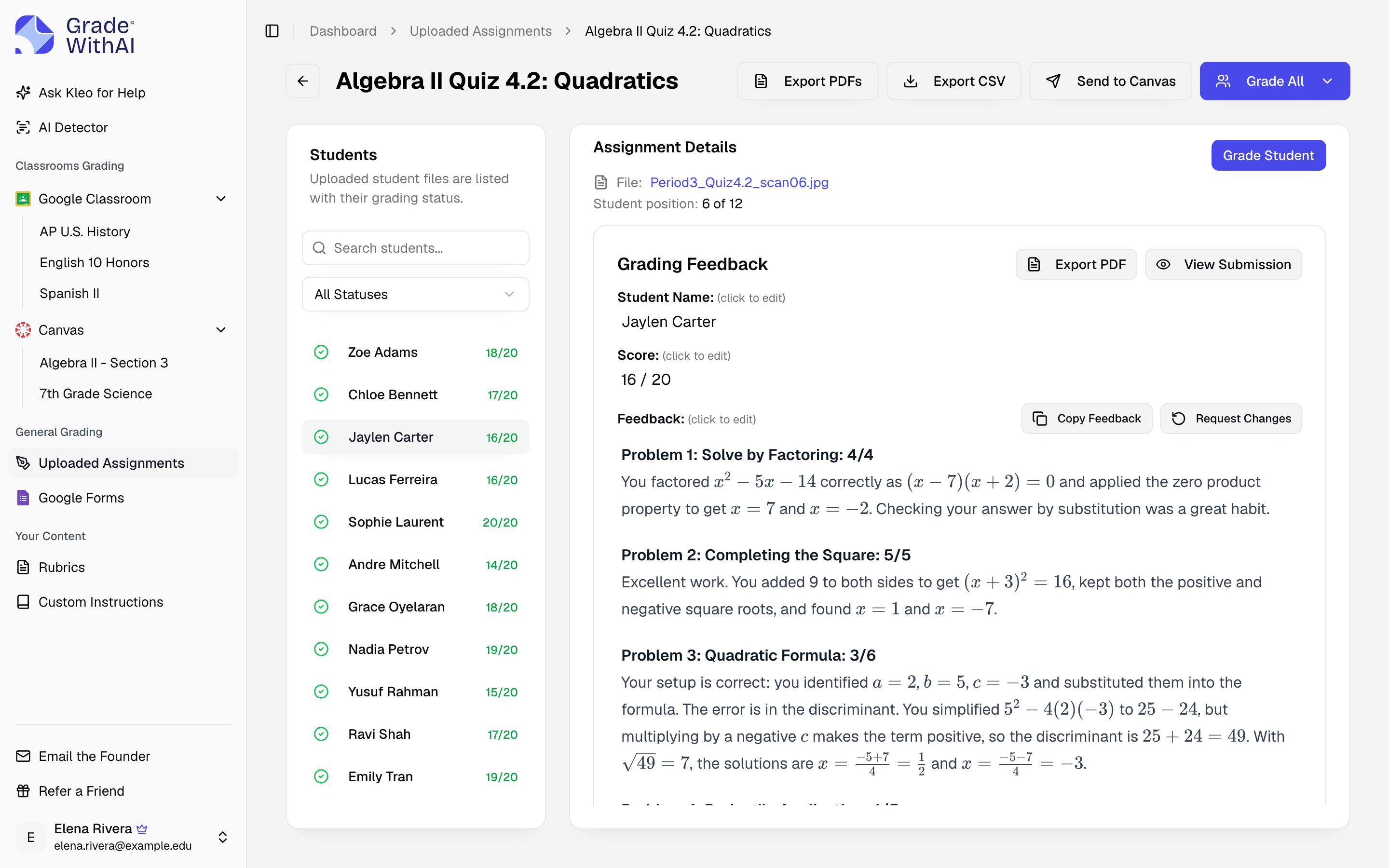
Scan or photograph the completed worksheets and upload them to GradeWithAI with your answer key. It reads handwriting, grades each item, and you review every score before it posts.
Students working on paper? See how GradeWithAI grades handwritten work
No. The PDF prints each item as plain text in a standard font with two plain writing lines underneath. Use the generator for the letter and word lists, then have students copy them onto your own primary or tracing paper, or type the list into a tracing font in a word processor.
Yes. Name the letters, letter families, or words in the description (for example, 'lowercase b, d, p, and q, with three short words for each') and set the number of items. The generator writes those items, plus an answer key you can leave off.
Many kindergarten teachers practice two or three target letters per session, with several repetitions of each. Longer sets lead to tired hands, and the last attempts get sloppy. Set a low item count (6 to 10) for kindergarten and have students repeat each item on their own lined paper.
Any text-based format you describe: fill in the blank, matching, short answer, word problems, vocabulary in context, and math practice. It doesn't draw tracing lines, cursive letters, or pictures.
Yes. Print or save a PDF with the title, instructions, and numbered items with answer lines, or copy the text into your own document.
Yes. Every item has an answer. Leave the key on to print it on a separate page, or turn it off for a student-only copy.
Yes. Pick kindergarten through 12th grade and easy, medium, or hard.
Yes. Generate again for new items on the same skill, or change the difficulty to easy, medium, or hard to make versions for different groups.
From 1 to 40. The default is 12.
Yes, with no account.
Worksheet generators by grade and skill
Starting points with the grade and skill filled in.
By type
By subject
Grade the completed worksheets
21,000+ teachers use GradeWithAI to grade essays, tests, and handwritten work, and report saving 10+ hours a week.
The free plan grades 25 submissions every 30 days. No credit card.
Reported by teachers using GradeWithAI, with feedback on every submission they grade.