The AI writing grader for any genre or grade level
Not every writing assignment is a five-paragraph essay. Grade narratives, journals, short responses, reflections, letters, and lab write-ups against the rubric you already use — with quoted feedback from the student's own words and edits you can make before anything goes live.
Free plan · Works on any writing genre · K–12 and college
Trusted by 10,000+ teachers for writing grader
Why writing teachers need an AI writing grader
Writing grows faster than the time to grade it.
Good writing teachers assign writing often. Quick journals, short responses, one-pagers, exit tickets — these are how writing actually gets better. But daily writing at thirty students per section becomes a feedback bottleneck by Wednesday. Skip a round and the habit breaks; read them all and the weekend disappears. The only sustainable path is an AI writing grader that produces rubric-aligned feedback you can edit, not replace.
- Short writing adds up
- A paragraph per student sounds trivial until it is ninety paragraphs a day, five days a week. Most teachers stop reading them carefully — which defeats the point of assigning them.
- Genre variety, one rubric
- Narrative one week, argumentative the next, reflection the week after. Each needs different feedback, but the rubric you carry in your head is the same fatigued rubric by Friday.
- Feedback students will read
- A letter grade and a checkmark get glanced at. A comment that quotes the student's own sentence and suggests a specific next move is what actually moves the writing.
Rubric-matched writing feedback
An AI writing grader that uses the rubric you already teach from
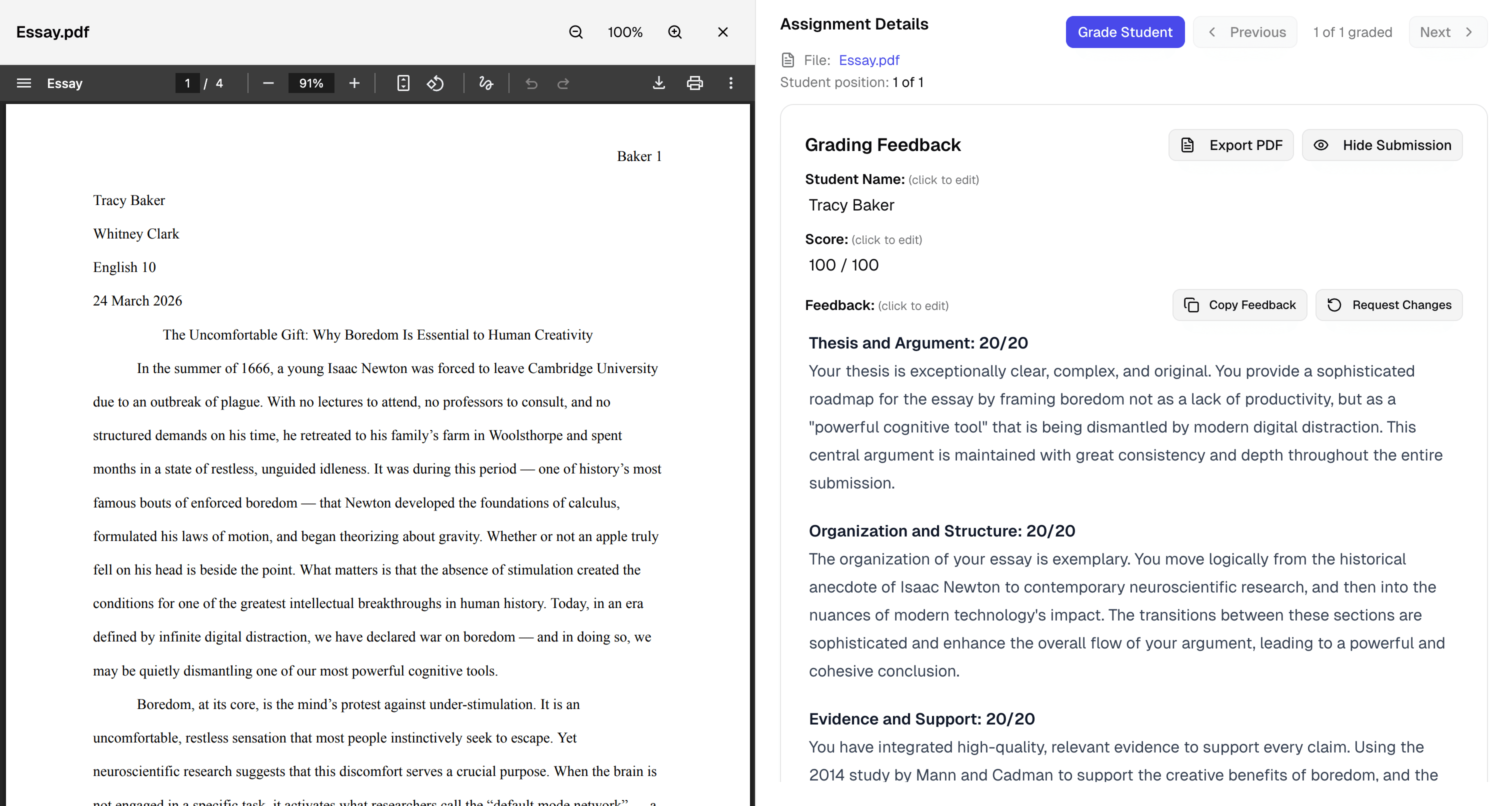
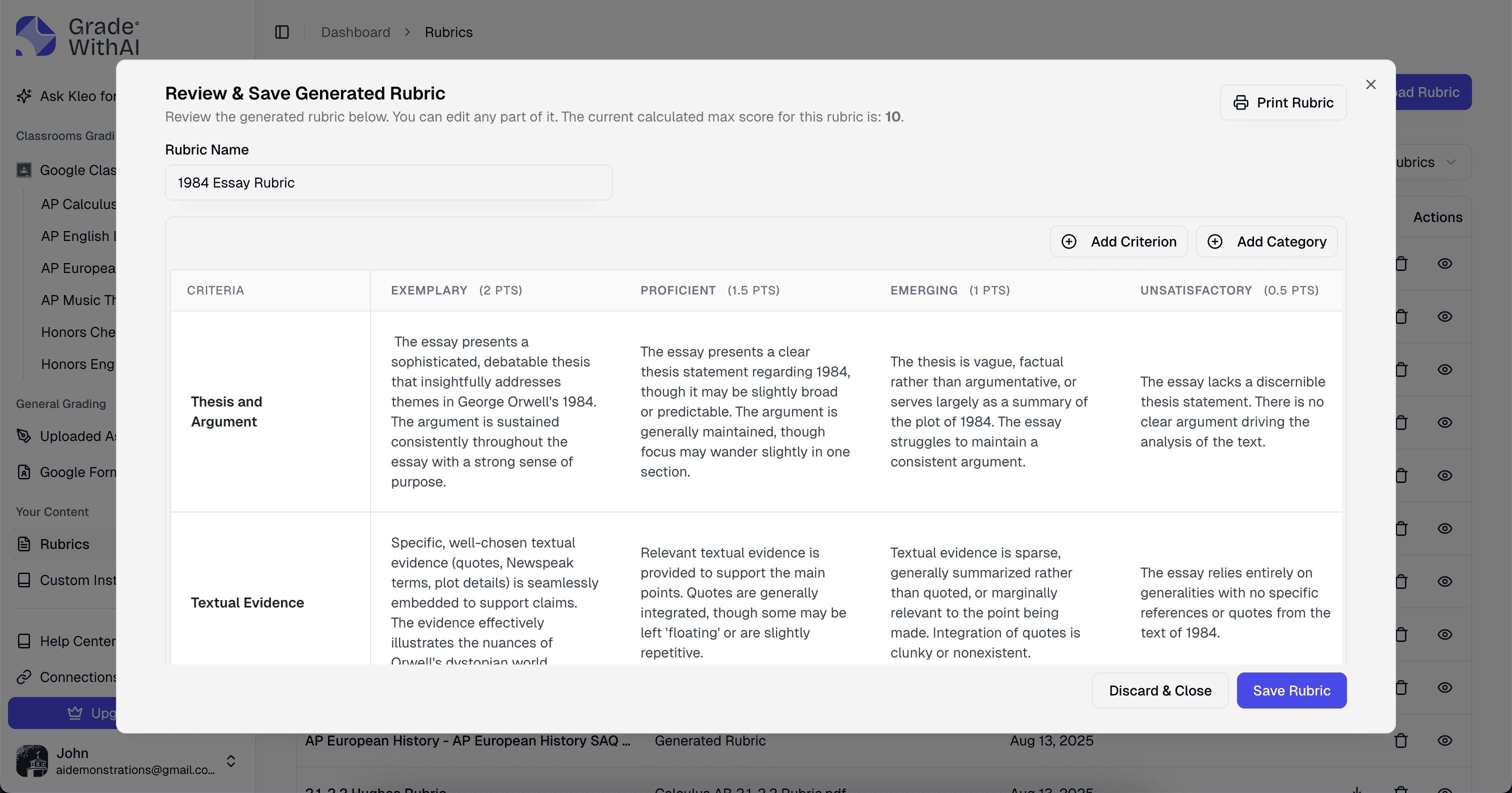
Paste in your writing rubric — narrative, expository, argumentative, informational, creative, whatever genre you teach — and the AI writing grader applies it. Each criterion is scored separately with a comment that quotes the student's own words. If you do not have a rubric for the genre, generate one from the assignment prompt and edit it before grading starts.
- Works on any genre
- Narrative, expository, argumentative, informational, literary analysis, reflection, free response, journal, letter, poem — the AI grades against the rubric, not a genre template.
- Quoted line-level feedback
- Every comment cites the sentence it is responding to, so students can trace criticism to their own writing rather than guessing which part the teacher meant.
- Editable before it ships
- Every score and comment is a draft. Edit, rewrite, or delete anything before feedback reaches students, and the system remembers your adjustments.
Example rubric
A general writing rubric that works across genres
Here is the default four-trait writing rubric the AI uses when you do not supply one. Swap in a genre-specific rubric, a state writing rubric, or a 6+1 Traits variant and the grading adjusts.
Writing grader rubric · AI-generated
Ideas & content
4 ptsClear purpose, specific details, and content that responds to the prompt.
- Strong
- Purpose is clear and supported by specific, relevant details that the reader can picture.
- Developing
- Purpose is present but details are thin, general, or only partly on-task.
- Beginning
- Purpose is unclear or off-prompt; details are vague or missing.
Organization
3 ptsLogical order, a clear opening, purposeful paragraphing, and a closing that lands.
- Strong
- Ideas build on each other; paragraphing is purposeful; the ending leaves the reader with something specific.
- Developing
- Basic structure with uneven transitions or a closing that only restates the opening.
- Beginning
- Order is unclear; paragraphs wander or run together.
Voice & word choice
3 ptsA distinct voice appropriate to the audience, with precise word choice.
- Strong
- Voice feels intentional and fits the audience; word choice is specific rather than generic.
- Developing
- Voice is present but inconsistent; word choice is serviceable but rarely specific.
- Beginning
- Voice is flat or inappropriate to the audience; word choice is generic throughout.
Conventions
2 ptsGrammar, spelling, and mechanics that support meaning rather than distract from it.
- Strong
- Minor errors that do not interfere with meaning; sentences are varied.
- Developing
- Errors are present but meaning is still clear in most places.
- Beginning
- Frequent errors disrupt meaning at multiple points.
AI detection on every piece
Know what the student actually wrote
Short writing is where AI-generated submissions hide in plain sight. Every piece — even a three-sentence exit ticket — runs through AI-use detection at grade time. Each submission gets a 0–100% AI score with a plain-language label alongside the rubric feedback, so you can address academic integrity in the same view as the writing feedback.
Words analyzed: 1,247
Text used for detection
The rapid proliferation of digital platforms has fundamentally altered the landscape of modern discourse, necessitating a reevaluation of longstanding epistemic frameworks.

In my experience, social media makes it easier to find people who think like me, but harder to meet people who don't.

Furthermore, the implications of this paradigm shift extend beyond mere communication into the very structure of civic engagement itself.
- Sentence-level highlights
- The specific sentences most likely to be AI-generated are marked in the piece, not just a single score for the whole submission.
- Built into grading
- Detection runs in parallel with the rubric pass — no separate workflow, no second tool, no added cost on the free plan.
- Teacher in the loop
- AI-use results are signals, not verdicts. You decide how to handle flagged work and can add context to the student comment before anything goes live.
Sample AI feedback
Feedback that shows the student where to cut and what to add
Here is the AI feedback on a short narrative opening. Notice the comment quotes the student's own sentence, names the rubric trait, and suggests one concrete revision — not a paragraph of generic praise.
Assignment prompt
Write a one-page personal narrative about a moment that changed the way you see yourself. Focus on a single scene rather than a whole story.
Student submission
It was a really hot day in the summer. I was playing with my friends outside and we were having a lot of fun. Then something happened that changed everything for me.
AI feedback · Ideas & content
2 / 4The opening is present but lands in the “Developing” band. “Really hot day” and “having a lot of fun” are both general — they could describe any summer afternoon. The reader cannot picture this day specifically. The last sentence also tells instead of shows: “something happened that changed everything” is a summary, not a scene. A narrative this short needs the change to live inside the reader's view of the scene, not be announced.
Revision tip · Try opening on the specific moment rather than the weather: “My knees hit the gravel before my brain caught up.” A narrative that starts inside the scene trusts the reader to orient themselves as they read.
- Quotes the student's actual work
- Feedback points to specific sentences and claims the student wrote, not vague impressions.
- Names the rubric language
- Comments reuse the criteria you set, so students learn what the rubric actually asks for.
- Suggests a concrete revision
- Every comment ends with a specific next step the student can take on the next draft.
Built for writing grader
Every detail, handled
- Any length, any grade level
- From a K–2 sentence journal to a senior capstone essay, the rubric complexity scales and the AI grades against the expectations you set.
- Handwritten writing supported
- Scan composition books or photograph notebook pages and the AI transcribes the writing before grading — no manual retyping.
- Revision-friendly mode
- Flip a toggle and students can resubmit after reading their feedback. The AI grades the new version against the same rubric, side-by-side with the original.
- Class-wide trend view
- See which rubric traits the whole class is landing on and which ones need a targeted mini-lesson tomorrow, without reading every piece twice.
Why teachers switch
The AI writing grader that lets you assign more writing, not less
When grading short writing takes five minutes per piece instead of one, teachers stop assigning it. GradeWithAI works as your AI writing grader across every genre — narrative, argumentative, reflection — so the feedback cost collapses and the writing habit is sustainable at the cadence writing actually improves at.
Grade a day's journals in under ten minutes per class
Quoted evidence for every rubric score
Same rubric used every time, across every section
AI-use detection on every submission at no extra cost
Handwritten and digital writing land in the same queue
Every score editable before feedback goes to students
“For Chadwick users, GradeWithAI has improved feedback efficiency and effectiveness, as it is grounded in existing platforms and is highly adaptable.”

Why it matters for writing grader
When grading short writing takes five minutes per piece instead of one, teachers stop assigning it. GradeWithAI works as your AI writing grader across every genre — narrative, argumentative, reflection — so the feedback cost collapses and the writing habit is sustainable at the cadence writing actually improves at.
How writing grading works
Three steps from assigned to graded
Setup happens once per rubric. After that, a full class of writing is a ten-minute review, not a Sunday-night marathon.
- 1
Pull in the writing
Import from Canvas, Google Classroom, or Google Forms, or drag in files and photos. Mixed digital and paper classes land in one queue.
- 2
Lock the rubric
Use your own rubric, generate one from the prompt, or pick the default four-trait rubric. The AI uses it identically for every piece.
- 3
Review and return
Scores and comments are drafted for you. Approve, edit, or rewrite, then push everything to your gradebook in one click.
Also covered
Writing feedback for every genre you teach
Different genres need different rubrics. The same grader handles them all — just swap the rubric in.
- Essay grading
- Formal essays — argumentative, narrative, analytical, synthesis — graded against your rubric with line-level feedback.
- Short-answer grading
- Short constructed-response questions scored for accuracy and specificity at scale across history, science, and ELA.
- AP Lang essays
- Rhetorical analysis, argument, and synthesis essays graded against the College Board 6-point rubric.
- History essays
- Analytical and argumentative history writing graded with historical-thinking skill rubrics.
Simple, transparent pricing
Start free and upgrade when you’re ready.
Free
Perfect for trying out AI grading.
- 25 AI requests/month
- Google Classroom integration
- Canvas integration
- Google Forms grading
- Handwritten assignment support
- AI rubric generation
- Unlimited Kleo AI assistant
Pro
Unlimited grading for dedicated educators.
- Unlimited AI requests
- Automated submissions grading
- AI detection on every submission
- Custom instructions
- Everything in Free
Schools & Districts
CustomEnterprise features for your entire school.
- Bulk user management
- Admin dashboard & analytics
- SSO / SAML authentication
- Dedicated onboarding & training
- Everything in Pro
Secure by design.
Built for K-12.
FERPA-aligned workflows, encryption everywhere, and no student data in model training. Ready for your district’s IT review from day one.
- FERPA-aligned
- SOC 2 practices
- AES-256 at rest
- TLS 1.2+ in transit
- Role-based access
- No AI training
- FERPA-aligned by default
- Role-based access and audit trails protect student submissions and grades.
- Never used for training
- Student work is processed for grading only — never used to train AI models.
- District-ready docs
- Security documentation and procurement support ready for your IT team.
Questions, answered
Writing grader FAQ
Answers to the questions we hear most from teachers using GradeWithAI for writing grader. Start a free account and explore in minutes, or email john@gradewithai.com for a fast reply.
Anything from a three-sentence exit ticket to a ten-page research paper. Narrative, expository, argumentative, reflection, journal, letter, creative, literary analysis — if you have a rubric, the AI grades against it. If you do not, the AI generates one from the assignment prompt.
By assignment
More grading guides


Ready to try the AI writing grader that scales with your rubric?
Teachers using GradeWithAI for writing report assigning more, reading more carefully, and giving better feedback than before — not less of any of those.
Free plan available · No credit card required
Teachers using GradeWithAI report grading in a fraction of the time, with richer feedback for every student.