The AI FRQ grader for every AP course
Score AP free-response questions against the College Board rubric for every AP course that uses FRQs — Biology, Chemistry, Physics, Statistics, Government, Psychology, Calculus, and more. Point-by-point feedback that names the exact rubric element the student earned or missed.
Free plan · Aligned to current College Board FRQ rubrics · All FRQ AP courses
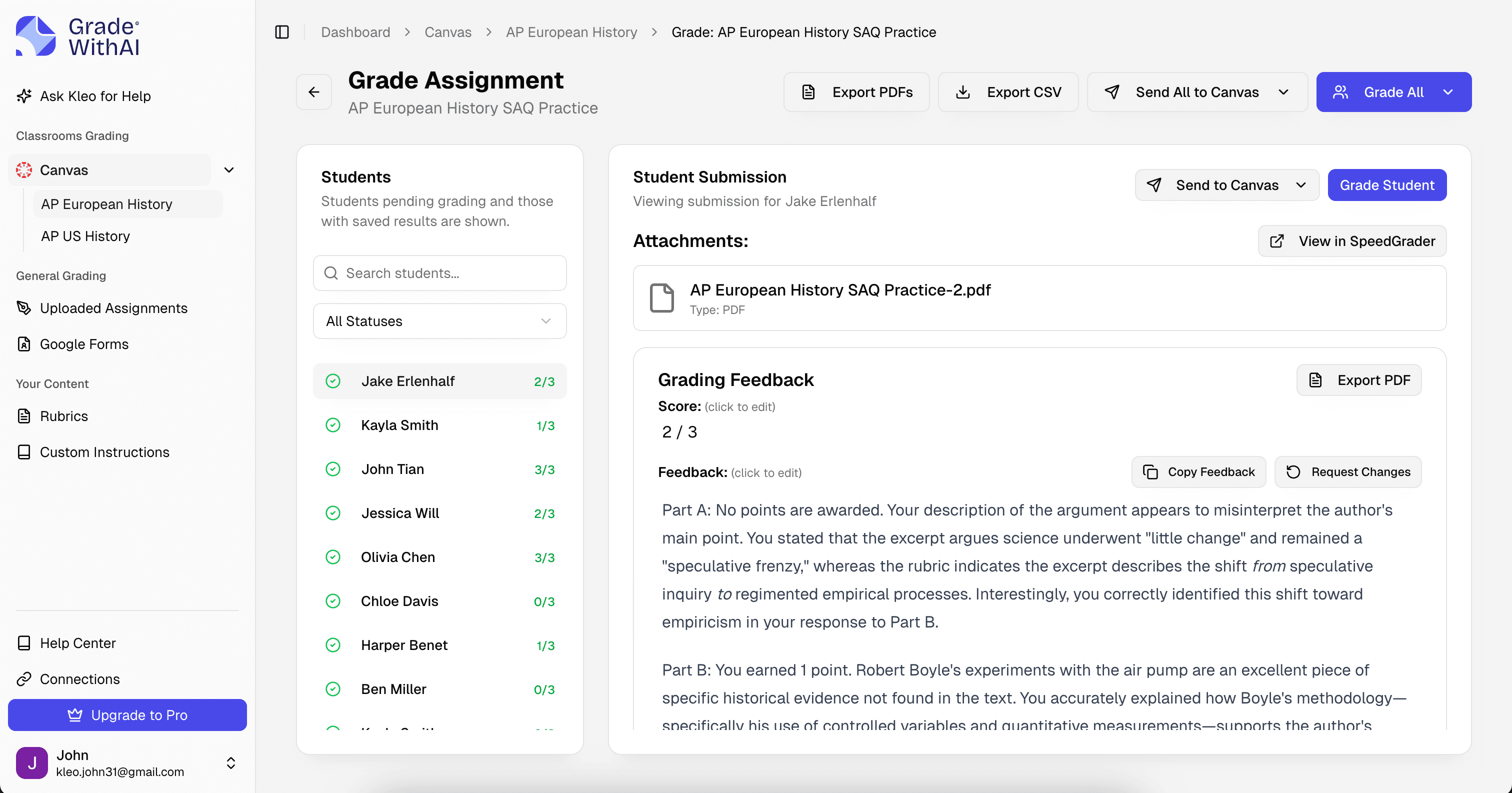
Trusted by 10,000+ teachers for FRQ grader
Why AP teachers need an AI FRQ grader
Every FRQ has a rubric. Every rubric has five to ten points.
An AP Biology teacher with 90 students across three sections grades 90 FRQs after every practice — times the four to six FRQs per unit. By April, that is well over a thousand rubric-scored responses. An AI FRQ grader is the only way to name which specific rubric element each student attempted, because hand-grading at that depth is what causes AP teachers to cut practice frequency in half by spring.
- Rubric elements are precise
- An AP Bio FRQ might have eight rubric points, each earned only if the student does a very specific thing. Generic feedback cannot teach students what those specific moves look like.
- Practice frequency matters
- Students who practice FRQs weekly score higher. Teachers who cannot grade weekly FRQs reduce the cadence — and scores drop with it.
- Calibration across teachers
- If you team-teach AP Physics, your FRQs and your colleague's FRQs need to use the same rubric the same way. Human calibration is exhausting and still drifts by exam week.
Point-by-point rubric scoring
Every rubric element checked individually — just like the reader does
The College Board scores FRQs one rubric element at a time, awarding the point only if the specific requirement is met. GradeWithAI grades the same way: each element is evaluated separately with a yes/no call plus a short comment explaining why. The result looks like what your students would see on an AP Reading scoring sheet, not a single holistic score.
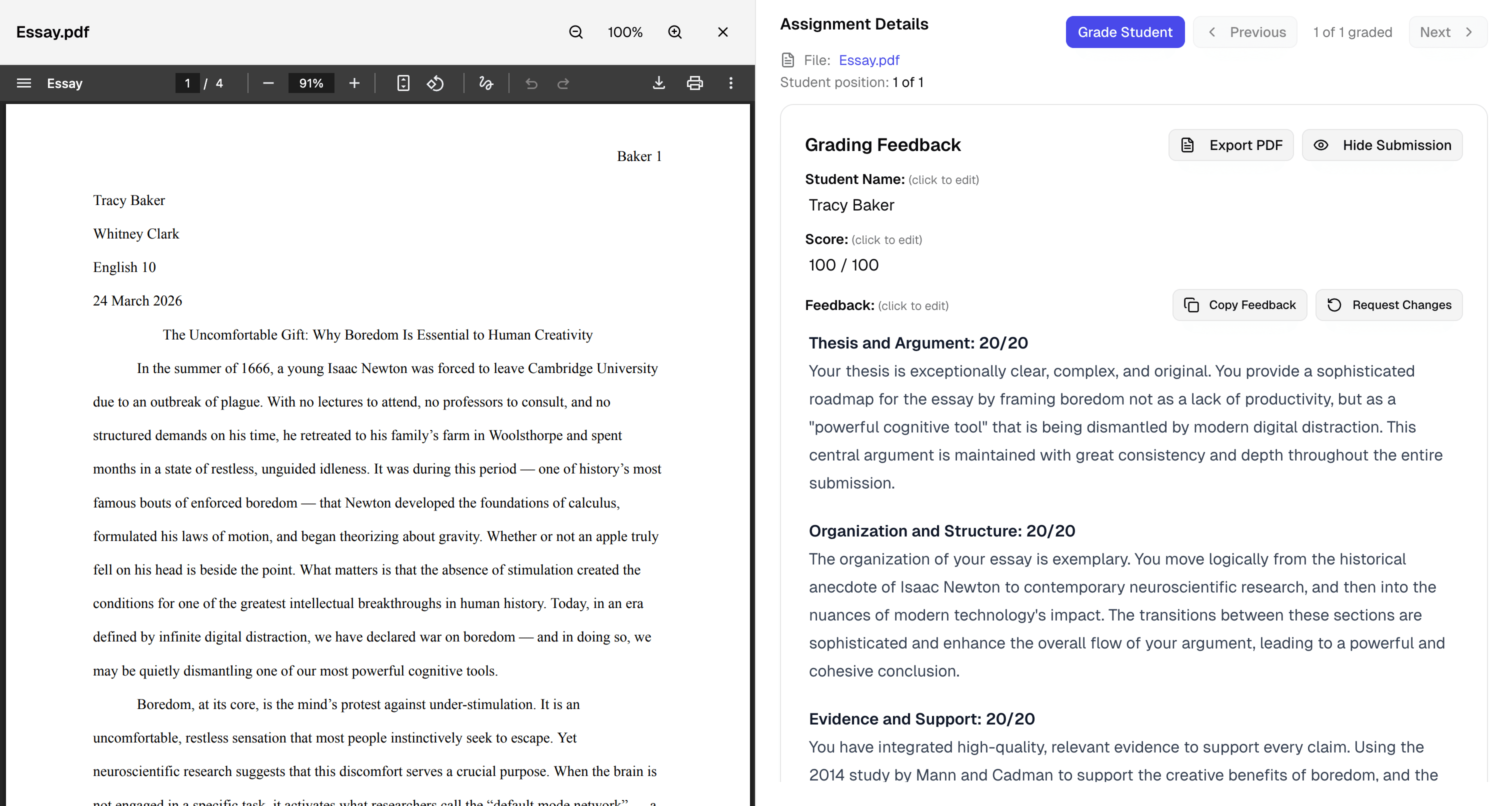
- Matches College Board scoring
- The AI applies the published rubric point-by-point — earning point 1a does not leak into point 1b, the way a general AI summary would.
- Works across AP subjects
- AP Biology, Chemistry, Physics 1/2/C, Statistics, Government & Politics, Psychology, Environmental Science, and Calculus FRQs all use the same point-based scoring model.
- Partial credit where the rubric allows
- Where the rubric grants partial credit for an attempt (AP Physics FRQ substitution points, AP Chem labeled calculations), the AI awards it — not just the binary earn/miss.
Example rubric
AP Biology FRQ point distribution
AP science FRQs are scored with a fixed number of points per question, each tied to a specific task verb. Here is a simplified AP Biology long-form FRQ rubric structure — swap in the exact rubric the College Board publishes for the specific FRQ you are grading.
FRQ grader rubric · AI-generated
Identify / describe
2 ptsName the specific biological process, structure, or pattern the question asks for.
- Earned
- Correct identification with the specific term the rubric requires (e.g., the actual name of the process, not a paraphrase).
- Not earned
- Missing, incorrect, or uses a close-but-different term.
Explain / justify
3 ptsExplain the mechanism, reasoning, or causation the question asks about.
- Earned (each)
- Explanation connects the identified concept to the phenomenon using correct biological reasoning.
- Not earned
- Explanation is restatement, missing a causal link, or uses incorrect mechanism.
Predict / analyze data
2 ptsInterpret the provided data (graph, table, experimental setup) and make a supported claim.
- Earned
- Specific, data-grounded claim with a valid inference from the given evidence.
- Not earned
- Claim not supported by the data, or cites the data without a valid inference.
Design experiment / evaluate
3 ptsPropose or evaluate an experimental design with an independent variable, dependent variable, and control.
- Earned (each)
- Design or evaluation includes the required experimental elements with clear reasoning.
- Not earned
- Missing a required element (IV, DV, control, replication) or evaluation is not specific.
Show the work, get the partial credit
Quantitative FRQs graded with partial credit for correct reasoning
AP Chemistry and AP Physics FRQs grant points for labeled calculations, substitution into equations, and correct reasoning even when the final number is wrong. The AI reads every step of handwritten or typed math work, awards each rubric point that was earned along the way, and flags the specific step where the error occurred.
Partial credit
3 / 5 pts
- Setup & strategy 2 / 2
- Perimeter and area equations set up correctly.
- Execution 1 / 2
- Discriminant sign flipped on last step: 400 − 384, not 400 + 384.
- Answer & units 0 / 1
- Negative width is not physically possible — signal to recheck.
- Handwritten math supported
- Scanned or photographed FRQs are transcribed before grading — arrows, fractions, and unit labels all preserved.
- Unit and significant-figure checks
- AP Chem sig-fig rules and unit-consistency checks are applied automatically when the rubric calls for them.
- One error, one deduction
- When a sign error cascades through the rest of the calculation, the rubric only deducts once (as it should) — not every line that inherits the error.
Sample AI feedback
Rubric-point feedback that names the specific miss
Here is a student's response to one part of an AP Biology FRQ on genetic drift, graded element by element. Notice the comment tells the student exactly which rubric move was missing — not that the answer was “incomplete.”
Assignment prompt
A population of 500 beetles experiences a flood that kills 450 individuals, with survivors chosen at random. Describe how this event affects allele frequencies in the population and explain whether natural selection occurred.
Student submission
After the flood, the beetle population is much smaller. The alleles in the population might be different because only 50 beetles survived. This is natural selection because the environment killed most of them.
AI feedback · Identify / explain (2 pts)
1 / 2Point 1 (identify) is not earned — the rubric requires naming the specific process (genetic drift, or the bottleneck effect as a special case). The response describes a consequence (“alleles might be different”) without naming the mechanism. Point 2 (explain) is earned in part: the student correctly identifies that allele frequencies change, which is a feature of drift. However, the incorrect claim that this is natural selection should be addressed separately in feedback, because the prompt's “chosen at random” is designed to rule that out.
Revision tip · The identification point is missed because the response does not name “genetic drift” or “bottleneck effect.” Also note that the last claim (“natural selection because the environment killed most of them”) is incorrect — natural selection requires heritable traits affecting survival, which the prompt explicitly removes (“chosen at random”).
- Quotes the student's actual work
- Feedback points to specific sentences and claims the student wrote, not vague impressions.
- Names the rubric language
- Comments reuse the criteria you set, so students learn what the rubric actually asks for.
- Suggests a concrete revision
- Every comment ends with a specific next step the student can take on the next draft.
Built for FRQ grader
Every detail, handled
- Every AP FRQ course supported
- AP Biology, Chemistry, Physics 1/2/C, Statistics, Government, Psychology, Environmental Science, Calculus AB/BC, and Human Geography FRQs are all handled.
- Current rubrics, not outdated ones
- FRQ rubrics update regularly. The AI uses the current published rubric structure for each course, so scoring matches what AP Readers will apply.
- Handwritten responses
- In-class timed FRQs on paper are transcribed and graded the same way as digital ones, so practice format does not bottleneck grading.
- Class-wide point analysis
- Which rubric point did the class collectively miss most often? The dashboard surfaces the answer so your review session targets the actual gap.
Why teachers switch
The AI FRQ grader that makes weekly AP practice sustainable
AP teachers who use GradeWithAI as their AI FRQ grader assign weekly practice instead of biweekly — because grading weekly FRQs is actually sustainable when every point is scored against the published rubric. Scores on practice exams track the additional reps.
Weekly FRQ practice that is actually gradable in a planning period
Point-by-point rubric feedback on every student response
Handwritten and digital FRQs in the same queue
Partial credit for substitution and labeled reasoning
Class-wide analysis of which rubric points to reteach
Calibration across teachers in the same course
“GradeWithAI doesn't just grade. It gives the student reasoning as to why every point is awarded or not awarded. That is a very valuable thing for the students.”

Why it matters for FRQ grader
AP teachers who use GradeWithAI as their AI FRQ grader assign weekly practice instead of biweekly — because grading weekly FRQs is actually sustainable when every point is scored against the published rubric. Scores on practice exams track the additional reps.
How FRQ grading works
From practice set to feedback in one planning period
Setup is per assignment — pick the course and FRQ, and the rubric is loaded.
- 1
Pick the FRQ
Select from a library of College Board FRQs, or paste in your own. The rubric loads automatically.
- 2
Upload responses
Scan paper FRQs, import from Google Classroom or Canvas, or drag in digital submissions. Mixed classes land in one queue.
- 3
Review and return
Point-by-point scores with comments are drafted. Approve, edit, and sync to the gradebook.
Also covered
FRQ grading by AP course
The FRQ grader handles every AP course that uses free-response questions — including the related AP essay courses that use a different free-response format:
- APUSH DBQ, LEQ, SAQ
- AP US History free responses graded against the College Board APUSH rubric with HIPP and complexity checks.
- AP World History FRQs
- AP World: Modern DBQs, LEQs, and SAQs graded with period-specific evidence verification.
- AP Lang essays
- AP English Language free responses — rhetorical analysis, argument, synthesis — graded against the 6-point rubric.
- SAQ grader
- Short-answer questions across AP history and AP science courses graded at scale.
Simple, transparent pricing
Start free and upgrade when you’re ready.
Free
Perfect for trying out AI grading.
- 25 AI requests/month
- Google Classroom integration
- Canvas integration
- Google Forms grading
- Handwritten assignment support
- AI rubric generation
- Unlimited Kleo AI assistant
Pro
Unlimited grading for dedicated educators.
- Unlimited AI requests
- Automated submissions grading
- AI detection on every submission
- Custom instructions
- Everything in Free
Schools & Districts
CustomEnterprise features for your entire school.
- Bulk user management
- Admin dashboard & analytics
- SSO / SAML authentication
- Dedicated onboarding & training
- Everything in Pro
Secure by design.
Built for K-12.
FERPA-aligned workflows, encryption everywhere, and no student data in model training. Ready for your district’s IT review from day one.
- FERPA-aligned
- SOC 2 practices
- AES-256 at rest
- TLS 1.2+ in transit
- Role-based access
- No AI training
- FERPA-aligned by default
- Role-based access and audit trails protect student submissions and grades.
- Never used for training
- Student work is processed for grading only — never used to train AI models.
- District-ready docs
- Security documentation and procurement support ready for your IT team.
Questions, answered
FRQ grader FAQ
Answers to the questions we hear most from teachers using GradeWithAI for FRQ grader. Start a free account and explore in minutes, or email john@gradewithai.com for a fast reply.
AP Biology, Chemistry, Physics 1, Physics 2, Physics C, Statistics, Government & Politics, Psychology, Environmental Science, Human Geography, Calculus AB, and Calculus BC — plus the AP history and AP English courses that use a different FRQ format (covered on their own pages). Any AP course that uses free-response questions is supported.
By assignment
More grading guides


Ready to try the AI FRQ grader for every AP course?
AP teachers who grade FRQs with GradeWithAI report doubling practice frequency without adding grading time. Students see their scores rise with the reps.
Free plan available · No credit card required
Teachers using GradeWithAI report grading in a fraction of the time, with richer feedback for every student.