The AI AP Seminar grader for IRR, IWA, and TMP
Score every AP Seminar performance task against the College Board rubric — Individual Research Reports (IRR), Individual Written Arguments (IWA), and Team Multimedia Presentation write-ups. Row-by-row feedback naming exactly where the student landed on each AP Seminar scoring row.
Free plan · Current AP Capstone rubric rows · PT1 and PT2 task formats
Trusted by 10,000+ teachers for AP Seminar
Why AP Seminar needs its own AI grader
Three AP Seminar performance tasks, three rubrics, one exhausted teacher.
AP Seminar teachers grade three major performance tasks per student per year — the IRR, the IWA, and the TMP defense — each with its own multi-row AP Capstone rubric. Few AI graders handle any of these; even fewer handle all three the way the College Board actually scores them. That is why the AP Seminar grader work typically falls on the one or two teachers in the building who got trained on Capstone.
- Rubric rows, not banded scores
- Each performance task has five to six rubric rows (Understand & Analyze, Evaluate Multiple Perspectives, Establish Argument, Apply Conventions, Select & Use Evidence, Convey Meaning). Feedback has to hit each row independently.
- Research methodology matters
- The IRR scores the research question, the selection of sources, and the synthesis across them. Generic essay grading misses two-thirds of what the rubric cares about.
- Argumentation criteria are precise
- The IWA scoring row on Establish Argument requires a specific, defensible claim and a clear line of reasoning across multiple perspectives. Students need feedback on the specific move their argument is missing.
Row-by-row AP Seminar rubric scoring
Every AP Capstone rubric row graded individually
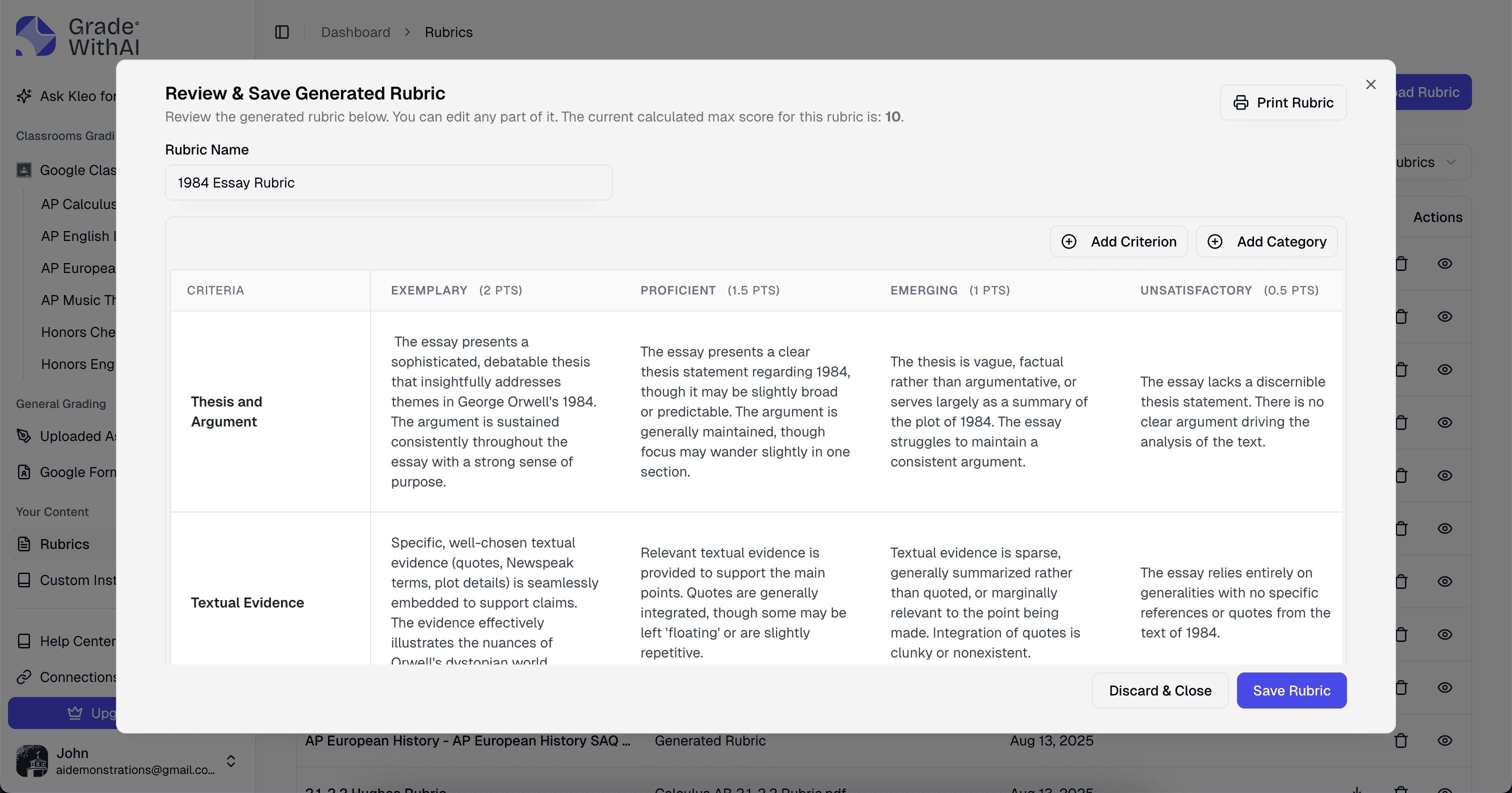
The AP Seminar rubrics assess five to six rows per performance task. GradeWithAI scores each row independently against the College Board descriptors, with a short comment explaining where the student landed on the row and what would move them up. No bundled “analysis” grade that conflates Understand & Analyze with Evaluate Multiple Perspectives.
- IRR, IWA, and TMP write-ups
- All three AP Seminar performance tasks are supported: the Individual Research Report (IRR), the Individual Written Argument (IWA), and the Team Multimedia Presentation defense/write-up.
- Research-question quality feedback
- For the IRR, the AI evaluates whether the research question is focused, contestable, and researchable — the three criteria the AP Capstone program actually trains readers on.
- Multiple perspectives check
- The “Evaluate Multiple Perspectives” row is scored specifically on whether the student identified and genuinely engaged differing perspectives, not just acknowledged they exist.
Example rubric
Simplified AP Seminar IWA rubric rows
The AP Seminar IWA uses six rubric rows, each scored independently. Here are four of them in simplified form — the AI uses the full published descriptors when grading.
AP Seminar rubric · AI-generated
Understand and analyze argument
5 ptsIdentifies and accurately explains the arguments in source material.
- High
- Accurately identifies and thoroughly explains the arguments and implications in source material.
- Mid
- Identifies the arguments but explanation is uneven or misses implications.
- Low
- Misidentifies arguments or describes sources without analyzing their arguments.
Evaluate multiple perspectives
6 ptsIdentifies, compares, and evaluates different perspectives on the issue.
- High
- Identifies multiple substantive perspectives and evaluates them with specific criteria.
- Mid
- Identifies multiple perspectives but evaluation is thin or one-sided.
- Low
- Acknowledges other perspectives in passing without real evaluation.
Establish argument
6 ptsEstablishes a defensible, clear argument with a line of reasoning.
- High
- Defensible, specific argument with a clear line of reasoning supported throughout.
- Mid
- Argument is present but general, or the line of reasoning is uneven.
- Low
- Argument is unclear, restated from sources, or not defensible.
Select and use evidence
5 ptsSelects credible sources, evaluates them, and uses evidence purposefully.
- High
- Selects a variety of credible, relevant sources and uses evidence purposefully to support the argument.
- Mid
- Sources are mostly credible and relevant; evidence use is sometimes decorative rather than purposeful.
- Low
- Sources are limited or not credible, or evidence is used to fill space rather than support reasoning.
AI-use detection built in
Know whether the argument came from the student
AP Seminar is one of the courses where AI-generated submissions have the highest incidence — the task format (research-driven written argument) is exactly what general-purpose AI writes comfortably. Every IWA and IRR runs through AI-use detection at grade time, with specific paragraphs highlighted in the submission alongside the rubric feedback.
Words analyzed: 1,247
Text used for detection
The rapid proliferation of digital platforms has fundamentally altered the landscape of modern discourse, necessitating a reevaluation of longstanding epistemic frameworks.

In my experience, social media makes it easier to find people who think like me, but harder to meet people who don't.

Furthermore, the implications of this paradigm shift extend beyond mere communication into the very structure of civic engagement itself.
- Paragraph-level highlights
- Passages most likely to be AI-generated are marked in the submission, not just a single score for the whole paper.
- Works with the AP academic integrity policy
- AI-use signals support the conversation you need to have with the student — they do not replace your judgment or the AP academic integrity process.
- No separate tool
- Detection runs with grading on the free plan. Your integrity workflow and your grading workflow live in the same place.
Sample AI feedback
Row-specific feedback, not bundled Capstone comments
Here is a fragment of an IWA on renewable energy policy, graded on the Establish Argument row. The AI feedback quotes the student's thesis, names the specific rubric descriptor, and suggests one concrete revision.
Assignment prompt
Write an Individual Written Argument (IWA) defending a position on a policy question related to energy transition. Your argument must engage multiple perspectives and cite a variety of credible sources.
Student submission
There are many different views on renewable energy. Some people think we should move quickly to solar and wind. Other people think we need to keep using fossil fuels for reliability. This paper will look at both sides and decide which is better.
AI feedback · Establish Argument (row 3)
3 / 6This paragraph lands on the Establish Argument row at the mid band. The introduction identifies competing perspectives but does not stake a defensible argument — “will look at both sides and decide which is better” telegraphs that the argument will emerge later, which the IWA rubric explicitly penalizes. A high-band argument on this row takes a specific, defensible position up front and names the line of reasoning the rest of the paper will defend. Without that move, even a well-researched IWA caps in the middle of this row.
Revision tip · The opening does the work of “acknowledging perspectives” but not “establishing an argument.” An IWA rubric-high argument would read: “The United States should prioritize grid storage investment over either generation subsidies or fossil fuel retention, because reliability at scale is the binding constraint on renewable transition — not raw generation capacity.”
- Quotes the student's actual work
- Feedback points to specific sentences and claims the student wrote, not vague impressions.
- Names the rubric language
- Comments reuse the criteria you set, so students learn what the rubric actually asks for.
- Suggests a concrete revision
- Every comment ends with a specific next step the student can take on the next draft.
Built for AP Seminar
Every detail, handled
- IRR, IWA, and TMP support
- Every AP Seminar performance task format is supported. The AI loads the appropriate rubric automatically.
- Source evaluation feedback
- The AI evaluates whether cited sources are credible for the claim they support and flags any that look like filler citations.
- Multiple-perspectives audit
- Counts substantive perspectives engaged versus merely acknowledged, so students know whether their evaluation landed at the mid or high band.
- AP Capstone-ready feedback language
- Comments use the descriptor language from the AP Seminar rubrics, so students see the same vocabulary they will see on the College Board's scoring rubrics.
Why teachers switch
The AI AP Seminar grader that ends the solo-teacher bottleneck
Most schools run AP Seminar with one or two trained teachers. The grading load for three performance tasks per student makes calibration meetings the only thing that fits on the calendar. GradeWithAI works as your AI AP Seminar grader for IRR, IWA, and TMP write-ups, handling the first-pass row-by-row feedback so those meetings can focus on the close calls.
Row-by-row scoring against the current AP Capstone rubrics
IRR, IWA, and TMP write-ups all in one workflow
Research question and source evaluation feedback built in
AI-use detection on every submission at no extra cost
Editable scores and comments before anything goes live
Shared rubrics for multi-teacher AP Capstone programs
“More impressive though is that it corrects student answers not simply using a pre-written answer, but by following the thought process they've pursued.”

Why it matters for AP Seminar
Most schools run AP Seminar with one or two trained teachers. The grading load for three performance tasks per student makes calibration meetings the only thing that fits on the calendar. GradeWithAI works as your AI AP Seminar grader for IRR, IWA, and TMP write-ups, handling the first-pass row-by-row feedback so those meetings can focus on the close calls.
How AP Seminar grading works
From submitted performance task to row-level feedback
Three steps, whether the task is the IRR, the IWA, or the TMP write-up.
- 1
Pick the task
Select IRR, IWA, or TMP write-up. The AI loads the current College Board rubric automatically.
- 2
Upload student work
Drag in the PDFs or sync from Canvas / Google Classroom. Source citations and appendices are read in the same pass.
- 3
Review and return
Every rubric row gets a score with a descriptor-language comment. Approve, edit, or rewrite, then sync to your gradebook.
Also covered
AP Capstone grading across the diploma
AP Seminar is part of the AP Capstone diploma sequence. Related grading workflows:
- Essay grading
- Rubric-based essay grading with quoted evidence and AI-use detection for every writing task.
- AP Lang essays
- Rhetorical analysis, argument, and synthesis essays graded against the College Board AP Lang rubric.
- Writing grader
- Any genre of student writing graded against your rubric — narratives, reflections, research drafts, journals.
- FRQ grader
- Free-response questions across AP science, stats, and social sciences graded point-by-point.
Simple, transparent pricing
Start free and upgrade when you’re ready.
Free
Perfect for trying out AI grading.
- 25 AI requests/month
- Google Classroom integration
- Canvas integration
- Google Forms grading
- Handwritten assignment support
- AI rubric generation
- Unlimited Kleo AI assistant
Pro
Unlimited grading for dedicated educators.
- Unlimited AI requests
- Automated submissions grading
- AI detection on every submission
- Custom instructions
- Everything in Free
Schools & Districts
CustomEnterprise features for your entire school.
- Bulk user management
- Admin dashboard & analytics
- SSO / SAML authentication
- Dedicated onboarding & training
- Everything in Pro
Secure by design.
Built for K-12.
FERPA-aligned workflows, encryption everywhere, and no student data in model training. Ready for your district’s IT review from day one.
- FERPA-aligned
- SOC 2 practices
- AES-256 at rest
- TLS 1.2+ in transit
- Role-based access
- No AI training
- FERPA-aligned by default
- Role-based access and audit trails protect student submissions and grades.
- Never used for training
- Student work is processed for grading only — never used to train AI models.
- District-ready docs
- Security documentation and procurement support ready for your IT team.
Questions, answered
AP Seminar FAQ
Answers to the questions we hear most from teachers using GradeWithAI for AP Seminar. Start a free account and explore in minutes, or email john@gradewithai.com for a fast reply.
All three: the Individual Research Report (IRR) from PT1, the Individual Written Argument (IWA) from PT2, and the Team Multimedia Presentation (TMP) defense and write-up. The AI loads the current College Board rubric for whichever task you select.
By assignment
More grading guides


Ready to try the AI AP Seminar grader built for IRR, IWA, and TMP?
AP Capstone programs using GradeWithAI report returning drafts within 48 hours instead of two weeks — which is the cadence revisions actually move the rubric row on.
Free plan available · No credit card required
Teachers using GradeWithAI report grading in a fraction of the time, with richer feedback for every student.