AP Research POD rubric generator
AP Research POD rubric generator for practice presentations. Build a rubric for the research question, method, conclusions, and oral defense answers.
Free · No account · Print or save as PDF
Rubric total will sum to this score.
Paste full instructions or describe in one sentence.
0/5000
Tip: Include the grade level and any standard codes for tighter alignment.
GradeWithAI is used by 21,000+ teachers, including teachers at
What the rubric generator does
- Points that add up
- The top level adds up to the total you set, such as 25 or 100. Every criterion gets equal points.
- Standards language
- Include a standard code, such as CCSS.ELA-LITERACY.W.9-10.1 or NGSS HS-LS1-1, and the criteria use that standard's wording.
- Editable before printing
- Rewrite any cell, rename criteria and levels, change points, and add or delete rows and columns.
- Printable PDF
- Print the rubric or save it as a PDF to hand out or attach to an assignment.
What is the AP Research POD rubric?
The AP Research presentation and oral defense (POD) rubric is the College Board's scoring guide for the presentation students give on their completed research, followed by questions from a panel.
What the AP Research presentation rubric scores
The presentation and oral defense run 15 to 20 minutes, including three or four questions from a panel of three evaluators, and the teacher scores it. Higher scores go to students who can defend the logic of the project. A practice rubric can score:
Research question and purpose: explains a focused inquiry and why it matters
Method and process: defends the chosen method and how it fits the question
Evidence and conclusions: connects findings to a reasoned new understanding
Limitations and implications: discusses constraints, significance, and future directions
Oral defense: answers questions with specific evidence from the project
Common POD scoring problems
The weakest presentations sound like a summary of the paper. Students lose ground when they cannot explain why their method fit the question, present limitations as an apology instead of analysis, or give general answers to defense questions.
Using the generator for the POD
Paste the student's research question, method, and presentation expectations, and set a point total for classroom use. A second, shorter rubric for the oral defense alone helps students rehearse answers. Use the College Board's current scoring guidelines for final scores.
AP and Advanced Placement are registered trademarks of the College Board, which is not affiliated with GradeWithAI.
How the rubric generator works
- 1
Describe the assignment
Paste the instructions or describe it in a sentence. Include the grade level and any standard codes.
- 2
Set the point total
The top level of the rubric adds up to it. Results take about 10 to 20 seconds.
- 3
Edit and print
Click any cell to rewrite it, then print the rubric or save it as a PDF.
What teachers say
Teachers across subjects, from AP history to astrophysics, on grading with GradeWithAI.
“I've really enjoyed using the GradeWithAI program. It saves me a ton of time, especially when I have class sizes of 35 or 36 students times five.”

“GradeWithAI doesn't just grade. It gives the student reasoning as to why every point is awarded or not awarded. That is a very valuable thing for the students.”

“More impressive though is that it corrects student answers not simply using a pre-written answer, but by following the thought process they've pursued.”

“For Chadwick users, GradeWithAI has improved feedback efficiency and effectiveness, as it is grounded in existing platforms and is highly adaptable.”

“GradeWithAI [provides] students with timely individualized feedback on their homework assignments and formative assessments. This is a job that is virtually impossible for a teacher to do on a regular basis.”

“Students have also appreciated the consistency and immediacy of the feedback I can provide through GradeWithAI. This has enabled them to make necessary corrections and achieve their desired scores on any assignment.”

Grade a whole class set with GradeWithAI
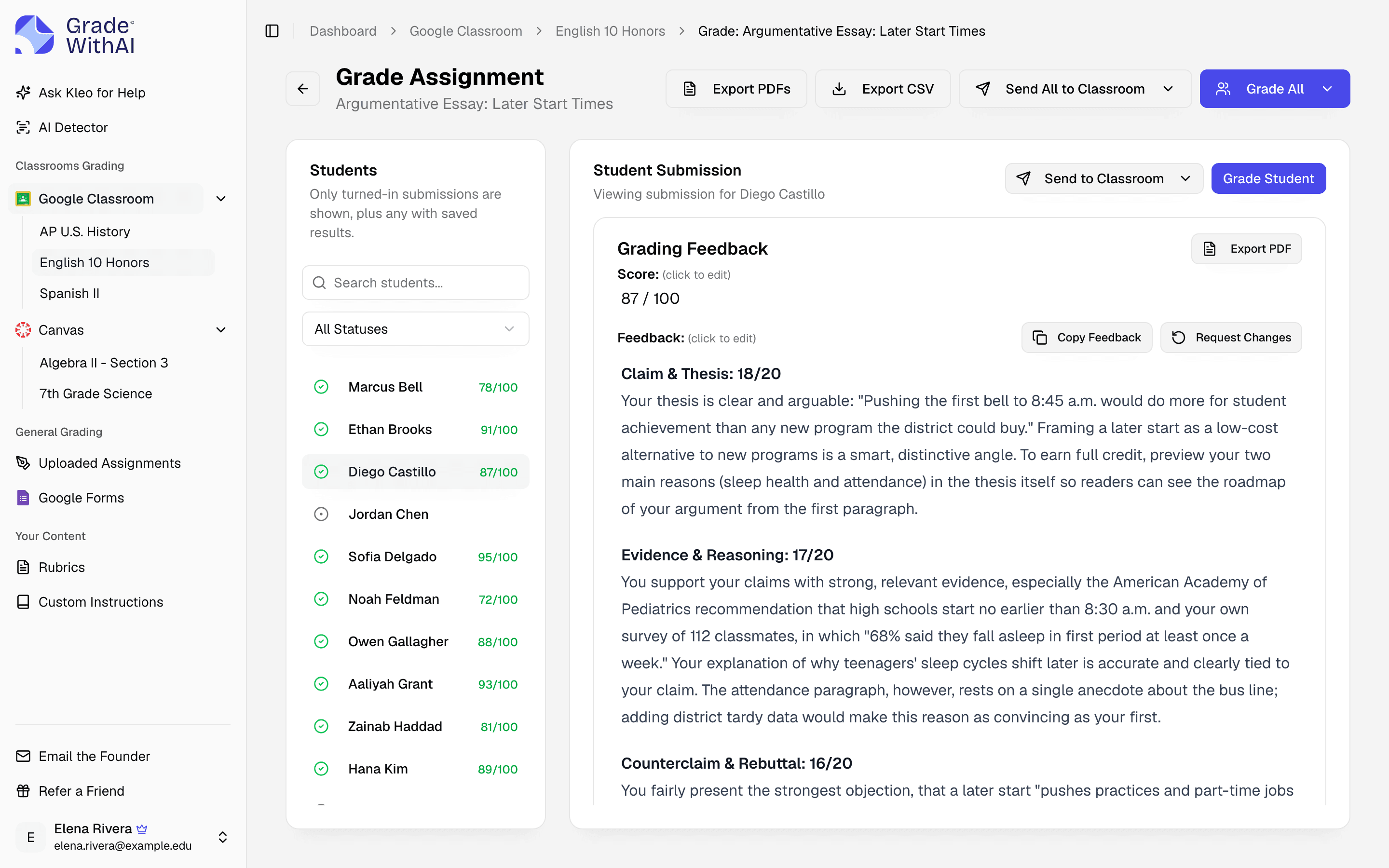
GradeWithAI scores each submission criterion by criterion against your rubric and writes feedback for each student.
Sync assignments from Canvas, Google Classroom, or Google Forms, or upload files from any other LMS
Reads typed work and handwritten pages from scans or phone photos
Edit any score or comment before students see it
Send scores and comments back to Canvas or Google Classroom, or export a CSV
Scoring AP Seminar or AP Research work? See how AI grading works for AP Seminar
The presentation and oral defense is 25 percent of the AP Research score. The academic paper is the other 75 percent, so students need separate preparation for each.
No. The paper rubric scores the written academic paper. The POD rubric scores how students present, defend, and discuss the research during the live presentation and oral defense.
Strong answers point back to specific choices in the project: the research question, the method, the evidence, the limitations, or the implications. Short, general answers rarely show enough command of the research.
An analytic rubric scores each criterion of an assignment separately, such as thesis, evidence, and organization, with a description of each performance level. A holistic rubric gives one overall score instead. The rubric generator builds analytic rubrics.
A rubric with criteria down the side, performance levels across the top, and a description in every cell. Each level is worth the same points on every criterion, and the top level adds up to the total you set.
Most classroom rubrics use 3 to 6 criteria and 3 to 5 performance levels. Fewer criteria keep grading fast and each one meaningful, and four levels avoid a middle column that everything falls into. Add or delete rows and columns after the rubric generates.
A checklist records whether each requirement is present. A rubric describes how well each one is done, with a description for every level. Use a checklist for completion tasks and a rubric when quality matters.
Yes. Click any cell to rewrite it. You can also rename criteria and levels, change point values, and add or delete rows and columns, then print the rubric or save it as a PDF.
No. It builds analytic rubrics only. You can delete the levels you don't need after it generates.
Yes, as a starting point. Name the rubric in the description, for example "AP US History LEQ", and it starts from the official rows. Every criterion gets the same points per level, so set each row's official points after generating, and check the wording against the published scoring guide.
Yes, with no account or credit card. Rubrics aren't saved, so print or download the PDF before you leave the page.
Rubric generators by assignment and exam
Starting points for the rubrics teachers ask for most, from argumentative essays to AP Lang rhetorical analysis.
Popular
Grade levels
Assessment types
AP English
AP exam
- LEQ rubric generator
- DBQ rubric generator
- APUSH DBQ rubric generator
- APUSH LEQ rubric generator
- AP World DBQ rubric generator
- AP World LEQ rubric generator
- AP Lang rubric generator
- AP Lang rhetorical analysis rubric generator
- AP Lang synthesis essay rubric generator
- AP Lang argument essay rubric generator
- SAQ rubric generator
- APUSH SAQ rubric generator
- AP Research rubric generator
- AP Gov argumentative essay rubric generator
Teacher evaluation
Framework
Related tools
Grade student work against your rubric
21,000+ teachers use GradeWithAI to grade essays, tests, and handwritten work, and report saving 10+ hours a week.
The free plan grades 25 submissions every 30 days. No credit card.
Reported by teachers using GradeWithAI, with feedback on every submission they grade.