SIOP lesson plan generator
Generate SIOP lesson plans with separate content and language objectives, key vocabulary, scaffolds, and structured interaction for English learners.
Free · No account · Print or save as PDF
Include grade level, subject, specific standards, and any instructional strategies or materials you want the plan to use.
0/5000 characters
Free · No sign-up · PDF export
GradeWithAI is used by 21,000+ teachers, including teachers at
What the lesson plan generator does
- 15 to 90 minutes
- Pick the lesson length, from a 15-minute mini lesson to a 90-minute block. Each plan covers one lesson.
- The framework you name
- 5E, gradual release, Madeline Hunter, UbD, SIOP, or another structure. Without one, it picks a structure that fits.
- Differentiation
- Supports for students who need help, extensions for students ready for more, and supports for English learners.
- Printable PDF
- Print the plan or save it as a PDF. To edit it, copy the text into Google Docs or Word.
What is the SIOP model?
The Sheltered Instruction Observation Protocol (SIOP) is a model for teaching grade-level content to English learners, developed by Jana Echevarria, MaryEllen Vogt, and Deborah Short. Every SIOP lesson has a content objective and a language objective. This generator writes a SIOP lesson plan with both; name your students' English proficiency level.
The eight SIOP components
SIOP has eight components with 30 features in all: Lesson Preparation, Building Background, Comprehensible Input, Strategies, Interaction, Practice and Application, Lesson Delivery, and Review and Assessment. Ask for the components by name and the plan labels them in its phases.
Content and language objectives stated separately
Background knowledge and key vocabulary built in
Comprehensible input with visuals and scaffolds
Structured academic talk with partners and groups
Content objectives and language objectives
A content objective says what students will learn ('compare decimals to the hundredths'). A language objective says what language they'll use to show it ('explain orally which decimal is greater using greater than, less than, and equal to'). The plan ties the language objective to a function such as comparing or explaining.
For content teachers with English learners
SIOP is designed for mainstream content teachers, so you don't need ESL certification to use it. Name the subject, grade, and proficiency level (for example, WIDA level 2) and the scaffolds are written for that level.
How the lesson plan generator works
- 1
Describe the lesson
Include the grade, topic, what students should be able to do, and any standard or framework.
- 2
Pick the length
From 15 to 90 minutes. The plan usually takes 15 to 30 seconds.
- 3
Check and print
Read the objectives and standard codes, then print or save the PDF.
What teachers say
Teachers across subjects, from AP history to astrophysics, on grading with GradeWithAI.
“I've really enjoyed using the GradeWithAI program. It saves me a ton of time, especially when I have class sizes of 35 or 36 students times five.”

“GradeWithAI doesn't just grade. It gives the student reasoning as to why every point is awarded or not awarded. That is a very valuable thing for the students.”

“More impressive though is that it corrects student answers not simply using a pre-written answer, but by following the thought process they've pursued.”

“For Chadwick users, GradeWithAI has improved feedback efficiency and effectiveness, as it is grounded in existing platforms and is highly adaptable.”

“GradeWithAI [provides] students with timely individualized feedback on their homework assignments and formative assessments. This is a job that is virtually impossible for a teacher to do on a regular basis.”

“Students have also appreciated the consistency and immediacy of the feedback I can provide through GradeWithAI. This has enabled them to make necessary corrections and achieve their desired scores on any assignment.”

Grade a whole class set with GradeWithAI
GradeWithAI grades what the lesson produces, from exit tickets and quizzes to essays and lab reports, against your rubric or answer key.
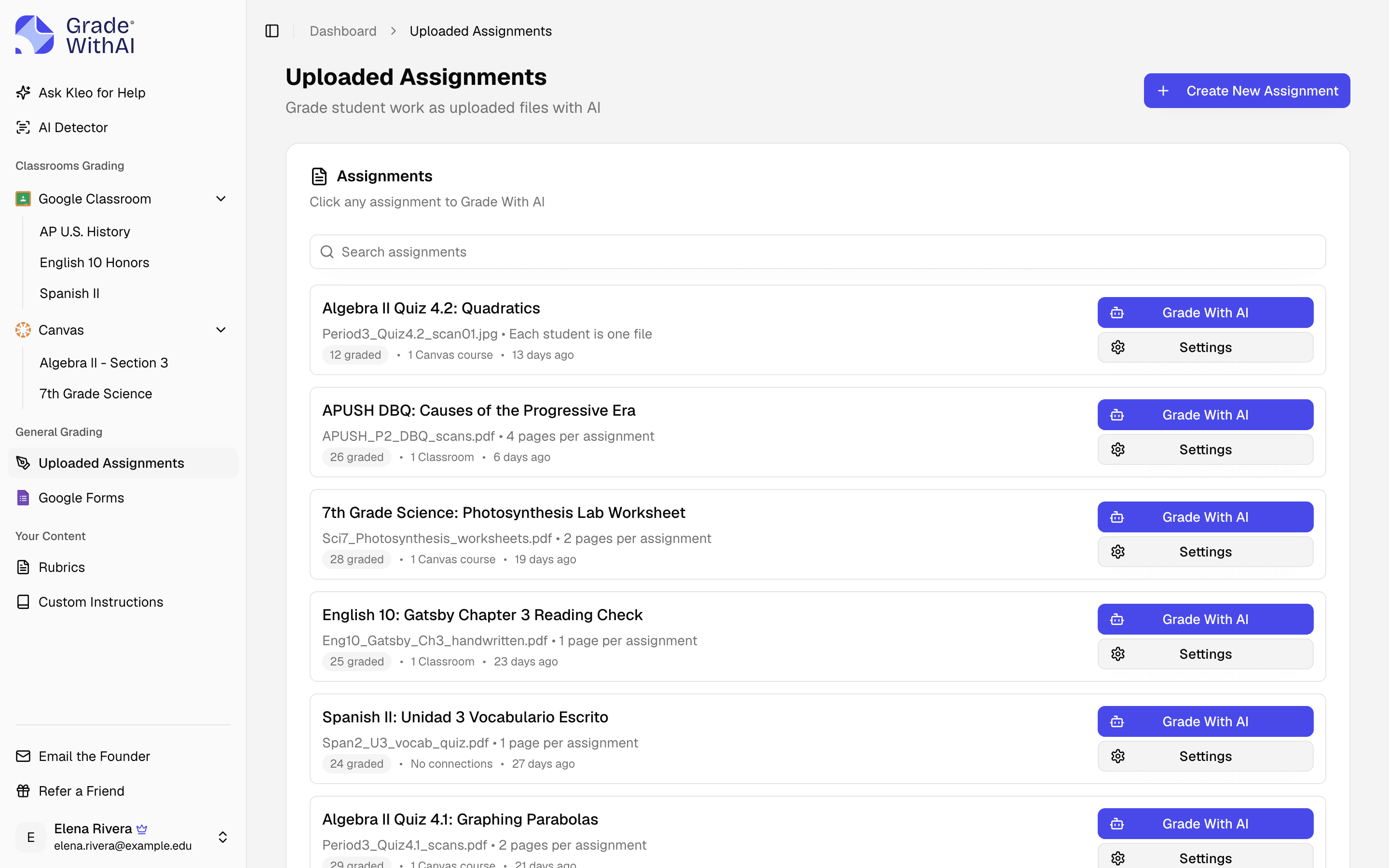
Sync assignments from Canvas, Google Classroom, or Google Forms, or upload files from any other LMS
Reads typed work and handwritten pages from scans or phone photos
Edit any score or comment before students see it
Grading the finished assignments? See how the AI assignment grader works
A title, learning objectives, standards when the lesson calls for them, materials, key vocabulary, timed phases, assessment, differentiation for students who need support, extension, and English learners, plus homework and teacher notes.
The one you name: 5E, gradual release (I do, we do, you do), Madeline Hunter, UbD, SIOP, or another. If you don't name one, it picks a structure that fits the lesson.
A template is a blank form with headings such as objectives, materials, and procedure. A generator, sometimes called a lesson plan maker or creator, fills the form in from your description. You can still use the generated plan as a template by copying it into Google Docs or Word and editing it.
Five phases: Engage, Explore, Explain, Elaborate, and Evaluate. Students investigate a question before the teacher explains the concept, which is why 5E is common in science. Name 5E in the description and the plan's phases follow it.
Not on the page. Copy the plan into Google Docs or Word to edit it, or print the PDF as is.
Yes. Ask for a substitute plan and say what the class has been working on. The plan lists timed steps and materials. Add your seating chart, schedule, and class routines yourself, since the generator doesn't know them.
Choose 15, 30, 45, 50, 60, or 90 minutes. Each plan covers one lesson, so for a unit, generate one lesson at a time.
Yes, when you name the standard or its code in the description, for example CCSS.MATH.CONTENT.5.NF.A.1. The objectives and activities are written to it. Check any codes it lists against your curriculum.
Treat them as drafts to check. Plans come from a general AI model prompted with a standard lesson structure, so check the objectives, facts, and standard codes before you teach the lesson.
Yes. It writes for the age group you describe, from infant and preschool rooms through 12th grade, in core subjects and electives. Put the grade level or age range in the description so the vocabulary and activities fit.
It is sent to an AI model to write the plan. Nothing is saved to an account. Leave student names, IEP details, and other personal information out.
Usually 15 to 30 seconds.
Yes, with no account, credit card, or subscription.
Lesson plan generators by subject, grade, and framework
Starting points with the subject, grade, and lesson length filled in.
Popular
Templates
- Lesson plan template generator
- Weekly lesson plan template: free daily plans
- Daily lesson plan template
- Preschool lesson plan template
- Kindergarten lesson plan template
- Elementary lesson plan template
- Middle school lesson plan template
- High school lesson plan template
- ELA lesson plan template
- Unit plan template and free lesson generator
- Substitute teacher lesson plan template
- Guided reading lesson plan template
- Toddler lesson plan template
- Infant lesson plan template
Instructional models
- 5E lesson plan generator
- Madeline Hunter lesson plan generator
- Backward design lesson plan generator
- UbD lesson plan generator
- UDL lesson plan generator
- Detailed lesson plan generator
- Semi-detailed lesson plan generator
- Direct instruction lesson plan generator
- Inquiry-based lesson plan generator
- PBL lesson plan generator
- Flipped classroom lesson plan generator
- Differentiated lesson plan generator
- Cooperative learning lesson plan generator
- Gradual release lesson plan generator
Subjects
- Math lesson plan template & generator
- Science lesson plan template & generator
- English lesson plan generator
- History lesson plan generator
- Social studies lesson plan generator
- Biology lesson plan generator
- Chemistry lesson plan generator
- Physics lesson plan generator
- Algebra lesson plan generator
- Phonics lesson plan generator
- Reading lesson plan template & generator
- Writing lesson plan template & generator
- Art lesson plan template & generator
- Music lesson plan template & generator
- PE lesson plan template & generator
- ESL lesson plan generator
- Spanish lesson plan generator
- French lesson plan generator
- Special education lesson plan generator
- SEL lesson plan generator
- Vocabulary lesson plan generator
- Grammar lesson plan generator
- Geography lesson plan generator
- Health education lesson plan generator
- Computer science lesson plan generator
Grade levels
- Preschool lesson plan generator
- Kindergarten lesson plan generator
- Elementary lesson plan generator
- Middle school lesson plan generator
- High school lesson plan generator
- 1st grade lesson plan generator
- 2nd grade lesson plan generator
- 3rd grade lesson plan generator
- 4th grade lesson plan generator
- 5th grade lesson plan generator
Related tools
Grade what your students turn in
21,000+ teachers use GradeWithAI to grade essays, tests, and handwritten work, and report saving 10+ hours a week.
The free plan grades 25 submissions every 30 days. No credit card.
Reported by teachers using GradeWithAI, with feedback on every submission they grade.