Kindergarten spelling words
Kindergarten spelling words built on short-vowel CVC patterns and first sight words. Generate short practice sheets and quizzes with an answer key.
Free · No account · Answer key included · Print or save as PDF
Tip: Describe the specific skill or topic. The generator calibrates complexity to the grade level you pick.
GradeWithAI is used by 21,000+ teachers, including teachers at
Kindergarten spelling words by sound pattern
Kindergarten spelling words are the first words children write from sound: mostly short-vowel CVC words (consonant-vowel-consonant, like cat, sit and hop) plus a few high-frequency words learned by heart (the, and, is, you). Common Core expects kindergartners to spell simple words phonetically (L.K.2.d). This generator writes practice sheets and quizzes from your list.
What makes a word right for kindergarten
A CVC word like 'cat' has one letter per sound, so a kindergartner can say each sound and write its letter. 'Friend' spells its vowel 'ie', which puts it beyond most kindergartners. Many programs teach short a in the fall, short i and o by midyear, and short u and e by spring.
Short a: cat, hat, bat, map, sad, ran
Short i: sit, hit, pig, big, win, lip
Short o: hop, top, mop, dog, pot, box
Short u: cup, pup, bug, hug, sun, run
Short e: bed, red, pen, net, hen, web
Heart words and decodable words
Kindergarten lists mix decodable CVC words with irregular high-frequency words ('the', 'said', 'was', 'you'). Programs based on the science of reading teach these as heart words: in 'said', the s and d follow the usual rules, and the 'ai' is learned by heart.
A weekly kindergarten spelling routine
Keep the weekly list to three to six words on one pattern, and generate each sheet from the same list so Monday's pattern matches Friday's check. Sheets print in a standard font, so students still forming letters can write on primary-ruled paper.
How to make a spelling test
- 1
Add the words
Paste your list, or describe the grade and spelling pattern.
- 2
Pick the format
Describe it in the box, then set the grade and number of items.
- 3
Print
Print the student copy, then the answer key.
What teachers say
Teachers across subjects, from AP history to astrophysics, on grading with GradeWithAI.
“I've really enjoyed using the GradeWithAI program. It saves me a ton of time, especially when I have class sizes of 35 or 36 students times five.”

“GradeWithAI doesn't just grade. It gives the student reasoning as to why every point is awarded or not awarded. That is a very valuable thing for the students.”

“More impressive though is that it corrects student answers not simply using a pre-written answer, but by following the thought process they've pursued.”

“For Chadwick users, GradeWithAI has improved feedback efficiency and effectiveness, as it is grounded in existing platforms and is highly adaptable.”

“GradeWithAI [provides] students with timely individualized feedback on their homework assignments and formative assessments. This is a job that is virtually impossible for a teacher to do on a regular basis.”

“Students have also appreciated the consistency and immediacy of the feedback I can provide through GradeWithAI. This has enabled them to make necessary corrections and achieve their desired scores on any assignment.”

Grading the spelling tests?
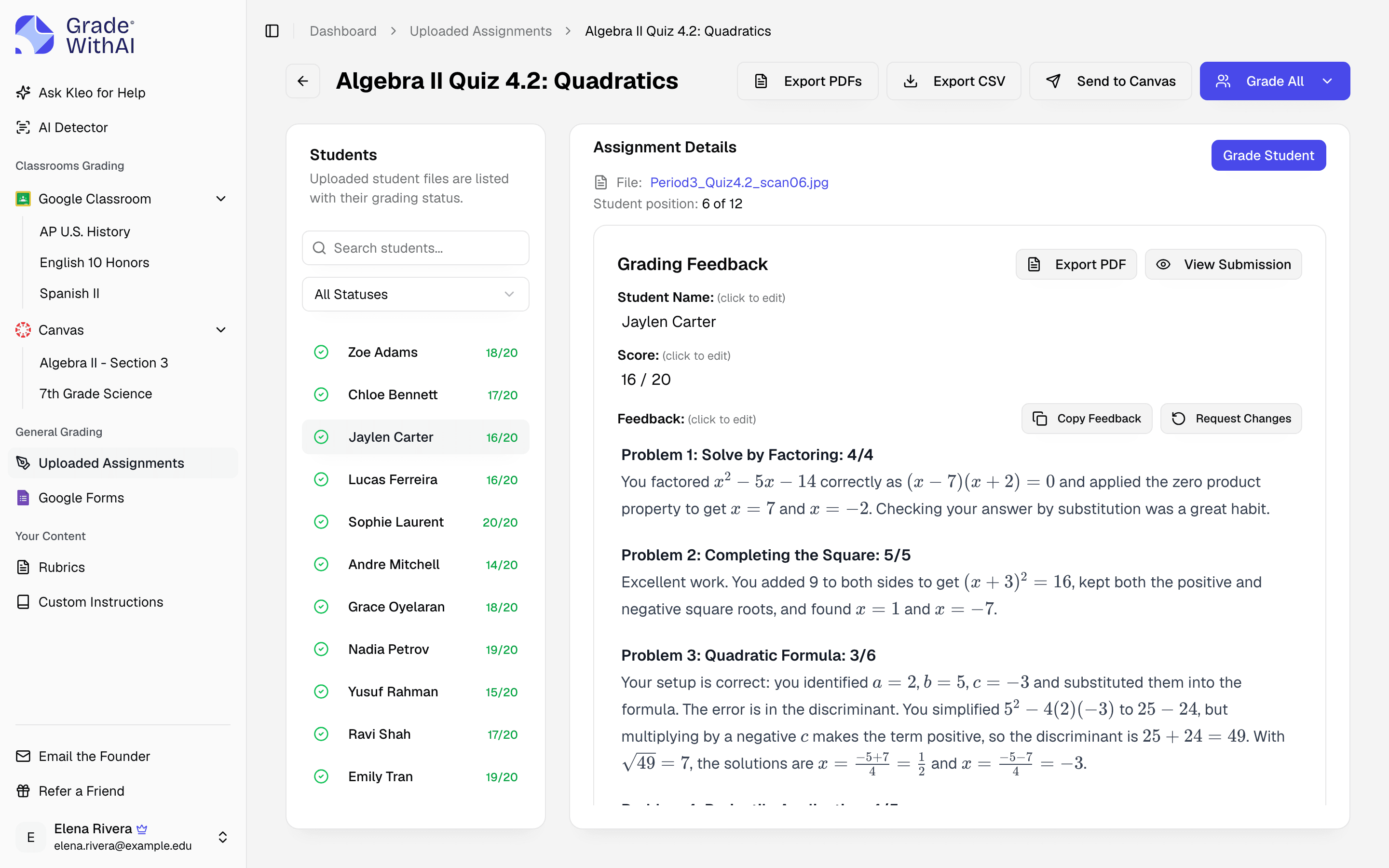
Upload the scanned or photographed tests to GradeWithAI with your word list as the answer key. It reads handwriting, and you review every score before it posts.
Students working on paper? See how GradeWithAI grades handwritten work
Most kindergarten lists are short, often three to six words built on one pattern. Add more late in the year only if students spell the current list easily. At this age the goal is the habit of writing words from their sounds.
Yes. Most children learn to write their first name early in kindergarten, usually before formal spelling lists begin, and many learn their last name later in the year. Practice names separately from the weekly list.
Consonant digraphs (sh, ch, th) and blends (bl, st, tr) often start late in kindergarten and continue in 1st grade, where Common Core lists digraphs (RF.1.3.a) and the silent-e and common vowel-team spellings of long vowels (RF.1.3.c).
Yes. Ask for a Dolch or Fry list by name (for example, Dolch pre-primer or Fry's first 100) and check the words against your district's copy before printing. The lists aren't stored in the tool; the AI writes them from what it knows.
Yes. Paste the words into the description and the worksheet uses them.
Fill-in-the-blank sentences, multiple choice with one correct spelling, practice sheets, and spelling bee lists. It doesn't draw tracing letters.
Yes. Leave it on to print the answers on a separate page, or turn it off for the student copy.
Yes, with no account.
Spelling lists and tests by grade
Starting points with the grade, list, or test format filled in.
Format
Spelling bee
By grade
- 1st grade spelling words
- 2nd grade spelling words
- 3rd grade spelling words
- 4th grade spelling words
- 5th grade spelling words
- Spelling test for 1st grade
- Spelling test for 2nd grade
- 3rd grade spelling bee words
- 4th grade spelling bee words
- 5th grade spelling bee words
- 6th grade spelling words
- 7th grade spelling words
- 8th grade spelling words
Grade the spelling tests with GradeWithAI
21,000+ teachers use GradeWithAI to grade essays, tests, and handwritten work, and report saving 10+ hours a week.
The free plan grades 25 submissions every 30 days. No credit card.
Reported by teachers using GradeWithAI, with feedback on every submission they grade.