7th grade math problems
Make 7th grade math problems: proportional relationships, operations with negatives, two-step equations, circles, and probability. With an answer key.
Free · No account · Up to 40 problems · Answer key included
Tip: Describe the specific skill or topic. The generator calibrates complexity to the grade level you pick.
GradeWithAI is used by 21,000+ teachers, including teachers at
What 7th grade math covers
7th grade math problems cover proportional relationships, operations with positive and negative rational numbers, multi-step equations and inequalities, scale drawings, angles, circles, and probability. This generator writes printable practice across the 7.RP, 7.NS, 7.EE, 7.G, and 7.SP standards, with an answer key on a separate page.
The 7th grade standards these problems target
7.RP introduces the constant of proportionality, the bridge to linear functions. 7.G adds complementary, supplementary, vertical, and adjacent angles, and 7.SP covers random sampling and probability. Key standards:
Proportional relationships and the constant of proportionality (7.RP.A.2)
Operations with rational numbers, including negatives (7.NS.A.1-3)
Two-step equations and inequalities (7.EE.B.4)
Circumference and area of circles (7.G.B.4)
Scale drawings (7.G.A.1)
Why rational number fluency matters in 7th grade
A 7th grader who cannot compute (−3/4) × (2/3) = −1/2 quickly will stall on equations later in the year. Solving −3x + 7 = −5 means subtracting 7 to get −3x = −12, then dividing two negatives to get x = 4.
Getting ready for 8th grade
7th grade leads into 8th grade linear functions, systems of equations, and the Pythagorean theorem, and for some students straight into Algebra 1. A mixed review page on rational number operations, multi-step equations, proportional relationships, and translating words into expressions shows where a student needs more work.
How the math problem generator works
- 1
Describe the set
The topic and the format, such as two-step equations or fraction word problems about cooking.
- 2
Set the details
Grade, difficulty, and number of problems. It usually takes 10 to 20 seconds.
- 3
Check and print
Work a few problems yourself, then print the student copy and the answer key.
What teachers say
Teachers across subjects, from AP history to astrophysics, on grading with GradeWithAI.
“I've really enjoyed using the GradeWithAI program. It saves me a ton of time, especially when I have class sizes of 35 or 36 students times five.”

“GradeWithAI doesn't just grade. It gives the student reasoning as to why every point is awarded or not awarded. That is a very valuable thing for the students.”

“More impressive though is that it corrects student answers not simply using a pre-written answer, but by following the thought process they've pursued.”

“For Chadwick users, GradeWithAI has improved feedback efficiency and effectiveness, as it is grounded in existing platforms and is highly adaptable.”

“GradeWithAI [provides] students with timely individualized feedback on their homework assignments and formative assessments. This is a job that is virtually impossible for a teacher to do on a regular basis.”

“Students have also appreciated the consistency and immediacy of the feedback I can provide through GradeWithAI. This has enabled them to make necessary corrections and achieve their desired scores on any assignment.”

Grading the completed problem sets?
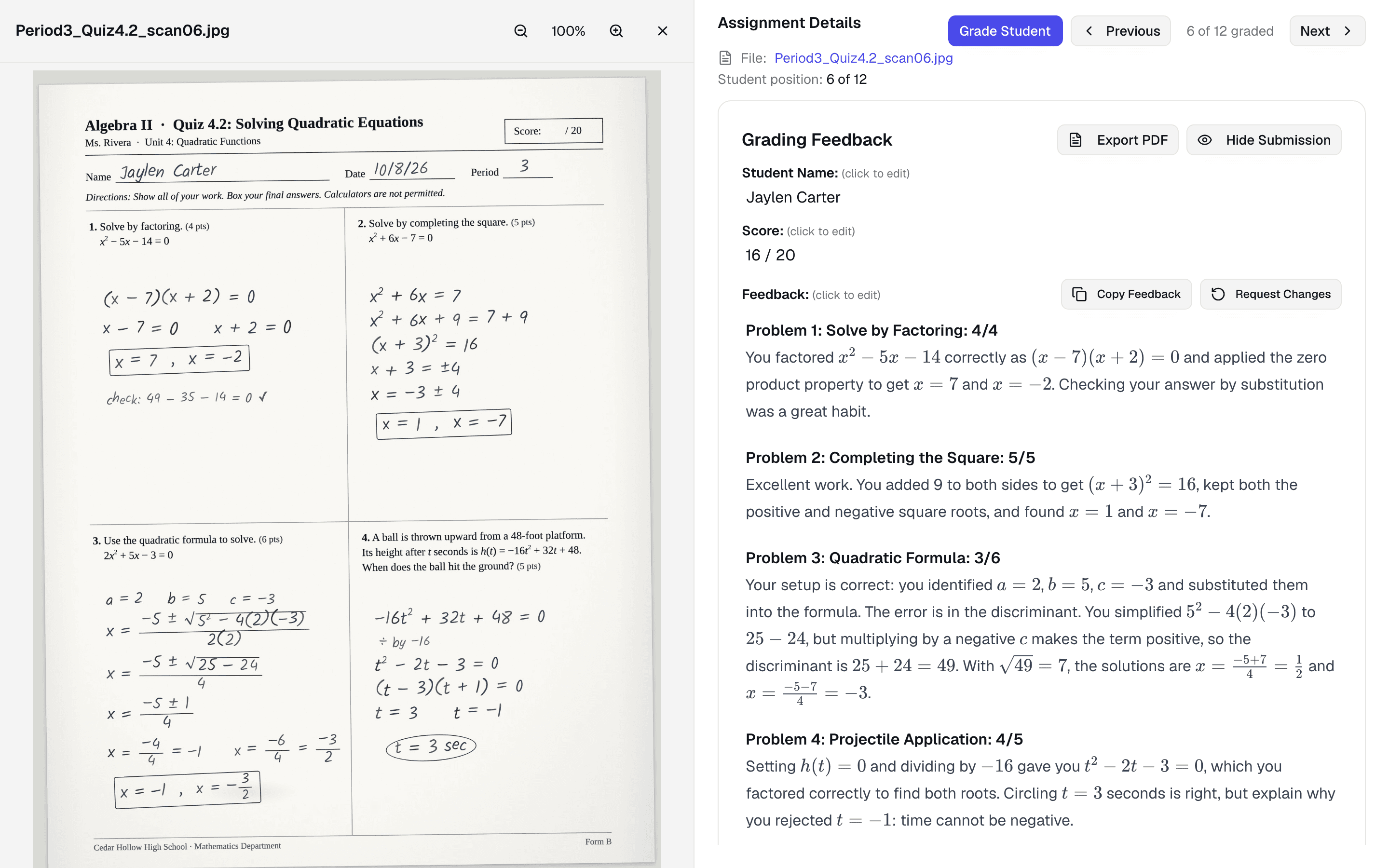
GradeWithAI reads handwritten math from scans or phone photos and gives partial credit under your rubric or answer key. You review each score before it posts.
Grading the completed math work? See how the AI math grader gives partial credit
In the Common Core: all four operations on rational numbers, multi-step equations and inequalities, proportional relationships and unit rates, circumference and area of circles, angle relationships, scale drawings, using random samples to make inferences, and basic probability.
A good deal of pre-algebra: students solve two-step and multi-step linear equations, simplify linear expressions with rational coefficients, and solve inequalities. Functions and systems of equations come in 8th grade, and quadratics in Algebra 1.
Describe the course in the description, for example 'compacted 7th grade: 7th grade content plus 8th grade linear equations and the Pythagorean theorem', and choose 7th or 8th grade in the form. Check the set against your district's course outline.
Addition, subtraction, multiplication, division (including long division), fractions, decimals, ratios, percents, pre-algebra, Algebra 1 and 2, and geometry.
Yes. Ask for word problems in the description, and add a context such as sports, animals, or food if you like.
Pick the grade, which sets the kind of numbers and operations, then choose easy, medium, or hard.
Yes. Every problem has an answer, printed on a separate page. Work a few problems yourself before handing the set out, since AI-generated math can contain mistakes.
No. It writes problems. To grade completed work, upload it to GradeWithAI, which reads handwritten math and gives partial credit under your rubric or answer key.
Yes, with no account.
Math problems by grade and topic
Starting points with the grade and topic filled in.
By operation
- Addition problems generator
- Addition word problems generator
- Subtraction problems generator
- Subtraction word problems generator
- Multiplication word problems generator
- Division problems generator
- Division word problems generator
- Long division problems generator
- Long division practice problems by level
- Fraction problems generator
- Fraction word problems generator
- Addition and subtraction word problems
- Multiplication and division word problems
By grade
- Math word problems generator
- 1st grade math word problems
- 2nd grade math word problems
- 3rd grade math word problems
- 4th grade math word problems
- 5th grade math word problems
- 6th grade math word problems
- Math problems for 2nd graders
- 3rd grade math problems
- 4th grade math problems
- 5th grade math problems
- 1st grade math problems
- 6th grade math problems
- 8th grade math problems
Algebra
Related tools
Grade the completed math work
21,000+ teachers use GradeWithAI to grade essays, tests, and handwritten work, and report saving 10+ hours a week.
The free plan grades 25 submissions every 30 days. No credit card.
Reported by teachers using GradeWithAI, with feedback on every submission they grade.