Math problems for 2nd graders
Make math problems for 2nd graders: add and subtract within 100, place value to 1,000, time, money, and measurement. Printable sets with an answer key.
Free · No account · Up to 40 problems · Answer key included
Tip: Describe the specific skill or topic. The generator calibrates complexity to the grade level you pick.
GradeWithAI is used by 21,000+ teachers, including teachers at
What math 2nd graders learn
Math problems for 2nd graders cover the full 2nd grade year: adding and subtracting within 100, place value to 1,000, telling time, counting money, measuring length, and one- and two-step word problems. This generator writes a printable set for any one of those skills, or a mixed page, with an answer key.
The 2nd grade standards these problems target
2nd grade math in the Common Core spans Operations and Algebraic Thinking (2.OA), Number and Operations in Base Ten (2.NBT), and Measurement and Data (2.MD). Key standards:
Addition and subtraction within 100, with and without regrouping (2.NBT.B.5)
Fluency with facts within 20 (2.OA.B.2)
One- and two-step word problems (2.OA.A.1)
Time to the nearest five minutes, a.m. and p.m. (2.MD.C.7)
Money stories with bills and coins (2.MD.C.8)
Skip counting by 5s, 10s, and 100s (2.NBT.A.2)
Single-skill pages and mixed pages
Use single-skill pages while you teach a skill and mixed pages ('12 problems: 4 regrouping, 4 time, 4 money') for spiral review. Time and money items are written in words, such as 'What time is 25 minutes after 3:10?' (3:35), since the output has no clock faces or coins.
Classroom uses across the year
A 10-problem fluency warm-up, a practice page tied to the day's lesson, a small-group reteach set, or a summer review packet. For story problems only, use 2nd grade math word problems.
How the math problem generator works
- 1
Describe the set
The topic and the format, such as two-step equations or fraction word problems about cooking.
- 2
Set the details
Grade, difficulty, and number of problems. It usually takes 10 to 20 seconds.
- 3
Check and print
Work a few problems yourself, then print the student copy and the answer key.
What teachers say
Teachers across subjects, from AP history to astrophysics, on grading with GradeWithAI.
“I've really enjoyed using the GradeWithAI program. It saves me a ton of time, especially when I have class sizes of 35 or 36 students times five.”

“GradeWithAI doesn't just grade. It gives the student reasoning as to why every point is awarded or not awarded. That is a very valuable thing for the students.”

“More impressive though is that it corrects student answers not simply using a pre-written answer, but by following the thought process they've pursued.”

“For Chadwick users, GradeWithAI has improved feedback efficiency and effectiveness, as it is grounded in existing platforms and is highly adaptable.”

“GradeWithAI [provides] students with timely individualized feedback on their homework assignments and formative assessments. This is a job that is virtually impossible for a teacher to do on a regular basis.”

“Students have also appreciated the consistency and immediacy of the feedback I can provide through GradeWithAI. This has enabled them to make necessary corrections and achieve their desired scores on any assignment.”

Grading the completed problem sets?
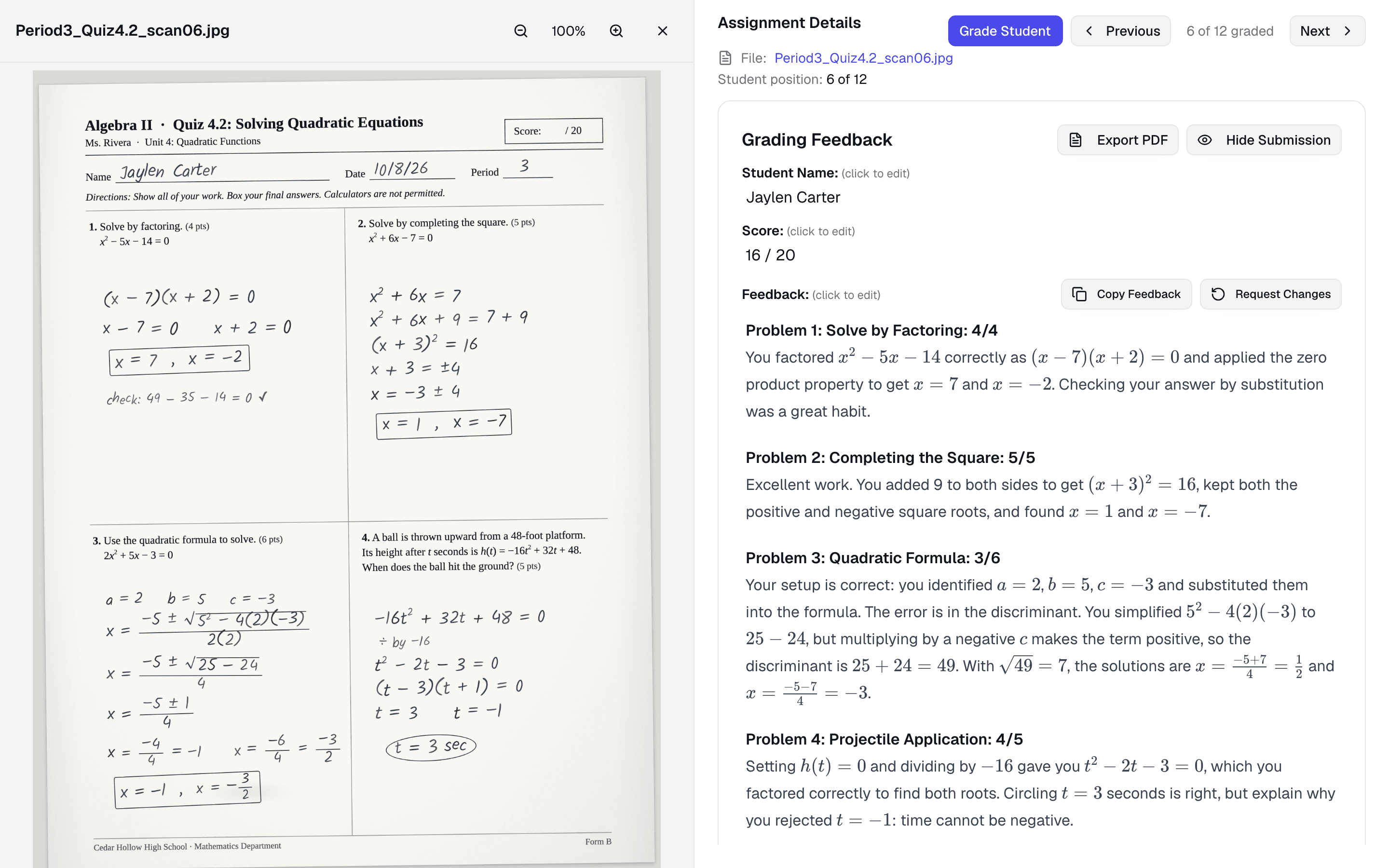
GradeWithAI reads handwritten math from scans or phone photos and gives partial credit under your rubric or answer key. You review each score before it posts.
Grading the completed math work? See how the AI math grader gives partial credit
In the Common Core, students should know sums of two one-digit numbers from memory, add and subtract within 100 fluently, solve one- and two-step word problems within 100, understand place value to 1,000 and skip count by 5s, 10s, and 100s, tell time to the nearest five minutes, solve money problems, and measure length in inches, feet, centimeters, and meters.
Shrink the numbers and keep the skill. A student stuck on two-digit regrouping can practice the same idea with smaller numbers, for example 'adding within 20 by making a ten', before going back to two-digit problems.
Not formally. Multiplication starts in 3rd grade (3.OA.A.1). 2nd grade builds the groundwork with skip counting, equal groups, and arrays up to 5 rows and 5 columns written as repeated addition (2.OA.C.4). Ask for 'arrays as repeated addition, 2nd grade' to practice it.
Addition, subtraction, multiplication, division (including long division), fractions, decimals, ratios, percents, pre-algebra, Algebra 1 and 2, and geometry.
Yes. Ask for word problems in the description, and add a context such as sports, animals, or food if you like.
Pick the grade, which sets the kind of numbers and operations, then choose easy, medium, or hard.
Yes. Every problem has an answer, printed on a separate page. Work a few problems yourself before handing the set out, since AI-generated math can contain mistakes.
No. It writes problems. To grade completed work, upload it to GradeWithAI, which reads handwritten math and gives partial credit under your rubric or answer key.
Yes, with no account.
Math problems by grade and topic
Starting points with the grade and topic filled in.
By operation
- Addition problems generator
- Addition word problems generator
- Subtraction problems generator
- Subtraction word problems generator
- Multiplication word problems generator
- Division problems generator
- Division word problems generator
- Long division problems generator
- Long division practice problems by level
- Fraction problems generator
- Fraction word problems generator
- Addition and subtraction word problems
- Multiplication and division word problems
By grade
- Math word problems generator
- 1st grade math word problems
- 2nd grade math word problems
- 3rd grade math word problems
- 4th grade math word problems
- 5th grade math word problems
- 6th grade math word problems
- 3rd grade math problems
- 4th grade math problems
- 5th grade math problems
- 1st grade math problems
- 6th grade math problems
- 7th grade math problems
- 8th grade math problems
Algebra
Related tools
Grade the completed math work
21,000+ teachers use GradeWithAI to grade essays, tests, and handwritten work, and report saving 10+ hours a week.
The free plan grades 25 submissions every 30 days. No credit card.
Reported by teachers using GradeWithAI, with feedback on every submission they grade.